
SOS Blog
-
Save Our wild Salmon’s Year-end Review 2020

Where we’ve come in 2020 – and where we’re headed in 2021
With your support and advocacy, the Save Our wild Salmon Coalition (SOS) has made 2020 a pivotal year for the Snake River and its endangered wild salmon and steelhead populations.

OUR TOP GOAL FOR 2021: To further our work with Northwest policymakers and people to develop a comprehensive investment package that will recover the lower Snake River and its salmon and invest in the region’s communities and infrastructure. Read on for a summary of SOS’ top accomplishments and related developments affecting salmon and orcas in 2020 - and a look at the year ahead.
Despite the pandemic, its economic challenges, social pr
 otest nationally and a contentious election, SOS and its coalition partners have made critical progress in 2020. We have significantly expanded public support and political engagement needed to restore the lower Snake River and rebuild its endangered native fish populations and the benefits they bring to the Northwest and nation. Strong support and focused advocacy by you and many others has been essential to our progress this year. Your generous support before the end of the year will help us leverage our momentum in the new year.
SOS in 2020 has pushed, supported and engaged key Northwest policymakers and stakeholders. Through our strategic, coordinated organizing, coalition-building, communications and outreach, we have worked assiduously in-region to build the public and political foundation for a comprehensive solution that restores endangered Snake River salmon and meets the needs of Northwest communities. Restoring the lower Snake River – an essential cornerstone of salmon recovery in the Columbia Basin - requires champions. Through our smart, persistent work, the governors and members of Congress in the Northwest are stepping up.
Here's a partial list of our accomplishments and related political developments from 2020:
I. SOS FOCUSED OUR PROGRAM WORK IN 2020 TO SECURE A STRATEGIC PIVOT – away from the federal agencies’ costly, inadequate and illegal salmon recovery efforts in the Snake and Columbia rivers and toward a new, urgent, regionally-led initiative. Under a 2016 court order won by conservation and fishing plaintiffs, the Nez Perce Tribe and State of Oregon, the federal government finalized a “new” FEIS and federal plan for Columbia Basin salmon this past summer. The feds’ latest approach has been widely panned as woefully inadequate by many Northwest states, Columbia Basin Indian Tribes, stakeholders and NGOs, scientists and economists. SOS has been working urgently with many of these same interests to develop a comprehensive solution that meets the needs of endangered salmon and orcas and the region’s communities and energy system.- SOS coordinated public and NGO engagement for the EIS public comment process. We organized hundreds of people and diverse voices to testify at the federal agencies’ virtual public meetings last winter. We coordinated with coalition partners to generate hundreds of thousands of public comments supporting Snake River dam removal and needed transition investments for communities. Many Northwest states and Tribes, and NGOs and business associations submitted comments sharply critical of the feds’ approach and pressing for a comprehensive regional solution that will actually meet the needs of salmon and communities.
- SOS helped generate and inform scores of media stories in 2020 including articles, guest opinions and editorials. SOS staff and leaders were quoted regularly in print, radio and digital media. We maintain regular contact with reporters and editorial boards across the Northwest.
 We published our Hot Water Reports and hosted two online speaker series: This past summer, SOS published our fourth annual series of HotWater Reports highlighting for the press, policymakers and people the harms of hot water to already-endangered fish populations caused by the federal hydrosystem and intensifying climate impacts. We hosted seven webinars in spring and fallfeaturing experts on dam removal economics, clean energy replacement, Indigenous perspectives, orcas, the faith community and more.
- We’re challenging a woefully inadequate federal plan in court:In October, led by Earthjustice, SOS’ member organizations initiated litigation challenging the feds’ “new” plan for Snake and Columbia River salmon. We believe the State of Oregon and Nez Perce Tribe will once again join forces with us in court. While we remain focused on urgently developing and delivering a regional solution, the litigation provides a critical backstop to help salmon - and salmon-reliant communities and orcas - in case collaboration with stakeholders and sovereigns founders or moves too slowly.
 SOS is leading development of the Snake River Vision Project. SOS’ Sam Mace is working closely with partners, including residents, local groups, and Tribal, community and business leaders in the Inland Northwest to re-imagine the opportunities of restoring 144-mile lower Snake River and the 14,400 acres of land submerged under the dams’ reservoirs today. Look for more about this project in early 2021!
II. SOS IS FOCUSED ON BUILDING THE POLITICAL LEADERSHIP AND STAKEHOLDER ENGAGEMENT we need to develop and deliver an investment package that meets the needs of Snake River salmon and Northwest communities. Here are a few examples of important programs and progress led by politicians and stakeholder leaders that SOS and our coalition partners have worked hard to bring about:
 In 2019, Congressman Mike Simpson (R-ID) put dam removal squarely on the table when he announced his interest in restoring Snake River salmon, investing in communities and ensuring an affordable, reliable regional energy system. His leadership continues to be strong in 2020. Earlier this year, for example, in response to a woefully inadequate DEIS, he publicly vented his frustration: “Salmon need one thing - they need a river!”
- In 2019/2020, Gov. Jay Inslee (WA) sponsored the lower Snake River stakeholder dialogue. SOS staff led the advocacy to establish and fund this forum and was
 deeply involved throughout. It brought farmers, shippers, utilities, fishermen, and Tribal and conservation leaders together to discuss salmon recovery and community needs. The initiative demonstrated a new readiness by diverse interests to explore shared solutions to these difficult, intersecting problems.
- These conversations continue today - focused on (i) restoring salmon, (ii) investing in communities, (iii) upholding our nation’s obligations to Tribes and (iv) sustaining the region’s affordable and reliable energy system. SOS staff and leaders are leading/co-leading critical conversations with leaders from farming, shipping and energy sectors - and the Snake River is at the center of these discussions.
- Last February, Gov. Kate Brown (OR) sent Gov. Inslee a letter expressing her interest in working with him on big solutions for salmon and communities. In her letter, she noted that the science is clear: restoring the Snake is our most effective path to salmon recovery. SOS and its partners in Oregon have worked steadily to build a strong dialogue with Gov. Brown and her team.
- Also in February, SOS helped draft a letter sent to the Northwest governors signed by 17 utility and conservation leaders calling for urgent leadership to develop a comprehensive solution that restores salmon and meets the needs of communities and regional energy system.
- In June, based on excellent organizing work by SOS and Sierra Club, Congressman Derek Kilmer (WA-6) publicly identified recovering salmon and orcas as a “moral obligation" and expressed his support for stakeholder discussions and working with his colleagues in Congress to address these linked crises.
- In October, four Northwest governors announced a new collaborative forum to be co-led by states and tribes to tackle the interconnected challenges facing Columbia Basin salmon and Northwest communities. This new regionally-driven effort is encouraging – and we’re pressing that the Snake River to be at the top of the agenda.
- While the governors begin this new initiative, Congress has a critical role to play
 – to develop and deliver a comprehensive legislative package that works for salmon and communities. SOS is moving regional politics today, but we have more to do to secure the champions we need to move a package in Congress. With public commitments to science, Tribes, climate change and collaboration, we hope that Biden Administration will play a constructive role. You'll find thoughts from Joseph Bogaard, SOS executive director, on what a Biden Administration could mean for salmon and orca in the Northwest - and how we'll need to hold it accountable to its promises.
III. LOOKING AHEAD: We’re focused now on supporting the introduction and eventual passage of a comprehensive legislative package in Congress. With public engagement and political leadership anchored in the Pacific Northwest, we’ll continue working urgently with others to develop and deliver solutions that restore the lower Snake River, invest in our communities and bring everyone forward together.
 But now is the time to act. Snake River salmon and Southern Resident orcas are in deep trouble today. Fishing and farming communities and the region’s energy sector face high uncertainty and rising costs as a result of the federal government’s repeated failures to protect and recover wild salmon and steelhead populations endangered by federal dams on the Columbia and Snake rivers. The status quo isn’t working for anyone – and a comprehensive solution represents both necessity and opportunity for the ecology, culture and economy of the Pacific Northwest.
We ask for your support before the end of the year to help us achieve our nation’s largest river and salmon restoration ever.
Thank you as ever for your support and advocacy. We are grateful for and humbled by your partnership.
Please reach out if you have questions.
With warm regards,
Joseph Bogaard, joseph@wildsalmon.org
Sam Mace, sam@wildsalmon.org
Carrie Herrman, carrie@wildsalmon.orgP.S. – You can make year-end gifts online or you can mail them to our office:
Save Our wild Salmon
811 First Ave., Suite 305
Seattle, WA 98104 -
Seattle Times Full-page Ad: Extinction is Forever. Columbia Basin Salmon are in peril.

Defenders of the lower Snake River dams recently placed prominent ads in the Seattle Times that grossly misrepresent the status of wild salmon populations and falsely portray salmon advocates’ return to litigation as demonstrative of our unwillingness to collaborate. Both suggestions are flatly wrong. Salmon advocates have been left with no alternative but to return to court following the Trump Administration’s sudden, unilateral withdrawal from the historic Resilient Columbia Basin Agreement (RCBA) and the continuing decline of Columbia Basin salmon - a decision that pushed and then applauded by the river industrialists like Northwest River Partners.
In response to the misinformation ad, the Governors of Oregon and Washington set the record straight in a recent Capital Press article:
- “The Trump administration’s decision to walk away from the Resilient Columbia Basin Agreement — without even contacting Washington, Oregon or the tribal signatories — ensured we ended up back in court. The agreement kept us out of the courtroom by creating a constructive partnership to address these issues without litigation. The administration made this choice.” – Dan Jackson, deputy communications manager with Washington Gov. Bob Ferguson’s office
- “The state of Oregon remains committed to a negotiated solution for Columbia Basin salmon recovery; it is precisely why the state of Oregon entered the 2023 agreement in good faith. The Trump Administration chose to walk away from that partnership, not us. That said, our door remains open to anyone serious about achieving healthy and abundant salmon populations through real solutions and genuine partnership.”– Anca Matica, spokesperson for Oregon Governor Tina Kotek’s office
Earthjustice and other NGO plaintiffs (and Save Our wild Salmon Coalition member organizations) – Columbia Riverkeeper, Idaho Conservation League, Idaho Rivers United, Northwest Sportfishing Industry Association, and Sierra Club – also responded by placing a full-page ad and digital ads in the Seattle Times on Wednesday, October 8 (click here to view the ad). The ad states:

Extinction is Forever.
We can’t let that happen. That’s why we’re going back to court – to protect salmon and secure a better future for the whole Northwest.
Biologists are sounding the alarm about imperiled Columbia Basin salmon and steelhead runs1. Several stocks are at risk of imminent extinction2. So are the Southern Resident orcas that depend on them for food3. We don’t have any more time to waste if we want to avoid further extinctions and restore healthy and abundant salmon and steelhead for our future.
Salmon need more than just talk – they need a healthy river.
Tribes, the states of Washington and Oregon, and the federal government all agreed on a comprehensive plan to guide the recovery of these iconic fish – while also investing in affordable, reliable clean energy and planning for removal of four lethal federal dams on the lower Snake River4.
In June, the Trump administration reneged on that agreement in favor of his previous administration’s illegal 2020 plan that ignores the needs of salmon, orca, fishing families, Tribes, energy customers and communities across the Northwest5.
Special interests who applauded the decision to kill that agreement want you to believe the Northwest’s salmon are recovering without further action6. But in reality our iconic salmon runs are collapsing – choked by dams, warming rivers, and vanishing habitat7.
For most of these imperiled salmon species, by far the largest threat they face is harm caused by federal dams and their reservoirs8.
We can have affordable and reliable energy and healthy and abundant salmon populations. But first we must prevent extinction, and we can’t do that by pretending this crisis doesn’t exist. The time for action is now.
The Trump administration is giving up on Columbia Basin salmon – but we never will.
Learn more at earthjustice.org/salmonperil
Sources:
1. https://www.spokesman.com/stories/2021/feb/25/scientists-say-removing-snake-river-dams-is-necess/
2. https://ryankinzer.github.io/SRAFS /
3. Scientists’ White Letter: Southern Resident Killer Whales & Columbia/Snake River Chinook: A Review of the Available Scientific Evidence (Feb. 2020) https://www.wildsalmon.org/images/factsheets-and-reports/2020.Salmon.Orca_Scientist.White_Paper.Feb.20.pdf
4. https://critfc.org/wp-content/uploads/2024/02/USG-Commitments-toCBRI.pdf
5. https://www.whitehouse.gov/presidential-actions/2025/06/stopping-radical-environmentalism-to-generate-power-for-the-columbia-river-basin/
6. https://www.seattletimes.com/seattle-news/climate-lab/trump-cancels-landmark-columbia-river-agreement-with-tribes-wa-or/
7. https://www.wildsalmon.org/images/factsheets-and-reports/2022-09-30-Rebuilding-Interior-Columbia-Basin-Salmon-and-Steelhead-ConsensusRecovery-Science-Report-1.pdf, NOAA Rebuilding Report p. 8, Table 2 (pulled from NOAA site) & pp.11-15
8. https://www.wildsalmon.org/images/factsheets-and-reports/2022-09-30-Rebuilding-Interior-Columbia-Basin-Salmon-and-Steelhead-ConsensusRecovery-Science-Report-1.pdf, NOAA Rebuilding Report p. 12, Table 3 (pulled from NOAA site) -
Seattle Times: Audit finds 70 percent of B.C. fish-processing plants do not comply with environmental regulations

Fri., July 6, 2018, 3:34 p.m.
By Lynda V. Mapes
SEATTLE – An audit of British Columbia fish-processing plants sparked by gory video of a pipe spewing bloody water into the Salish Sea has found that more than 70 percent of plants audited are out of compliance with environmental regulations, and some operate under rules decades behind modern standards.
Stronger measures are needed for the fish-processing industry, to ensure protection of the marine environment, including wild salmon, according to the audit of 30 fish-processing plants released Wednesday by the B.C. Ministry of Environment and Climate Change Strategy in response to controversy that erupted over the plume.“This audit clearly tells us more work needs to be done to ensure our coastal waterways are safe for all wild fish stocks,” George Heyman, minister of Environment and Climate Change Strategy, said in prepared remarks announcing the findings.
“The industry has been largely operating under an outdated permitting regime, going back several decades. We are taking immediate steps to ensure permits are updated and strengthened at fish processing facilities throughout B.C.”
The most serious infractions revealed in the audit include plants that exceed the volume and quality of fish-processing effluent discharged to open water allowed under the permits. The effluent-discharge quality and toxicity results detected in the audit indicate that typical undiluted fish-processing effluent passed through current treatment works is “frequently acutely lethal to fish,” according to the audit.
The effluent was not tested for pathogens.
Most of the noncompliance findings were administrative, such as not completing paperwork as required or posting proper signage.
Shawn Hall, spokesmen for the B.C. Salmon Farmers Association, agreed new standards are needed.“The current wastewater permitting system is outdated,” Hall said. “We are happy the government is on a path to address that, bringing permits into best practices. Updating is going to enable us to evolve, and operate in an environmentally responsible manner.”
Some processors already were working to upgrade their plants, Hall said.
Meanwhile, a videographer on June 26 filmed the bloody plume still spewing from the same plant that first made news on Canadian national television last December. The videographer, Tavish Campbell, spokesman for Wild First, is an opponent of open-net-pen salmon farms and contends the effluent is harmful to wild salmon.A statement on the website for Brown’s Bay packing declares the plant’s waste is disinfected and causes no harm. The plant is at Campbell River on the east side of Vancouver Island.
Washington is home to a much smaller farmed-salmon industry, and farmed salmon are processed at just one plant, in Seattle, which is hooked up to the municipal sewage system.
The owner of Washington’s farms, Cooke Aquaculture, recently was blocked by the state Department of Fish and Wildlife from planting more of its fish out in grow pens near Bainbridge Island because the fish at its hatchery were found to have been tainted with an exotic virus.
Ken Warheit, director of fish health for Fish and Wildlife, said the department intends to test waters outside of Cooke’s hatchery in Rochester, Thurston County, to ensure the virus, detected in May, has not gotten into water outside the hatchery.
The department also intends to test adult salmon at Cooke’s facilities for the virus as part of a biosecurity review of all aquaculture facilities in Washington.
The department is also updating state aquaculture records and rules, and working through a protocol for a revised testing program to ensure more regular biosecurity testing at all aquaculture facilities, Warheit said.
The Washington State Legislature last session enacted a phase out of open-water net-pen farming in state waters by 2025. That was in response to a large escape from Cooke’s pens at Cypress Island that state regulatory agencies determined was caused by Cooke’s negligence.The issue of salmon farming in the Salish Sea has been in turmoil on both sides of the U.S.- Canada border since the escape. Some First Nations in Canada have protested the presence of net pens in their territorial waters.
Ernest Alfred, a traditional Namgis chief, occupied a net pen at Swanson Island for nearly 280 days beginning in August, until removed by court order in May sought by Marine Harvest, which operates 12 fish farms in the Broughton Archipelago.The B.C. government announced June 20 that fish farms in B.C. waters are on a month-to-month lease, until 2022, when all fish farms must receive consent from First Nations to operate.
Farmers must also demonstrate their operations do not harm wild salmon.
“We need to take the necessary steps – steps that should have been taken years ago – to ensure that fish farm operations do not put wild salmon stocks in jeopardy,” said Doug Donaldson, minister of Forests, Lands, Natural Resource Operations and Rural Development in a prepared statement.
The $1.5 billion salmon-farming industry in B.C. supports more than 6,000 direct and indirect jobs and supplies more than 70?percent of the salmon harvested in B.C., Hall said. Some farms operate with the consent and support of First Nations, while others in the Broughton Archipelago on the northeast side of Vancouver Island have been bitterly contested.Alfred said the decision from B.C. was a disappointment because it did not require an immediate shut down of open-water net-pen farms in the territorial waters of his people. He made his stand for wild salmon, saying the pens spread disease and pollution. “We wanted to send them packing.”
The policy shift eventually requiring indigenous peoples’ consent to operate all fish farms took farmers by surprise, Hall said, and the industry is still reviewing it.
-
Seattle Times: Biden appointments, including Nez Perce fisheries champion, bolster Native American presence in federal government

By Lynda V. Mapes
March 6, 2021There’s a saying in Indian Country: either you are at the table, or you are on the menu.
Appointments by the Biden administration now in the works would put American Indian and Alaska Native people very much at the table, including posts where Native people have never before served, with enormous influence over lands and waters and environmental policy across the U.S.
The appointments, some already made and others under consideration, are a redemptive moment for federal agencies that in the past terminated the federal relationship with tribes, destroyed tribal fisheries and worked hard to eliminate tribal cultures.
The biggest appointment, still to be confirmed by Congress, is that of U.S. Rep. Deb Haaland, of New Mexico and a member of the Laguna Pueblo tribe, to serve as secretary of the Department of the Interior. Other appointments include Robert Anderson, who would be one of Haaland’s top lawyers, and Jaime Pinkham, a Nez Perce tribal member, to a top post at the U.S. Army Corps of Engineers.
David Z. Bean, council member for the Puyallup Tribe of Indians, an important donor in federal and state elections, called the appointments “both historic and exciting. It is going to change the conversation, and right the wrong of so many wrongs through the years.”
While they run their own governments and nations, tribes care deeply about the partners they work with at every level of government.
That is because the exercise of tribal sovereignty and even the most fundamental aspects of protecting and continuing their way of life depend on productive government-to-government relationships.
Haaland’s potential confirmation holds significant promise, Bean said.
“With her historic and eventual confirmation, she will be the first Native American to head an agency that had one time charged itself with the destruction of our people,” Bean said.
During the so-called Termination Era from 1953 to 1969, the Bureau of Indian Affairs, under the Department of Interior, oversaw the termination of federal relations with more than 100 tribal governments across the country, and the relocation of tribal members from their communities and reservations to live in cities, including Seattle.
Earlier, beginning in the 1870s, Indian children were also taken from their families and sent to boarding schools whose mission under U.S. federal policy was to destroy their tribal culture. The legacy of trauma inflicted by the schools, some of which operated under what would become known as the Bureau of Indian Affairs, continues today.
Indian leaders who grew up hearing their parents’ and elders’ stories honor what their elders survived, and the changes underway today.
“My dad and so many elders literally went through blood, sweat and tears to fight for who we are,” said Willie Frank Jr. III, a Nisqually tribal council member. He is the son of Billy Frank Jr., a nationally celebrated treaty rights activist jailed dozens of times for his defense of tribal treaty fishing rights.
A statue of his father, who died in 2014, is now under consideration by state lawmakers to replace missionary Marcus Whitman as one of two statues representing Washington state in Statuary Hall at the U.S. Capitol.
Meanwhile, other native leaders around the region also are being tapped for important appointments.
Anderson would be one of Haaland’s top lawyers if she is confirmed. He has been appointed principal deputy solicitor at the Department of Interior.
He is enrolled in the Bois Forte Band of the Minnesota Chippewa Tribe and taught at the University of Washington School of Law and directed its Native American Law Center for the past 20 years. He also for more than a decade has been a visiting professor at the Harvard Law School.
Pinkham, a Nez Perce tribal member and treaty fishing rights champion as executive director of the Columbia Inter-Tribal Fish Commission, has been invited by the Biden Administration to serve a primary deputy secretary for civil works at the U.S. Army Corps of Engineers.
-
Seattle Times: Fish farm caused Atlantic salmon spill near San Juans, then tried to hide how bad it was, state says
 By Lynda Mapes
January 30, 2018A Washington state investigation of the catastrophic net-pen collapse in August at Cooke Aquaculture’s Cypress Island fish farm finds the company at fault for a disaster that freed more than twice as many Atlantic salmon into the Salish Sea as the company has reported.
Cooke Aquaculture Pacific vastly underrepresented the scope of a catastrophic Atlantic salmon net-pen spill at its Cypress Island farm in August and misled the public and regulators about the cause, according to a new report by state investigators that blames the pen collapse on company negligence.
The investigation found that Cooke lowballed the number of escaped fish by more than half, and did not do essential maintenance at its farm, causing the escape.
The company also misled agencies about the seriousness and cause of an earlier mishap at the farm in July; as a result, state agencies did not investigate Cooke’s operations sooner, investigators found.
“The collapse was not the result of natural causes,” said Hilary Franz, state commissioner of public lands. “Cooke’s disregard caused this disaster and recklessly put our state’s aquatic ecosystem at risk.”
The report, released Tuesday by the state departments of Ecology, Fish and Wildlife and Natural Resources, is the result of a review begun in September by an investigative panel of experts from the agencies probing the breakup of one of three net-pen farms Cooke Aquaculture operates near Cypress Island in August, and an earlier incident at the same farm in July.
Ecology also fined Cooke $332,000 on Tuesday for violating its water-quality permit before and during the net-pen collapse.
Cooke initially blamed the net-pen collapse on strong tides coincident with the solar eclipse — an explanation from which it later backed off.
The state investigation tells a different story. It departs sharply from what Cooke reported to state agencies in significant aspects — from the seriousness and cause of the initial trouble at the farm in July, to the number of fish released to Puget Sound.
Investigators determined the escape was much larger than Cooke told the public or state agencies, with as many as 263,000 fish released — not the 160,000 Cooke reported. As many as 206,000 Atlantics are still unaccounted for — more than double what Cooke told the public.
“Cooke misled us,” said Amy Windrope, north Puget Sound regional director for the Department of Fish and Wildlife.
“This is far more than … we thought had escaped, based on Cooke’s false reporting,” Franz said. “We all know how to count fish, Dr. Seuss made it easy: One Fish, Two Fish,” Franz said, recalling the author’s children’s book.
Cooke Aquaculture on Tuesday disputed the agencies’ findings, particularly the fish count, which the company said was based on flawed estimates of the average weight of the recovered fish.
Sign up for the Morning BriefDelivered bright and early weekday mornings, this email provides a quick overview of top stories and need-to-know news.
The company acknowledged it had fallen behind in net cleaning, but it said the report overstated the extent of the fouling on the nets, and the forces of drag created as a result.
Joel Richardson, vice president for public relations for Cooke, said the company was “shut out of this investigation by the state agencies” and could not meaningfully participate in the review.
Agency directors pushed back hard at Cooke’s criticism, stating the company itself failed to provide information requested by investigators, missed deadlines in the review process and misled both the state and the public.
“Our investigative team doggedly pursued the truth,” said Maia Bellon, director of the Washington Department of Ecology. “Cooke Aquaculture was negligent, and Cooke’s negligence led to the net-pen failure. What’s even worse was Cooke knew they had a problem and did not deal with the issue. They could have and should have prevented this.”
Other key findings from the investigation:
• Cooke did not adequately clean the nets on the pens containing 305,000 Atlantic salmon — nearly 3 million pounds — and allowed excessive buildup of mussels and other sea life on the nets. The nets were carrying up to 110 tons of biofouling.
Most crucial was the clogging of the net by heavy growth of mussels and other sea life. That increased the lateral force of drag on the nets in the current, causing the pen — already heavily corroded and past its useful life — to collapse.
• Breakdown of two of three machines used to clean the nets caused Cooke to fall critically behind in net maintenance.
• Cooke knew excessive fouling of the nets caused a serious failure of the mooring system at the same farm in July. Yet it told regulators two days after the incident that high tidal currents had caused “some movement” of the net pen, but that everything was back under control.
Internally, however, Cooke said it “almost lost the farm.” Managers discussed replacing the nets after that event, but they elected not to.
• Tidal currents were within normal ranges during both the July and August incidents, and a properly designed, sited and maintained net pen should have been able to withstand the forces at the site, as it had for 16 years at or near the same location under previous owners. However, Cooke’s farm was inadequately maintained and hampered after the July incident by a makeshift repair that had not been approved by an engineer, the agencies found.
• At the time of the incident the company and state lacked an adequate fish-recovery plan for escapes of Atlantic salmon from net pens, investigators found. The response to the emergency by both Cooke and the state was slow and inadequate, allowing fish to infiltrate rivers throughout the region.
The future ecological effect of the spill remains unknown, investigators stated.
Atlantic salmon are still in some area rivers, including the Skagit, and only long-term monitoring will determine whether the fish are reproducing or causing other effects, investigators said. Concerns include escaped fish competing for food and habitat with wild fish; continued escapes from net pens eventually allowing Atlantics to establish themselves in Pacific salmon habitat; pollution and spread of disease from the pens.
Windrope said the risk to native Pacific salmon from the Atlantics that escaped is low. But it is real.
“Our native salmon are not doing well. It is a death by 1,000 cuts. And this is another cut,” Windrope said.
“There is risk here … the fish within the Upper Skagit demonstrate that.”
Legendary angler Bill McMillan said sport fishers have caught at least 200 Atlantics in the Skagit between December 16 and January 3, as far as 67 miles upriver. By contrast, only two native steelhead were reported caught in the Skagit.
Since the August net-pen collapse at Cypress Island, Franz, the public-lands commissioner, has ordered inspections at all of Cooke’s facilities around Puget Sound. Those are ongoing.
Cooke lost its lease to operate its Port Angeles Atlantic salmon farm last December after an inspection revealed the farm was not adequately maintained and was outside its leasehold boundaries.
The company is fighting the Port Angeles lease termination in court.
Cooke could soon face termination of its Cypress Island lease as well if the Department of Natural Resources finds it did not maintain its farm there in a clean and safe condition, as required by its lease. The company has three net pens at Cypress Island; two of those are still operating.
“In the coming days, I will make an announcement regarding the future of Cooke’s Cypress Island facility,” Franz said.
Cooke also faces opposition from treaty tribes. Chairmen from 21 tribes, in an unusual show of solidarity, signed a letter to every legislator Jan. 18 asking lawmakers to shut down Atlantic salmon net-pen farming in Puget Sound as soon as possible to protect native fish and Puget Sound, home to multiple threatened and endangered species.
Recreational and commercial fishermen and conservation groups from around the region have also written lawmakers and testified in opposition to continued Atlantic salmon net-pen farming in Puget Sound.
The report comes as lawmakers are considering legislation to end Atlantic salmon net-pen farming in Puget Sound immediately upon signature of the governor, or phase it out as Cooke’s leases expire. The last lease terminates in 2025.
State Sen. Kevin Ranker, D-Orcas Island, co-sponsor of the phaseout bill, said Cooke has disrespected and violated the public trust. “It is absolutely shocking that a corporation working in Washington would be this negligent and be so very untruthful about it,” Ranker said. “This is not the kind of business we want operating in the state of Washington.”
Washington stands alone on the U.S. West Coast in allowing Atlantic salmon net-pen farming in its public waters. California and Alaska ban the practice, and Oregon has no Atlantic salmon net-pen farms.
Lynda V. Mapes: 206-464-2515 or lmapes@seattletimes.co
-
Seattle Times: Once-flooded Elwha land becomes forest

‘Nature can do most of the work for you’: Once-flooded Elwha land becomes forest
By Lynda V. Mapes, May 29th 2018
FORMER LAKE ALDWELL RESERVOIR, Clallam County — Josh Chenoweth pushes through trees grown 30 feet overhead and walks into a plush purple pool of blooming lupine, the flowers fragrant and abuzz with insects.
It is hard to believe that as recently as 2011 this very spot was underwater, drowned by the reservoir behind the Elwha Dam.
Now the site of the largest dam-removal project in the world, the Elwha is also home to a first-of-its-kind revegetation program, led by Chenoweth, for the National Park Service.
The mission was to return more than 600 acres of the former lake beds at Lake Aldwell and Lake Mills, impounded by the Elwha and Glines Canyon dams, to native forests.
And while it will be 100 years before a mature forest rises here, Chenoweth couldn’t be happier with the strong start the revegetation effort has given these former barren lake-bed sediments. As soon as dam removal began in 2011, the park service started a nearly $4 million replanting effort here. It was a plan intended from the start to cope with the uncertain situation of how the former lake beds would respond to planting.
With no top soil, no possible irrigation and only lake-bed sediments as much as 60 feet thick to work with, this was a task like none other. Chenoweth took a cautious approach, letting nature take the lead.
Instead of bombing the lake beds with seeds and stuffing them with plants, the revegetation plan was gradual, undertaken with an adaptive approach, letting natural seed from the surrounding forest take the lead in reforesting the edges closest to the woods.
The gradual drawdown of the lakes, to enable a slow release of sediment to the river, had a side benefit. Moisture retained in the sediments as the lakes gradually receded helped water seeds brought on the wind and waters of the lake as well as the plants and seeds Chenoweth and the revegetation team had planted.
The forests of cottonwood rising today all over the former reservoirs are the result of a cottonwood seed gradually distributed across the lake bed as the waters dropped.
Contrary to expectations that the trees would die as the waters dropped, their roots chased the moisture deeper and deeper into the sediments, and the trees shot up and vigorously colonized the former lake beds.
There were more surprises. Riverbank lupine seeds collected from nearby and broadcast over the lake beds sprouted spectacularly. Great clouds of purple flowers now in bloom all over the river banks are the result. A nitrogen-fixing plant that improves the soil wherever it grows, the lupine has enabled other plants to thrive.
Plants rooted most successfully in the fine material left by the river. The coarse cobble and gravel were a tougher challenge. Bare spots still lingering there are concerns for the future; managers will need to monitor those spots for weeds over time, Chenoweth noted.But elsewhere, strong, young forests have taken over, covering what were barren, blowing terraces of gray.
Replanting the area was important because vegetation prevents erosion. Closer to the river, it also shades the water, and a steady rain of leaf litter and other detritus feeds the tiny organisms in the water that feed everything else, including fish.
Of course the story here is still unfolding. “In terms of succession, that is a long process,” Chenoweth said. In all, 320,000 plants were put in the lake beds to boost natural revegetation — less than Chenoweth estimated would be needed because nature did much of the work, he said. The revegetation team, including many volunteers, also cast about 6,500 pounds of seeds on the lake beds.
The plant diversity that survived is rich, including conifers, shrubs, flowers and grasses. The most abundant of all won’t surprise anyone: horsetail, growing in soft, verdant swaths all over the landscape. It sprouted on its own.
Cedars, firs, willows, bitter cherry, thimbleberry, twinberry and so many more are all thriving here. The berries on the shrubs are drawing white-crowned sparrows, nesting in the young forest. Biodiversity is getting a reboot as the trees and shrubs thrive.
“I am walking away from this project happy,” said Chenoweth, with the planting all finished. The only thing left to do is write up his final report and scientific papers from the historic effort.
Already others have come here to observe the success of the project, including managers for a dam-removal project planned for the Klamath.
“We show them this, and they can see that it works,” Chenoweth said. It even cost less than projected, with about $3.8 million spent rather than the $4 million budgeted.“Nature can do most of the work for you,” Chenoweth said. The biggest surprise in the replanting effort was how quickly the valley walls converted from lake to forest, mostly from natural-seed rain.
“It’s a show piece,” Chenoweth said, the young forest towering over his head.
-
Seattle Times: State kills Atlantic salmon farming in Washington

March 2, 2018
After a tough floor fight and fancy parliamentary footwork, the state Senate passed a bill phasing out Atlantic salmon net-pen farming in Washington.
By Lynda V. Mapes, Seattle Times environment reporterAtlantic salmon net-pen farming will be phased out in Washington by 2025 under legislation passed by the state Senate on Friday after a tough floor fight and fancy parliamentary footwork.
With at least six lobbyists in a last-minute campaign, Cooke Aquaculture Pacific worked hard until the last vote Friday to keep its Atlantic salmon net-pen industry alive in Washington.
But in the end the bill, which was buried under a blizzard of amendments, each one defeated, passed on a vote of 31-16.
Lawmakers steamrollered through amendments by opponents of the bill to avoid sending it back for further review in the House.
With the 5 p.m. cutoff for passage of bills from the opposite chamber looming, senators had filed some 30 amendments. Using a parliamentary move, backers of the measure were able to continue debate past the cutoff to pass the bill at 6:30 p.m.
But opponents continued debate on most of the amendments anyway, from requiring all-female fish at Atlantic net-pen farms, to giving operators a state tax break and lease-fee reduction to pay for converting to farming only native fish.
Like other opponents of the bill, Sen. Mark Schoesler, R-Ritzville, minority leader of the Senate, said he opposed it because “I don’t think we should ban any job creator in this state. If we need to make improvements to regulation for the environment, that is reasonable. But an out-and-out ban is not.”
Backers said Cooke created its own problems by negligence and the industry was too risky for Puget Sound and its native fish.
Joel Richardson, Cooke’s vice president for public relations, said the company would consider “all our available options” regarding its operations, which employ more than 600 people.
“We know that we have work to do with our state, tribal and community partners to rebuild public confidence and demonstrate the value that our industry brings to Washington and the world,” said Richardson.
Cooke has poured money into a lobbying campaign against the bill, signing up at least six lobbyists retained at a total of $72,000, according to registration forms Cooke filed with the state Public Disclosure Commission.
The most recent registration was added this week, signing on three more lobbyists. They include Steve Gano, one of the most experienced and powerful in Olympia, on Feb. 26 for a $30,000 flat fee to work through the legislative session and on any executive action by Gov. Jay Inslee. The governor has said he would sign a net-pen phaseout bill.
The debate at times was bitter. “There are a lot of people making money today; out in the hall, we are not supposed to talk about that,” said Sen. Judy Warnick, R-Moses Lake, referring to lobbyists. “But the people not making money are the employees of Cooke Aquaculture.” She and other opponents of the bill said the state should not put people out of work.
Cooke is one of the largest farmers of Atlantic salmon in the world with $2.5 billion in revenue last year, operations in six countries and 6,000 employees. Its operations in Washington, where it hopes to remain and expand, include net-pen operations in four locations around Puget Sound and an $8.5 million payroll in the state.
The legislation to phase out Atlantic salmon net-pen farming was the result of an escape last August from Cooke Aquaculture Pacific’s Atlantic salmon farm at Cypress Island, where as many as 263,000 fish were released into the Salish Sea. The incident ignited controversy over the industry.
Cooke initially told the public and its regulators the incident was just a small release of fish, and primarily a business loss for the company, caused by unusually high tides coincident with the solar eclipse the same week. Three state agencies in a four-month investigation found the escape actually was due solely to Cooke’s negligence, and that the company had misled the public about the size and cause of the escape.
Cooke’s Washington operations are already facing reduction by administrative action. Commissioner of Public Lands Hilary Franz has terminated two of the company’s leases, at Port Angeles and Cypress Island because of violations by Cooke. The company is fighting the Port Angeles termination in court.
While always controversial, the question of whether to retain Atlantic salmon farming in Washington has taken on a new urgency as Puget Sound and its federally listed species — including native Pacific salmon — struggle for survival. Many fear the state’s identity as a place of wild salmon is slipping away.
“I thought it would be difficult, a pretty heavy lift,” Sen. Kevin Ranker, D-Orcas, said of the bill. “It is never easy to take on a global corporation like this.” He said the bill was a chief focus for him coming into the legislative session.
“We have done the right thing,” Ranker said. “We have supported our culture and our natural resources.”
The Washington Fish Growers Association launched a letter campaign this week with aquaculture consultants and retired scientists writing to legislators, declaring the industry does not harm Pacific salmon. The state Department of Fish and Wildlife regards the risk of the industry as low — but not risk-free.
Joel Richardson, vice president for public relations at Cooke, has told lawmakers the company, based in New Brunswick, Canada, will sue the state under the North American Free Trade Agreement to recover its $76 million investment in Washington should the bill pass.
The company bought its net-pen operation here in 2016 from Icicle Pacific.
Richardson could not immediately be reached for comment.
https://www.seattletimes.com/seattle-news/politics/bill-to-phase-out-atlantic-salmon-farming-in-washington-state-nears-deadline/
Lynda V. Mapes: 206-464-2515 or lmapes@seattletimes.com
-
Seattle Times: Supreme Court showdown: Washington’s attorney general vs. tribes over salmon habitat
 April 17, 2018
By Lynda V. Mapes, Seattle Times environment reporter
State Attorney General Bob Ferguson goes up against the tribes in the Supreme Court Wednesday, seeking to overturn multiple court rulings calling on the state to fix culverts that block salmon habitat.
A 20-year battle over salmon-blocking road culverts lands in the U.S. Supreme Court Wednesday, in a historic showdown pitting the Washington state attorney general against the U.S. government and Washington tribes defending their treaty right to fish.
Washington Attorney General Bob Ferguson — widely regarded as a liberal champion for his crusading lawsuits for immigration rights and other causes — will oppose the tribes in oral argument before the court.
At issue is whether the state must replace road culverts that block salmon passage. Tribes insist, and courts have affirmed, that the tribes’ treaty right to fish also means the state must not destroy the habitat that healthy fish runs need.
More than 20 tribes in Western Washington have a treaty right to fish in their traditional places, including off reservation, secured in treaties signed beginning in 1854 with territorial Gov. Isaac Stevens. The right was reserved in those treaties in return for the tribes turning over their property right to nearly all of Western Washington.
Supreme Court must clarify culvert ruling
Washington state and local officials, court scholars and treaty-rights defenders said in briefs filed with the court and in interviews that Ferguson should have let stand nearly 20 years of decisions on the culvert case, first filed by tribes in January 2001.
But Ferguson in a written statement said he disagrees with findings by the lower court, which he says will compel the state to make expensive repairs — up to $1.9 billion by one disputed estimate — that don’t help fish.
“This is a step backward,” said Bob Anderson, director of the Native American Law Center at the University of Washington. “I thought that Bob Ferguson, our liberal darling attorney general, would tell those career people in his office, ‘Look, we are going to live with this. Let’s make it work, take it as an opportunity to do some really good things for the environment’ … Instead, he goes for the nuclear option.”
Gov. Jay Inslee does not support the appeal to the U.S. Supreme Court, his spokeswoman, Tara Lee, wrote in an email to The Seattle Times. “Gov. Inslee and Attorney General Ferguson discussed this case and they don’t agree … the governor supports discussions to settle.”
Hilary Franz, commissioner of public lands at the Department of Natural Resources, filed an amicus brief with the court calling for respect for the tribes’ treaty rights and stepping forward with habitat repairs to sustain salmon runs not only for tribal fisheries, but for all Washingtonians.
Dan Evans, a former Washington governor and U.S. senator, and former Secretary of State Ralph Munro — both Republican luminaries — also filed briefs in support of the tribes and habitat protection. So did local elected officials who contend the state’s appeal undercuts their own efforts to do the right thing.
Tribes are defending a federal court ruling, affirmed by the U.S. Court of Appeals for the Ninth Circuit, that the state can’t block fish passage. That decision and others build on a ruling by U.S. District Court Judge George Boldt in 1974 — upheld by the U.S. Supreme Court in 1979 — affirming tribes’ reserved treaty right to fish in all of their traditional places.
The fight over fishing rights has been one of the ugliest in the state’s history, resulting in violence and reluctance by the state to enforce court rulings affirming the tribes’ treaty right, recalled Tom Keefe, of Spokane, an aide to former U.S. Sen. Warren Magnuson and longtime supporter of Indian treaty fishing rights.
Sign up for Evening BriefIn their 1979 opinion, the Supreme Court justices underscored how intransigent the state had been in upholding Boldt’s decision.
“Except for some desegregation cases … the district court has faced the most concerted official and private efforts to frustrate a decree of a federal court witnessed in this century,” the opinion states. The argument before the Supreme Court Wednesday continues proceedings now underway for nearly 50 years, first brought by the United States in 1970 against Washington to enforce the treaties.
And while the tear gas and billy clubs used to beat tribal members back from their fishing grounds during the fish wars are gone, the state is still fighting its treaty obligations, Keefe and others said.
“This is more of the same, and it is sad,” Keefe said. “We deserve better. The fish deserve better.”
Ferguson said he agrees the state must do more to repair habitat. But he disagrees with the findings by the lower court.
“Salmon are vital to our way of life here in Washington,” Ferguson said. “Regardless of the outcome of this case, the state must do more to restore salmon habitat. The Legislature should not need a court order to fix culverts that are blocking salmon runs.
“However, important issues are at stake in this appeal, as explained by the many dissenting Ninth Circuit judges,” he said, referring to nine judges of 29 on the Ninth Circuit who wanted to take the appeals-court ruling under review. In their dissent in the May 2017 ruling, the judges said the lower-court mandate to protect habitat for fish is overly broad and could be extended to block all kinds of other development, including dams.
Ferguson also said the Ninth Circuit’s decision forces the state to expend significant resources on fixing culverts that will not benefit salmon, because of other habitat problems.
“That makes no sense,” Ferguson said. “The decision also requires Washington taxpayers to shoulder the entire financial burden for problems largely created by the federal government when it specified the design for the state’s old highway culverts. That’s not fair.”
The cost of the culvert work is disputed.
The Department of Transportation had estimated the cost of repairing more than 800 culverts within the case area at $1.9 billion over the course of the 17-year schedule.
However, the court of appeals affirmed the district court’s finding that the department greatly overestimated both the cost and the number of culverts that need to be corrected within that time frame. The state also can expect funding from the federal government for culvert repairs it must make anyway, regardless of the court case, the appeals court found.
Ferguson’s argument that the lower-court rulings force repairs that will do no good has not been reflected in work underway.
Several state agencies, including the Department of Natural Resources and state Parks Department, have met a court-ordered schedule fixing culverts, opening miles of salmon habitat.
The Washington Department of Transportation, with the most culverts along the 7,056 miles of Washington highways, is working on repairs and replacements, its 2017 report on the problem shows. A two-prong approach has been underway in which the department makes culvert repairs whenever it is already at work on a road. It also repairs culverts on a prioritized list, as required by the lower-court ruling, collaborating with tribes and other agencies to target repairs on streams where they will do the most good.
Since the culvert case was filed in 2001, the agency has completed 319 fish-passage barrier corrections, allowing access to approximately 1,032 miles of potential upstream habitat.
That is the work that must continue, critics of the appeal said, instead of fighting the tribes in court.
“This is disappointing at so many levels. It is a slap in the face to tribes, and it is not good for salmon,” said Mark Trahant, editor of Indian Country Today, and a member of the Shoshone-Bannock Tribes. Win or lose, the state is going to have to make the repairs anyway, because people want salmon to survive, Trahant said.
“The people want fish. Of all the metaphors of the Northwest, the mountains, the fish and the waters are just linked to our souls.”
Jay Julius, chairman of the Lummi Nation, said he will be in the audience as the U.S. Supreme Court hears arguments Wednesday and that he hopes he carries the prayers of his people and citizens all over Washington with him.
“The tribes being in the forefront, having the fortitude to take this on, be bold, be strong, and demand accountability and change, it is good for everybody,” Julius said. “Therefore, send some prayers. If we lose, the salmon lose. The rivers lose. The streams lose. If the tribes lose, we all lose.”
Lynda V. Mapes: 206-464-2515 or lmapes@seattletimes.com
-
Seattle Times: Tied U.S. Supreme Court decision means Washington must remove barriers to salmon migration
A tie 4-4 vote by the high court upholds a lower-court decision ordering barriers to salmon migration be removed, ending a bitter decades-old controversy.
By Hal Bernton, Seattle Times staff reporterJune 11, 2018
The U.S. Supreme Court is leaving in place a lower court order that forces Washington state to restore salmon habitat by removing barriers that block fish migration.
The justices split 4-4 Monday in the long-running dispute that pitted the state against Indian tribes and the federal government.
The tie means that a lower-court ruling in favor of the tribes will stand. Justice Anthony Kennedy stepped aside from the case because he participated in an earlier stage of it when he served on the 9th U.S. Circuit Court of Appeals.“The judgment is affirmed by an equally divided court,” said the brief statement released by the Supreme Court.
At issue is whether Washington state must fix or replace hundreds of culverts. Those are large pipes that allow streams to pass beneath roads but can block migrating salmon if they become clogged or if they’re too steep to navigate.
“It is a fantastic day for the tribes and the fish. It is a fantastic day for anyone in Washington who cares about these resources,” said John Sledd, a Seattle-based counsel for the tribes.
Washington Attorney General Bob Ferguson, who had challenged the 9th Circuit ruling, said the Supreme Court ruling marks the end of the case, which had gone on for nearly 20 years.
Ferguson said that the federal government provided faulty designs for culverts but that the Washington taxpayers will be footing the entire bill for the culvert replacements.
“The Legislature has a big responsibility in front of it to ensure that the state meets its obligation under the court’s ruling,” Ferguson said.
The case initially was filed by 21 Washington tribes with treaty-protected fishing rights in 2001. At issue is the state’s obligation to repair road culverts that block salmon from their spawning habitat.
-
Seattle Times: Violations prompt Washington state to cancel Atlantic salmon farm lease at Port Angeles
 Cooke Aquaculture must shut down and remove its Port Angeles Atlantic salmon farm after the state deemed it unsafe and illegal and canceled its lease.
By Lynda V. Mapes, Seattle Times environment reporter
December 17, 2017Cooke Aquaculture Pacific has lost the lease for its Atlantic salmon net-pen farm in Port Angeles and must shut down and remove it, said Hilary Franz, state commissioner of public lands, who terminated Cooke’s lease.
The farm, operated by a series of owners since 1984, currently holds nearly 700,000 Atlantic salmon. Franz said the Washington Department of Natural Resources (DNR) would work with other state agencies to enforce an orderly shutdown and complete removal of the farm.Franz said her decision is final. “There is no room for negotiation.”
At issue are risks to the public and the environment posed by Cooke’s farm on the east side of the Ediz Hook, Franz said. The farm, which comprises one large pen with 14 cages and a smaller pen with six cages, is outside the boundaries of its lease with the department and causing a navigation hazard, Franz said.
Featured VideoThe farm also is polluting the water with fragments of Styrofoam crumbling off its floats. Finally, anchor lines for the farm are missing or damaged, posing a risk of collapse and fish escape — as happened last summer at another Cooke farm, at Cypress Island, Franz said.
The dangers and unauthorized placement of the farm were discovered during inspections the week of Dec. 4 that Franz initiated, part of ongoing inspections she has ordered for all of Cooke’s Washington fish farms following the Cypress Island escape.
“These are clear breaches and endanger the public,” she said, noting the net pens “are located in a high traffic area near Coast Guard and Naval facilities and the ferry between Port Angeles and Victoria.”
Two anchor chains had come loose from their anchors, and a third had an open link vulnerable to complete failure, inspectors hired by DNR found.
“As we have already seen with Cypress Island, a weakened facility poses significant threat to the Puget Sound,” Franz said. Just one month before Cooke’s Cypress Island farm fell apart, it drifted badly as half its mooring lines snapped. Cooke knew the farm needed total replacement, but elected to keep it in operation and postpone replacement until after harvest, in September. Instead, the farm, with 305,000 fish inside, fell apart the weekend of Aug. 21.
The previous owner of the Port Angeles farm, Icicle Seafoods, had been questioned by DNR in October 2015 as to whether the net pens were operating outside of the lease boundaries. Icicle agreed to ensure that its net pens were fully within the boundaries by October 2016. Cooke assumed the lease when it bought Icicle the following May. DNR’s inspection this month revealed the net pens are still outside the boundaries — and discovered the crumbling Styrofoam and missing and broken anchor chains.
“We are not allowing them that kind of disregard of their maintenance and lease terms to go unnoticed and unresolved, and took action,” Franz said in an interview Friday.
Joel Richardson, vice president, public relations, for Cooke, said the letter of termination, which the company was informed of Friday afternoon, was a surprise.
“Cooke Aquaculture Pacific just received a notice from the Department of Natural Resources and we are evaluating their request,” Richardson said in an email. “This came as a surprise given the extensive improvements we have been undertaking to the site to ensure compliance, and our efforts to work with DNR to address self-identified issues in a cooperative manner.”
In her role as commissioner, Franz oversees 2.6 million acres of aquatic lands to ensure the public’s waters are protected and terms of leases enforced. Cooke leases public bed lands from DNR for all of its fish farms around Puget Sound.
“I’ve instructed my staff to work with Cooke to bring the operation to a close and dismantle the facility in an appropriate and timely manner,” Franz said. “We are dealing with a lot of equipment, waste and biological material, and we will make sure this happens correctly and safely.”
Violations, fines
The lease termination came in the same week that the Washington Department of Ecology fined Cooke $8,000 for repeated violations of its permits for polluting the water at another one of its farms, in Rich Passage at the south end of Bainbridge Island. There, despite repeated warnings by the department, employees pressure-washed nets and trucks over the water, allowing the wastewater to flow into the Sound, and changed boat engine oil over the water, according to the state.The fine was imposed after Ecology sent two warning letters, issued a notice of violation and requested that the company fix the violations on many occasions, the agency said.
Neighbors first reported the pollution back in August, and said living with the farm nearby has been a significant nuisance. “It’s the noise and the smell and the truck traffic, then they pull these nets and power-wash them, and none of that overwater washing is allowed,” said Kathleen Hansen, director of Rich Passage Estates Home Owners Association, whose house overlooks the Bainbridge Island farm.
She said the problems have gone on for years and didn’t change when Cooke, a Canadian corporation, took over the operation from Icicle in 2016. “I don’t care if they are from Scotland or Mars, or where they are from,” Hansen said. “It is incumbent on them to understand the rules and follow them.”
Meanwhile Atlantic salmon from the collapse of one of three farms at Cooke’s Cypress Island facility are still turning up in Washington rivers. The Upper Skagit tribe keeps catching Atlantics more than three months after that farm fell apart, dumping more than 160,000 Atlantic salmon in Puget Sound. More than 105,000 of the fish are still unaccounted for.
The Washington Department of Fish and Wildlife confirmed Friday that ear bones of fish caught by the Upper Skagit crew bear the unique mark Cooke makes on its Atlantic salmon while in the hatchery.
Both the company and state experts said several weeks ago that they presumed all the escaped fish are dead or wasting away. But Cooke’s fish were very much alive, and swimming more than 42 miles up the Skagit River more than 110 days after their escape.
Future up for debate
These are not the first troubles for Cooke.The multibillion-dollar corporation, with operations in several countries, agreed to pay $100,000 in fines and $400,000 in penalties in 2013 as part of a plea agreement in connection with illegal use by a Cooke subsidiary of pesticide to kill sea lice in its Atlantic salmon farms, CBC News reported.
The pesticide also killed hundreds of lobsters. It was one of the largest environmental penalties ever imposed in Canada, enforcement authorities told the CBC.
Cooke’s future in Washington, where it runs eight Atlantic salmon fish farms in four locations, is up for debate during the upcoming legislative session. Two GOP lawmakers have introduced legislation to terminate all of Cooke’s leases with emergency legislation that would take effect with the governor’s signature. A Democratic lawmaker also has proposed terminating all of the company’s leases as they run out; the last lease expires in 2025.
Franz said that as long as the company continues to operate on DNR lands, it will be expected to maintain its farms in a clean and safe manner.
“If we identify violations, we will take action immediately,” Franz said.
The latest actions involving Cooke are separate from the investigation by multiple state agencies into the escape at Cooke’s Cypress Island Farm last summer.
That investigation is ongoing, and could result in additional penalties and fines. The investigation and a final report on the escape are expected to be completed by mid-January.
Lynda V. Mapes
206-464-2515 or lmapes@seattletimes.com -
Sen. Murray & Gov. Inslee's historic decision: replace the services, remove the dams, restore salmon

From the desk of Joseph Bogaard, executive director, Save Our wild Salmon Coalition
September 1, 2022
(Note: this is the first in a series of posts on this recent decision and announcement from Sen. Murray and Gov. Inslee)Late last week, U.S. Senator Patty Murray and Washington State Governor Jay Inslee took an historic step when they released their final Lower Snake River Dam Benefits Replacement Report, recommendations, and public statements outlining a way forward to protect and recover endangered Snake River salmon and steelhead populations and aid endangered, salmon-dependent Southern Resident orcas.
Sen. Murray and Gov. Inslee announced key action items for the Snake River as one part of a larger set of important priorities and next steps designed to protect and restore abundant populations of salmon and steelhead across the Columbia Basin and Pacific Northwest. Save Our wild Salmon welcomes and appreciates this very significant package and proposal from the governor and senator and we look forward to working with them and others in the region and in D.C. to advance them - and with the great urgency that circumstances demand.
Their long-anticipated recommendations include this essential conclusion: “The science is clear that – specific to the Lower Snake River – breach of the dams would provide the greatest benefit to the salmon. Salmon runs in the Lower Snake River are uniquely impacted by the dam structures relative other watersheds, and the waters of the lower Snake River have unique potential for robust aquatic ecosystem and species recovery.”
While the senator and governor’s communications last week about breaching the dams were not as direct and detailed as we had hoped, we are now nevertheless on a clear path to replace the services of the dams and breach them to restore salmon. Murray and Inslee’s overall package includes essential commitments and next steps for state and federal governments working with Tribes and stakeholders to develop and implement a comprehensive regional solution to restore this historic river, protect and rebuild abundant salmon populations, uphold our nation’s promises to Tribes - and meet the needs of communities.
Our way forward – to plan and implement (i) the replacement of services and (ii) removal of the lower Snake River dams – will require significant collaborative planning, policy, advocacy, and state and federal investments. With salmon and steelhead populations and the Southern Resident orcas struggling for survival today, immediate and sustained action is essential. The crucial role of advocates remains to:
- Continue to build momentum and public demand for urgent action
- Deepen and expand political leadership – and
- Hold our elected officials - regionally and nationally - accountable to their commitments to protect salmon and orca from extinction and restore abundance.
We're entering a critical new phase of work. The report, statements and recommendations by Sen. Murray and Gov. Inslee, along with the recent commitments by the Biden Administration as part of the continued litigation stay, have put the Northwest on a presumptive path to breaching the four lower Snake River Dams. After years of pushing to protect and restore the Snake River and its fish, there is now a way forward that we must push on - urgently, strategically and effectively. Importantly, this announcement also solidifies Washington State's leadership role moving forward, including the opportunity to strengthen its partnership with Gov. Kate Brown and the State of Oregon.
We would not be here today without your passionate and sustained support, advocacy, agitation and collaboration – supporting the visionary leadership of the tribes, engaging diverse communities and constituencies, reshaping the politics and demanding leadership and real and lasting solutions from our elected officials.
The past few days – following this announcement – have been fast and furious - and they come on top of the Biden Administration’s recent commitment to restore salmon in the Snake and Columbia Rivers. With the Final Report, recommendations, various press statements and wide-ranging media coverage (stories have run in 250+ different news outlets!), there’s a lot of information to review and digest.
So we’ve compiled some information: key conclusions, excerpts and links about what happened, what it means and where we go from here. We’ll follow up soon with additional updates and developments – and, of course, ways that you can help.
I. Sen. Murray and Gov. Inslee’s key themes and conclusions:
- The status quo is not working and must change. Changing economic, energy and climate conditions require leaders to plan for changing circumstances in the Columbia Basin region in the coming decades.
- Extinction is unacceptable. Saving salmon and other iconic species in the Columbia Basin is imperative. “Extinction of salmon, orca and other iconic species in the Pacific Northwest is categorically unacceptable…we will not permit Washington state to lose its salmon."
- Saving salmon requires a restored river. The federal government's recent scientific review affirms that breaching the LSR dams offers the greatest benefit to the salmon. “We must recognize that breaching the dams does in fact offer us the best chance at protecting endangered salmon and other iconic species that run through these waters."
The Northwest and nation are now on a path to replace benefits and breach the four lower Snake River dams as part of a comprehensive plan to restore salmon in the Columbia Basin.This requires building new energy, transportation and irrigation infrastructure. “We can do so in a manner that is responsible and environmentally safe, that addresses the concerns of communities, and that respects the Treaty rights and cultural imperatives of Tribal sovereigns. But we must do this work.”
II. Murray/Inslee recommendations - some excerpts:
- While we have heard disagreement and intensity of feeling, we have also seen clear areas of common agreement. People of every perspective share a desire to see progress on the underlying issues and relief from the uncertainty created by litigation for communities. (p.1)
- The present moment affords us a vital opportunity to build on these areas of agreement, and we firmly believe that the region cannot afford another fifty years of confrontation, litigation, and acrimony over the Lower Snake River Dams.(p.1)
- The Joint Federal-State Process makes clear that - with adequate investment and coordination - it is possible to replace most of the services and benefits provided by the Dams in the event of breach and to mitigate the loss of others.(p.2)
- [W]e are adamant that in any circumstance where the Lower Snake River River Dams would be breached, the replacement and mitigation of their benefits must be pursued before decommissioning and breaching. This is especially true in ensuring that reliable, dispatchable, and carbon-free energy is available and operating…
- Some assert that energy scarcity and environmental calamity are inevitable results of changing our approach to hydropower on the Lower Snake River Dams, and that doing so will derail the Pacific Northwest’s decarbonization goals as we confront the climate crisis. We believe that is an oversimplified binary choice, and it is one that we do not accept... (p.2)
- [T]he federal and state governments should move forward with a program to replace the benefits provided by the Lower Snake River Dams... (p.2)
- To establish breach of the Lower Snake River Dams as a realistic and actionable option, we must focus on short-and medium-term actions to invest in the region's transportation network and electrical grid...Important, we must also aggressively pursue projects and initiatives to restore habitat and support salmon recovery throughout the Columbia River Basin and the Puget Sound. (p.3)
- [B]reaching of the Lower Snake River Dams should be an option....at the conclusion of this Process, that it must be an option we strive to make viable. (p.4)
- A great deal of work remains to resolve the technical and financial questions that remain, and it is time to transition from endless debate and litigation to taking concrete steps now that ensure every option is available to policymakers. (p.5)
- As this Joint Federal-State Process was underway, new developments are providing an unprecedented opportunity to reach solutions that serve everyone that relies on the dams, the river, and the salmon: the year-long stay agreed to on August 4th by litigants in NWF et. v. NMFS et. al; the commitment by the Biden administration to negotiate toward a regionwide solution to salmon, and the passage of landmark federal investments in clean energy, climate and infrastructure. (p.5)
Salmon, orca, clean energy and fishing advocates have hard work ahead in order to realize this opportunity: to support the Tribes and work with Northwest states, members of Congress and the Biden Administration to secure the necessary funding and replace the dams' services as quickly as possible.Plenty of interests will throw up roadblocks if they can. Meanwhile, important work by the Nez Perce Tribe, State of Oregon and conservation/fishing plaintiffs continues - to reach a settlement with the Biden Administration over the next twelve months that will restore the river and salmon and meet other regional needs. While we will need direct congressional authorization and funding, our work and way forward is clear – and with your continued partnership, we will begin to check items off the list. Salmon and orca - and our nation’s responsibility to uphold its promises with Tribes - demand it.
III. Selected press coverage:
NY Times: Breaching Dams ‘Must Be an Option’ to Save Salmon, Washington Democrats SayKING5: Inslee, Murray recommend taking action to make breaching the Snake River dams a ‘viable option’.
Associated Press: Report: Benefits of dams must be replaced before breaching.
Seattle Times: Inslee, Murray say Snake River dam removal is possible, but not yet.
IV. Additional resources:
- Final Lower Snake River Dam Benefits Replacement Report
- Senator Murray / Governor Inslee recommendations
- Gov. Jay Inslee press release
- Sen. Patty Murray press release
- Gov. Kate Brown (OR) statement
- Yakama Nation press release
- Conservation and fishing advocates press release
Thank you, as ever, for your support and advocacy.

Save Our wild Salmon Coalition
-
Seven Sisters - Seattle: Return of the Matriarchy

 "Seven Sisters" © Fiorella De La O.
Saturday, June 27, 2026 6:00-8:00pm PT
St. Mark's Cathedral
1245 10th Ave E, Seattle, WA 98102Join Se'Si'Le in partnership with Tribal, environmental, and faith-based organizations for an event amplifying Indigenous women's leadership — leaders whose approaches emphasize relational responsibility, ecosystem restoration, collective action, and long-term stewardship.
This gathering at St. Mark's Cathedral in Seattle is part of a nationwide series of events that will showcase the wisdom of seven Indigenous women whose work addresses the intersecting crises of biodiversity loss, climate disruption, and environmental injustice.
Seven Sisters - Seattle: The Return of the Matriarchy is also one of many regional events during June as we celebrate Orca Action Month, which raises awareness of the threats facing the Southern Resident orcas and focuses on actions we can all take to protect them. This year’s theme is Orcas Can’t Vote, But You Can. Orca Action Month will inspire people to take action by voting and letting our elected officials know that we view Southern Resident orca recovery, and the recovery of the salmon they rely on, as a top concern.
By centering Indigenous ways of knowing, the Seven Sisters campaign advances solutions grounded in accountability, resilience, and care for future generations. Participants will be invited to rethink their relationship with nature, with one another, and with the responsibilities we share.
Join us to hear the inspirational voices of seven Indigenous Women and two Witnesses:
The Sisters
Fiorella De La O. (Quechua of the Andes and the Amazon) is an environmental conservationist and artist who has supported the care of land, water, and wildlife from a young age. She is known for her deep care for animals and the natural world, and for the way she connects with both. Her work continues through science and art, supporting Indigenous-led efforts and helping others reconnect with the natural world.
Chenoa Egawa (S’Klallam/Lummi Tribes) comes from a long line of caretakers of Mother Earth. She is a ceremonial leader, medicine carrier, singer, speaker, published author, artist and nature photographer. She has traveled throughout North and South America working with Indigenous communities to protect their cultural and spiritual lifeways. She is also an accomplished Senior Level Qigong Instructor.
A. Cyaltsa Finkbonner (Lummi Tribe) is a multimedia artist, welder by trade, an experienced fisherman, a partner of Northwest Artists Against Extinction, and serves on the Board of Directors for Se’Si’Le. She is a lifelong advocate for our Mother Earth, the Salish Sea and our cultural ways of connection and expression.
Robin Lovelace (Tlingit and Tagesh), Shuwátinée, also known as Kitchkashi (Tlingit and Tagish), is a transboundary Tlingit artist of the Wolf Moiety, Yanyedi Clan of the Taku River, and a grandchild of Deisheetaan with roots extending from Angoon, Alaska to the interior. Born and raised in the North with ancestral relations across Alaska, British Columbia, and the Yukon Territory, she serves as a cultural archivist, researcher, and counselor for her First Nation. Her work is deeply grounded in haa shagóon and her responsibilities to the land, sea, and sky.
Alyssa Macy (Wasco/Dine/Hopi and citizen of the Confederated Tribes of Warm Springs) is the CEO of Washington Conservation Action, the state's leading environmental organization. Her foundational work began with the International Indian Treaty Council in 2003, and she has devoted her life to protecting Indigenous rights, traditional cultures, and sacred lands, and ensuring we honor our collective treaties. She is the recipient of the 2023 Indigenous Leadership Award, a foster parent, and a cancer survivor.
Raynell Morris (Lummi Tribe) is a lifelong Salish Sea and Indigenous Sovereignty Advocate, Senior Manager for Children of the Setting Sun Productions, former Manager of the Lummi Nation’s Sovereignty and Treaty Protection Office, the subject of numerous documentaries, and served in the Clinton Whitehouse. Raynell is a cancer survivor.
Kayeloni Scott (Spokane/ Nez Perce) served as Communications Manager for the Nez Perce Tribe for five years before working at American Rivers as the Communications Director for the Northwest Region. She continued her work with the Nez Perce Tribe, providing communications consulting on Lower Snake River. She is a co-producer for the film, Covenant of the Salmon People and currently serves as Executive Director for the Columbia/Snake River Campaign.
Witnesses
Anna Johnson: Program Manager of Laudato Si Movement
Lynda Mapes: Journalist, Nature Writer, AuthorHosted by Se’Si’Le in partnership with:


-
SIGN THE PETITION: Endangered orca and salmon need bold action now!
 Last week, the Task Force created by Governor Jay Inslee to protect critically endangered Southern Resident orca from extinction released it initial set of draft recommendations. The Task Force is now taking public comment.
PLEASE SIGN SOS' PETITION to the Governor's Orca Task Force!
SOS and its leaders have participated in AND bird-dogged this process since it began in March. These draft recommendations reflect an important first step, but fall short of the Governor's call for actions that are "bold" and "urgent". The draft recommendations must be strengthened before they are finalized and delivered to the Governor - And they must include a call for real, tangible action on lower Snake River dam removal.
Just 74 whales remain today. We must act quickly, or they could disappear forever.
The public comment period is short - it closes on October 7. Please act today!
The petition identifies priority recommendations that are especially critical to orca survival and recovery - and it emphasizes actions to increase chinook salmon populations orca need in both the near-term and long-term by protecting, restoring and reconnecting healthy, resilient habitats and ecosystems.
Add your name and help send a powerful message: "The Orca Task Force must strengthen and adopt key recommendations if we hope to protect orca from extinction."
Please share this petition widely with your networks and over social media before Oct. 7!
Thank you for your support,
Joseph, Sam and the whole SOS team
http://www.wildsalmon.orgPS - For more information, read these excellent articles from the Seattle Times:
Another Southern Resident orca is ailing - and at least three more are pregnant (9.25.2018)
Controversy heats up over removal of the lower Snake River dams as orcas suffer losses (9.22.2018)
Read the Orca Task Force's Sept 24 Report and full list of draft recommendations here. (draft recs begin on page 20).
-
Snake River Vision Project Launches Interactive Map Tool Imagining a Free-Flowing River
What did the lower Snake River look like before lower Snake River dams were built in the 60s and 70s? What was lost under the reservoirs? What could be restored with dam removal?
There is growing interest in these questions since Idaho Congressman Mike Simpson put forth a proposal to remove the lower Snake River dams and provide $33.5 billion in investments to affected stakeholders and communities that would go beyond replacing the benefits of the dams, but improve our transportation and energy systems and revitalize river communities.
Congressman Simpson’s proposal is a response to the alarming decline in Snake River salmon and steelhead populations, and the drastically reduced sportfishing in Idaho that has hurt small businesses and cost local communities millions of dollars in fishing and tourism revenue. The 2021 fish returns are looking no better. A comprehensive solution is desperately needed. We have an opportunity this year, in Congress, to make his visionary proposal a reality.
The Snake River Vision Project, lead by Save Our Wild Salmon Coalition and endorsed by many Inland Northwest recreation, fishing, and conservation groups, works to inform answers to the “What If?” questions. For the past decade, SOS has worked with local experts, combed historical archives, and interviewed people who fished, hunted, hiked, farmed, and lived in the lower Snake River corridor before dams. Not only were 144 miles of the river turned into reservoirs, but 14,400 acres of land were buried underwater. Tribal cultural sites, farming communities, prime bird and wildlife habitat, as well as much loved steelhead fishing holes were lost. Many people have fond memories of boating, fishing, and hunting the canyons and breaks along the beautiful river
Over the past several months SOS worked with Defenders of Wildlife to build an interactive map incorporating historic photos, first-person accounts, maps to give people a sense of what was once there, and what could be there again. It provides context and background to jumpstart stakeholder discussions on how best to restore and manage the river corridor for local communities and economies if the dams are removed.
Explore the map at www.tinyurl.com/snakerivervision and sign up for updates and leave a comment. For more information reach out to Sam Mace at sam@wildsalmon.org
-
SOS Blog: The federal agencies' "new" Draft report - what just happened and what's next

From the desk of Joseph Bogaard
March 1, 2020
HERE'S WHAT JUST HAPPENED: Last Friday, federal agencies released their long-awaited Draft Environmental Impact Statement for Columbia Basin salmon and dams. The draft report offers no surprises: it recommends minor tweaks to a 25-year federal approach that has spent huge sums of money, brought salmon and steelhead to some of their lowest levels on record, helped push orcas to the edge of extinction and has been invalidated five consecutive times in federal court.
In the report, the federal agencies acknowledge (again!) that restoring the lower Snake River by removing its four federal dams would deliver the greatest recovery benefits to its endangered salmon and steelhead, but rejects it because it would, according to the agencies, be too costly and disruptive.
'Flexible spill' is this plan's centerpiece. The report embraces a 'flexible spill' program already in place for 2020 and 2021. Increasing levels of spill have been critical for buying some additional time for imperiled fish populations, but it is, by itself, no long-term recovery strategy. Fish Passage Center scientists have already determined that that this new plan would NOT deliver salmon survival benefits through the hydrosystem they need to survive much less recover. The warming impacts of a changing climate only underscore the urgency and need to act quickly. Salmon – and the irreplaceable benefits they bring to communities and orcas and ecosystems – face extinction today - and the clock is ticking.
If the strategy recommended by this Draft EIS is adopted as a long-term strategy for Columbia Basin fish, recovery is not an option. And extinction becomes almost certain for all four endangered wild Snake River stocks: sockeye, spring/summer chinook, fall chinook and steelhead.
HERE'S WHAT'S NEXT: With the release of the draft report, federal agencies opened a 45-day public comment period that will include hearings across the Northwest: Lewiston (ID), Kennewick (WA), Seattle (WA), Portland (OR), Spokane (WA), and Kallispell (MT). We need you and your friends and family to show up and speak up for salmon and steelhead abundance and a healthy, resilient, freely flowing lower Snake River!
We will follow up soon with details about the hearings, the public comment period and ways that you and others can help us send a strong message that salmon extinction and this draft report is unacceptable. If you have questions, ideas, or want to get more involved – please contact us. SOS will be working hard through the end of the agencies' short 45-day comment period (the executive summary is 36 pages; the report - 5,000!) to help you and others understand the report and encourage and enable people to show up and speak for salmon and steelhead and their rivers at the hearings and in other ways.
With the release of the draft report, we want to emphasize an important point: The federal agencies' salmon recovery record in the Columbia-Snake River Basin is dismal: they've spent $17B dollars and have not recovered any of the thirteen imperiled populations there. All of their last five plans have been found inadequate and illegal – most recently in 2016. This new report offers no meaningful departure from this past approach - only minor tweaks to a system experts agree requires a "major overhaul".
In truth, the federal agencies cannot and will not fix this flawed plan: They don't have the missions or authorities to deliver the plan the people of the Northwest and nation require and deserve – a plan that (1) recovers salmon abundance, (2) invests in vibrant fishing and farming communities and (3) supports a reliable, affordable and increasingly decarbonized regional energy system for current and future generations. This is the plan we need to call for and fight for!
For thisplan, political leadership in the Northwest is the critical ingredient. Thanks to excellent work by you and many others, leadership has recently begun to emerge – Congressman Simpson, Governor Inslee, Governor Brown provide three examples.
Recovering salmon, protecting orca from extinction and meeting the needs of communities will require Northwest policymakers supporting and working urgently with the region's stakeholders and sovereigns to develop a lawful scientific, long-term plan that meets these three goals. The federal agencies must be constructive partners in this process but they cannot lead it. Northwest people and political leaders must lead. Our collective work in the weeks and months ahead must support and demand that Northwest governors and members of Congress engage and lead and help solve these linked problems of salmon, communities and energy.
Or these crises are likely to become more urgent and painful and costly for all involved.
Here are a few recent articles about the just-released draft report.
-- Lewiston Morning Tribune: Feds - Snake River dams should stay
-- Seattle Times: Feds reject removal of 4 Lower Snake River dams in key report
-- Associated Press: Feds reject removal of 4 Snake River dams in key report
We'll follow up soon with more information and ways to get involved.
Thank you as always for your support and advocacy,
Joseph Bogaard, executive director
Save Our wild Salmon Coalition -
SOS Blogpost: Finally! Washington State Democrats weigh in on Simpson proposal

From the desk of Joseph Bogaard
This past week was a big one for wild salmon and steelhead and the lower Snake River.
First, several hundred people attended a virtual 4-hour conference hosted by the Andrus Center for Public Policy at Boise State University – Salmon, Energy, Agriculture and Communities – Revisited. Featured speakers included Nez Perce Tribal Chairman Shannon Wheeler, Rep. Mike Simpson (ID), Rep. Earl Blumenauer (OR) and Rep. Dan Newhouse (WA).While Mr. Newhouse found many "creative" ways to embrace a failed status quo, ignore the extinction crisis unfolding before our eyes in Snake River Basin and generally pretend all is well, other speakers highlighted the urgent need for a new approach built upon collaboration, big investments and restoring the lower Snake River through dam removal.
You can read more about the conference here in the Lewiston Morning Tribune:
Simpson calls on his challengers to provide ‘alternatives’ The conference was then followed by big news Friday on the front page of the Seattle Times:As the headline reflects, Washington State’s Governor and its two U.S. Senators finally made public comment on Congressman Simpson’s transformative proposal – more than three months after he introduced it and invited feedback.
The bad news is they oppose his proposal. They “do not believe the Simpson proposal can be included in the proposed federal infrastructure package.” And Washington State’s two powerful U.S. senators will have a lot of influence on the multi-trillion dollar infrastructure bill that is now taking shape in Washington D.C. (More on that later...)
As you’ll recall, in February Rep. Simpson unveiled a visionary concept to protect and restore critically endangered salmon and steelhead populations by removing four deadly dams on the lower Snake River and making major investments in Northwest communities and energy/transportation infrastructure. His stated goals: to solve problems, meet needs, provide certainty, and encourage a lot less conflict and a lot more collaboration.
Salmon, orca and fishing advocates across the Northwest and beyond are extremely grateful for Rep. Simpson’s courageous and visionary leadership to disrupt a costly and painful status quo that has been harming salmon and communities for a very long time. After three decades, five illegal federal plans, $18B in spending, wild salmon and steelhead are still heading toward extinction. Committed, active political leadership is urgently needed - and there's no time to waste!
With his proposal – and to his great credit - Mr. Simpson has spurred a desperately needed conversation about the future of the Pacific Northwest: our identity, values, culture, economy and environment. More pointedly – about whether we will stubbornly resist making a set of adjustments in how we live and do business in order to prevent wild salmon and steelhead – and the irreplaceable benefits they bring - from disappearing forever. This is an especially poignant and existential question for Native American Tribes – the Salmon People of the Northwest – and for the Southern Resident orcas that rely mainly on chinook salmon for their food and survival.
Despite Friday’s disappointing headline, this conversation - recently invigorated by Rep. Simpson - is far from over.
There is also potentially good news in last week's announcement. Senator Patty Murray and Governor Jay Inslee issued a joint statement in which they acknowledge that “[r]egional collaboration on a comprehensive, long-term solution to protect and bring back salmon populations in the Columbia River Basin and throughout the Pacific Northwest is needed now more than ever.”

They declare that “[a]ny solution must honor Tribal Treaty Rights; ensure reliable transportation and use of the river; ensure ongoing access for our region’s fishermen and sportsmen, guarantee Washington farmers remain competitive and are able to get Washington state farm products to market; and deliver reliable, affordable, and clean energy for families and businesses across the region.”
And they conclude with “[w]e are ready to work with our Northwest Tribes, states, and all the communities that rely on the river system to achieve a solution promptly. We, too, want action and a resolution that restores salmon runs and works for all the stakeholders and communities in the Columbia River Basin.”
Setting aside the fact that their statement sure sounds a lot like what Rep. Simpson has been saying for months, Governor Inslee and Senator Murray have now planted their stake in the ground. They’ve made a commitment to bring people together, honor Tribal Treaty Rights, meet community needs, to restore salmon – all on an urgent timeline.
Sadly, Washington Senator Cantwell has made clear that protecting Snake River salmon from extinction is not among her priorities. Last month, she opposed Simpson’s effort and last week she declined to support the initiative put forth by Murray and Inslee. Instead, she announced her focus on Puget Sound salmon recovery. While restoring salmon in the Puget Sound Basin is also very important, her dismissal of critically endangered salmon and steelhead in the Columbia-Snake Basin is deeply disappointing. Restoring these populations is critical to Tribes, river communities, recreation and a way of life east of the Cascade Mountains. She needs to hear from her constituents that protecting and restoring salmon must be an urgent state- and region-wide priority – in the Puget Sound and the Columbia-Snake.
Senator Murray and Governor Inslee, however, have made a commitment – and it is up to us to hold them accountable – and to support their leadership. This our work now and we start it today.
The campaign to restore the lower Snake River and its salmon, of course, is bigger than two politicians or a single state. This has always been a regional endeavor - and one with great national significance. Our success depends not only on leadership in the Northwest, but also Washington D.C. – from the full Congress and the Biden Administration.
Finally, we would be remiss at this moment not to communicate our deep appreciation for the leadership of public officials like Congressmen Simpson and Blumenauer and Oregon's Governor Kate Brown. Their support for salmon recovery, willingness to disrupt a status quo that no longer works or makes sense, and advocacy for comprehensive long-term solutions for salmon and orcas and communities – has been critical to bring us to where we are today. We look forward to continuing to work with them in the weeks and months ahead.
If you are interested in more information about these recent developments, take a look at Friday’s excellent press statement from the Nez Perce Tribe, and one from SOS as well.
Thank you, as ever, for your advocacy and support. Just like the public officials we applaud above, we would not be where we are today – with two members of Washington State’s senior leadership stepping up - without your active participation and committed partnership – to educate, to mobilize – to deliver endless pressure, endlessly applied.
Joseph Bogaard, executive director
Save Our wild Salmon Coalition -
SOS Photo Gallery - Highlights from 2023


With your support and your advocacy, we've accomplished A LOT this year and are heading into 2024 with momentum and opportunity. Scroll down to see a few photo highlights from our work over the past twelve months. Thank you for your partnership - we can't do our work without you!(Note: not pictured: Graeme Lee Rowlands, Greg Haller, and Maanit Goel)
From all of us at SOS - Have a relaxing, restorative holiday season!
Winter 2023


Spring 2023


Summer 2023


Fall 2023


-
SOS Photo Gallery - Highlights from 2024!

With your support and your advocacy, the SOS team and our coalition partners have covered a lot of ground this year.
Scroll down to see some photo highlights from our program work and activities in 2024. Thank you very much for your partnership - we can't do our work without you!
From all of us at SOS - Have a relaxing, restorative holiday season!


-
SOS Photo Gallery - Highlights from 2025!


With your support and advocacy, the SOS team and our coalition partners have made a real difference for Northwest rivers and wild salmon this year.
Scroll down to see some photo highlights from our program work and activities in 2025. Thank you very much for your partnership - we can’t do our work without you!
From all of us at SOS - Have a relaxing, restorative holiday season!
![]()
![]()
![]()
![]()
![]()
![]()
![]()
![]()
![]()
![]()
![]()
![]()
![]()
![]()
![]()
![]()
![]()
![]()
![]()
![]()
![]()
![]()
![]()
![]()
![]()
![]()
![]()
![]()
![]()
![]()
![]()
![]()
![]()
![]()
![]()
![]()
![]()
![]()
![]()
![]()
![]()
![]()
![]()
![]()
![]()
![]()
![]()
![]()
![]()
![]()
![]()
![]()
![]()
![]()
![]()
![]()
![]()
![]()
![]()
![]()
![]()
![]()
![]()
![]()
![]()
![]()
![]()
![]()
![]()
![]()
![]()
![]()
![]()
![]()
![]()
![]()
![]()
![]()
![]()
![]()
![]()
![]()
![]()
![]()
![]()
![]()
![]()
![]()
![]()
![]()
-
SOS staff’s recommended reading


The SOS team has compiled a list of some of our favorite books that we love to read over the holidays and offer as gifts to our friends and family. We hope you join us in reading or gifting the following books that center salmon, orca,natural and human history, and contemporary culture of the Pacific Northwest.
Poetry:

I Sing the Salmon Home: Poems from Washington State
Edited by Rena Priest
Published by Empty Bowl PressFor this unique collection celebrating salmon, Lummi Tribal member and former Washington State Poet Laureate Rena Priest gathered poems from more than 150 Washington poets ranging from first graders to tribal elders, all inspired by the Northwest’s beloved, iconic salmon. Purchase the anthology from Empty Bowl Press here.
Patriarchy Blues
By Rena PriestPatriarchy Blues highlights how patriarchy takes on different forms and the clear gender divide continues to perpetuate itself in modern society. Her poems are set against a lyrical, accessible backdrop, and the result is a provocative contemporary critique that will reframe perceptions and the way we see the world. Learn more about the book here.
WHEREAS
By Layla Long SoldierWHEREAS confronts the coercive language of the United States government in its responses, treaties, and apologies to Native American peoples and Tribes, and reflects that language in its officiousness and duplicity back on its perpetrators. Through a virtuosic array of short lyrics, prose poems, longer narrative sequences, resolutions, and disclaimers, Layli Long Soldier has created a brilliantly innovative text to examine histories, landscapes, her own writing, and her predicament inside national affiliations. Learn more about the book here.
For Love of Orcas
By Andrew Shattuck McBride and Jill McCabe JohnsonAfter the Southern Resident orca Tahlequah swam with her newly born dead calf for 17 days, scientists, poets, and writers responded to her grief and the plight of the endangered orcas in this moving anthology. The anthology features poetry, essays, and environmental writing from more than ninety esteemed authors. Learn more about the book here.
Non-Fiction:

Jesintel: Living wisdom from Coast Salish Elders
By Children of the Setting Sun Productions
Edited by Darrell Hillaire and Natasha FreyAs the title of a new book Jesintel —“to learn and grow together”— tells, there is more than one community at the heart of this work. Nineteen elders from Coast Salish communities in the Pacific Northwest and British Columbia offer a portrait of their perspectives on language, revitalization, and Coast Salish family values. Topics include naming practices, salmon, canoe journeys and storytelling. Jesintel reminds us of the importance of maintaining relations and traditions in the face of ongoing struggles. Learn more about the book here.
ORCA: Shared Waters, Shared Home
By Lynda MapesORCA is an important book project about our Puget Sound region, with meaning and implications that will resonate around the globe. Brought to life by the enduring partnership of two local and independent media—The Seattle Times and Mountaineers Books— and written by award-winning environmental reporter Lynda Mapes, with photos by Times photographer Steve Ringman and others. Learn more about the book here.
Elwha: A River Reborn
By Lynda MapesElwha: A River Reborn is a compelling exploration of one of the largest dam removal projects in the world—and the efforts to save a stunning Northwest ecosystem. Through interviews, field work, archival and historical research, and photojournalism, The Seattle Times has explored and reported on the dam removal, the Elwha ecosystem, its industrialization, and now its renewal. Elwha: A River Reborn is inspiring and instructive, a triumphant story of place, people, and environment striving to come together. Learn more about the book here.
The Salmon Way: An Alaska State of Mind
By Amy GulickAlaskans have deeply personal relationships with their salmon. Yet while salmon are integral to the lives of many Alaskans, the habitat they need to thrive is increasingly at risk as communities and decision makers evaluate large-scale development proposals. Through story and images, author Amy Gulick shows us that people from wildly different backgrounds all value a salmon way of life. Learn more about this book here.
Healing the Big River: Salmon Dreams and the Columbia River Treaty
Photography by Peter MarbachHealing The Big River masterfully combines the art of visual storytelling with passionate essays.The twelve contributing authors, a mix of First Nations, Tribes, and salmon recovery advocates speak of their relationship to the Columbia and advocate for a new treaty that honors Indigenous knowledge and starts the process to restore one of the greatest salmon runs the world has ever seen. Learn more about the book here.
Project 562: Changing the Way We See Native America
By Matika WilburProject 562: Changing the Way We See Native America is a photographic and narrative celebration of contemporary Native American life and cultures, alongside an in-depth examination of issues that Native people face, by celebrated photographer and storyteller Matika Wilbur of the Swinomish and Tulalip Tribes. The body of work Wilbur created serves to counteract the one-dimensional and archaic stereotypes of Native people in mainstream media and offers justice to the richness, diversity, and lived experiences of Indian Country. Learn more about the book here.

Thunder in the Mountains
By Daniel J SharfsteinIn the summer of 1877, General Oliver Otis Howard, a champion of African American civil rights, ruthlessly pursued hundreds of Nez Perce families who resisted moving onto a reservation. Standing in his way was Chief Joseph, a young leader who never stopped advocating for Native American sovereignty and equal rights. Thunder in the Mountains is the spellbinding story of two legendary figures and their epic clash of ideas about the meaning of freedom and the role of government in American life. Learn more about the book here.
Message from Frank’s Landing
By Charles WilkinsonIn Messages from Frank’s Landing, Charles Wilkinson explores the broad historical, legal, and social context of Native American fishing rights in the Pacific Northwest, providing an account of the people and issues involved, and a focus on Billy Frank Jr and his father and the river flowing past Frank’s Landing. A Messages from Frank’s Landing points to the significance of the traditional Indigenous world view - the powerful and direct legacy of Frank’s father, conveyed through generations of Native people who have crafted a practical working philosophy and a way of life. Learn more about the book here.
River Teeth
By David James DuncanIn River Teeth, a uniquely gifted American writer, David James Duncan, blends two forms, takes the reader into the rivers of truth and make-believe, and all that lies in between. At the heart of Duncan’s tales are characters undergoing the complex and violent process of transformation, with results both painful and wondrous. Equally affecting are his nonfiction reminiscences, the "river teeth" of the title. He likens his memories to the remains of old-growth trees that fall into Northwestern rivers and are sculpted by time and water. These experiences—shaped by his own river of time—are related with the art and grace of a master storyteller. Learn more about the book here.
A Watershed Runs Through You: Essays, Talks and Reflections on Salmon, Restoration and Community
By Freeman HouseThe essays and talks in A Watershed Runs Through You, Freeman House shares lessons learned from four decades working with his community to restore the Mattole River watershed: the idea of watershed as an organizing principle; the realization that the work of restoration and recovery, for watersheds as for people, has to come from within; and that this undertaking comes to us as lived experience. In these essays, House reminds us that restoration requires both interspecies knowledge and community cooperation and asks us not only to learn to think like a watershed but to recognize—with humility—our place as humans within it. Learn more about the book here.
What Water Holds
By Tele AadsenIn What Water Holds, a series of lyrical essays, Tele Aadsen examines questions of equity, identity, community, the changing climate, and sustainability with loving, detailed attention, revealing the complexities within their many shades of gray. Weaving stories of what lies beneath the surface and the possibilities beyond, What Water Holds speaks to anyone who has fallen under the spell of the sea, struggled to find their own uncharted path, and wrestled with big philosophical questions—in short, anyone seeking to live a full, deeply considered life. Learn more about the book here.
A River Lost
By Blaine HardenWashington Post journalist Blaine Harden returned to his small-town birthplace in the Pacific Northwest to follow the rise and fall of the West's most thoroughly conquered river. A River Lost: The Life and Death of the Columbia is a personal narrative of rediscovery, joining a narrative of exploitation: of Native Americans, of endangered salmon, of nuclear waste, and of a once-wild river now tamed to puddled remains. Learn more about the book here.
Murder At The Mission: A Frontier Killing, Its Legacy Of Lies, And The Taking Of The American West
By Blaine HardenMurder at the Mission is a story of two missionaries Dr. Marcus Whitman and Reverend Henry Spalding who in 1836 set out to convert members of the Cayuse and Nez Perce Tribes but they would soon fail their mission. However, Spalding would invent a story that recast Whitman as a hero, and helped to fuel the massive westward migration. Murder at the Mission reminds us of the cost of American expansion, and the problems that can arise when history is told only through one perspective. Learn more about the book here.
River of Life, Channel of Death
By Keith PetersenRiver of Life, Channel of Death tells the history of the four Lower Snake River dams and their impact on Northwest salmon and the long struggle to bring navigation to Lewiston and hydro-power to a region; of the influence of powerful congressional representatives and booster organizations; of a clash of cultures; and of the role of the federal government in Western settlement. Learn more about the book here.

Looking for additional salmon, orca, and river gifts for your friends and family...or yourself?Check out Save Our wild Salmon and Northwest Artists Against Extinction's official storefront.
We’re excited to offer apparel, water bottles, coffee mugs, tote bags, and beanies with incredible artwork from Annie Brule, Alyssa Eckert, Britt Freda, Jen McLuen, and Claire Waichler. These amazing artists located across the Pacific Northwest have generously donated their artwork to support NWAAE and our collective efforts to restore and repair our region's native fish and their rivers.
Shop the storefront here! This online store will continue to grow with additional pieces from NWAAEcollaborating artists in the upcoming year—stay tuned!
-
Speak up for salmon! The Draft EIS for Columbia and Snake River Salmon – A Resource Page

*** First and foremost, please observe the advice and guidance of local health professionals and do all you can to protect the health of your family and our communities at this unprecedented time.
*** The federal agencies' 45-day DEIS public comment period closes on April 13.
*** Public hearings originally scheduled for March have been cancelled due to the rapid spread and community health risks associated with the coronavirus. "Virtual" meetings via phone have been scheduled in lieu of hearings. See details below.
*** SOS' advocacy workshops and other SOS-sponsored events are canceled for the foreseeable future.
*** Check back here regularly for updates and new developments. Thank you and take good care.
Introduction to the Feb. 2020 Draft Environmental Impact Statement for Snake-Columbia River Salmon and Steelhead: Produced by federal agencies under a 2016 court order, the Draft EIS analyzes several options for the future management of federal dams in the Columbia Basin, including one option that would remove the four dams on the Lower Snake River.Unfortunately, despite the DEIS' recognition that restoring the lower Snake River would deliver the greatest survival benefits to Snake River fish compared to any of the other options, it instead recommends a Preferred Alternative with only minor modifications to a longstanding approach that has proven to be illegal, costly and ineffective over 25 years.
The scope of this EIS process is simply too narrow to deliver the kind of changes required to meet the needs of imperiled salmon populations and fishing and farming communities facing loss and uncertainty. Citizens in the Northwest and across the country must work together to use the current public comment period to contact elected officials in the Northwest and call for their urgent leadership and solutions.
We have a unique window of opportunity today for an unprecedented conservation and community success story in the Northwest: to restore the lower Snake River and recover its endangered salmon and steelhead populations and the benefits they bring to the people of the Northwest and nation.
Unfortunately, neither the federal agencies nor the Draft EIS will deliver the solution Northwest salmon and communities need. Right now, we need the urgent engagement and leadership of the region's policymakers working with stakeholders, sovereigns and citizens to develop and deliver a lawful, science-based solution that recovers salmon and steelhead populations and meets the needs of communities. What is the DEIS?DEIS is a Draft Environmental Impact Statement and it is being developed in accordance with the National Environmental Policy Act (NEPA) by the U.S. Army Corps of Engineers, Bonneville Power Administration, and the Bureau of Reclamation to assess the impact of the 14 federal dams on the survival of wild salmon and steelhead populations in the Columbia-Snake River System.
We're going through this process now because in 2016, the U.S. District Court in Portland (OR) rejected federal government's the 5th consecutive Columbia-Snake salmon plan.The court ordered the federal agencies to develop a new plan and to complete a NEPA review that considers lower Snake River dam removal as a key salmon recovery alternative.
Many stakeholders and sovereigns across the region are eager to avoid more litigation, however it seems likely given that the new plan is likely to include many of the previous plans' mistakes. In order to save salmon and the communities that rely on them, we must contact our elected leaders in the Northwest and demand their leadership and a lasting resolution. We need your help to do this!
The NEPA review began in Fall 2016; the Draft EIS was released on February 28th, 2020. Following the DEIS release, there is a (too short!) 45-day comment period for the public to provide feedback input. The series of six public hearings originally scheduled in March across the Northwest have been canceled due to the serious public health risks from the coronavirus. Virtual phone meetings have been scheduled in lieu of the hearings.
A Final EIS is expected in June 2020 with the adoption of a new plan in September 2020
Given the fact that neither the federal agencies nor the DEIS process is capable of meeting the needs of Northwest salmon and communities, SOS is recommending a comprehensive solution that addresses three urgent issues. And we need Northwest policymakers working urgently to bring people together to develop a lawful, science-based plan that:
- Restores abundant, harvestable populations of salmon and steelhead;
- Protects and invests in the economic vitality of local communities, especially farming and fishing communities; and
- Continues the region’s legacy of providing reliable, affordable, increasingly carbon-free energy.
Here is what is happening in March and April and how you can get more involved:
(1) Submit your comments on the Draft EIS here!
(2) Phone into a one or more of the 'virtual public meetings'. The three leading agencies are hosting public call-in meetings in March to hear from the public about these important issues. March 17, 18, 19, 25, 26 and 31. Phone lines open 3:45-8:00 p.m PST. Toll free number: 844-721-7241. After calling the number above, enter this access code: 599-8146#. Speaking order will be determined once participants are connected and if they indicate interest in providing comments (3 minute time limit).
(3) Call and write your elected officials - especially the four Northwest governors and Northwest members of Congress: Right now, Northwest elected officials have an especially critical role to play to bring people together and to develop and then deliver a comprehensive plan that meets the needs of endangered salmon and orcas, and the region's communties and energy system. They need to hear from you today! Questions? Contact:
Carrie Herrman
Inland Northwest Lead
carrie@wildsalmon.orgAmy Grondin
Seattle/Western Washington Lead
ajgrondin@gmail.comBob Rees
Portland/Western Oregon Lead
brees@pacifier.comHere are some links to recent press coverage on this next phase in salmon recovery:
- Lewiston Morning Tribune: Groups want more time to comment on river plan (March 7)
-
SOS Blog: The federal agencies' "new" Draft report - what just happened and what's next (March 2)
-
AP/Seattle Times: Feds reject removal of 4 Snake River dams in key report (Feb. 28)
-
East Oregonian: Oregon looks upstream to the lower Snake River (Feb. 2020)
-
Spokane Mural RFP—Northwest Artists Against Extinction

I
NTRODUCTION:Since 1992, Save Our wild Salmon (SOS) has had offices in Seattle and Spokane and has led a diverse coalition of organizations – conservationists, fishing people, businesses, clean energy and orca advocates – to protect and recover endangered wild salmon and steelhead populations in Northwest rivers and marine waters for the benefit of people and ecosystems.
Our advocacy is focused on the Columbia-Snake River Basin where we're working to secure programs and policies that protect, restore, and reconnect the resilient rivers and habitats that wild salmon and steelhead need. The Columbia-Snake River Basin was once the most prolific salmon landscape on the planet – experiencing returns of adult wild salmon and steelhead exceeding 16 million fish annually. Salmon are vital to WA's economy, and iconic to the history and culture of the Pacific Northwest.
Today, however, due mainly to the scores of large dams built on the Columbia and Snake Rivers last century, populations have plummeted. Thirteen populations are listed under the Endangered Species Act. All four remaining salmon and steelhead populations in the Snake River Basin are at risk of extinction. Wild salmon —and the Southern Resident orcas who rely on them—are at risk of disappearing today.
Salmon are a keystone species, providing for countless species and the overall health and function of the region, and a crucial part of the spiritual and cultural identity of our region. The salmon and steelhead sustained the cultures and economies of Tribal Nations since time immemorial. For the Tribes, their past, present, and future is inextricably linked to the continued existence of salmon and the health of the rivers that support them. Tribes, our ecosystem, and communities experience profound consequences from the dwindling salmon runs.
Art is an essential part of the fabric and identity of the Pacific Northwest - just like salmon and orcas. So it makes sense that artists would team up with advocates and reach out to others to speak up on behalf of some of this region's defining species that are struggling for survival today. The Pacific Northwest is home to amazing artists – many of whom are inspired by the region's rich lands and waters and fish and wildlife.
At SOS, we are honored by the opportunity to partner with them - and highlight their artwork - to reach new people and connect with policymakers and communities in creative and compelling ways.
Northwest Artists Against Extinction is a creative collaboration between artists, SOS, and advocates, to build public support - and political leadership in 2022 - to restore the lower Snake River and its imperiled wild salmon and steelhead.
Unlike anything else, art can draw people in and inspire them to care about issues and people beyond themselves and their communities. When it comes to environmental activism, art is not a supplemental tool, but rather a necessary and vital part of the work towards environmental justice.
The vision for NWAAE isn’t a new concept, it is art + activism. Knowing that emotions and cultural connection, more than anything else, move us to action- we are engaging artists whose work is connected to conservation, endangered species and the environment, that we believe will engage the public in a new way around the campaign to restore the Snake River and its endangered salmon. Our
partnership with artists will help us access people on an emotional and cultural level and invoke in them a sense of regional identity and action.
PROJECT BACKGROUND:
Save Our wild Salmon (SOS) Coalition developed the program Northwest Artists Against Extinction (NWAAE) to provide interested artists with the opportunity to support our Campaign to restore the lower Snake River, recover imperiled salmon, and support artists whose work is connected to conservation, endangered species and the environment.
NWAAE is a creative collaboration with artists who value healthy rivers and salmon abundance, and our partnership is engaging the public in a new way around the campaign to restore the Snake River and its endangered Salmon, and the many ecological and community benefits they bring to our region.
SOS is launching NWAAE efforts in Spokane, and as a first step- seeking proposals for a mural in Spokane that incorporates these benefits, values, and challenges into an engaging, uplifting design.
SCOPE OF WORK:
The scope of work includes developing a design in partnership with SOS, and painting a 10x10 mural in Spokane highlighting the purpose and values of the campaign to restore the lower Snake River and recover imperiled salmon.
LOCATION:TBD (SOS will secure private space preferably in North Hill, Perry, or Emerson-Garfield neighborhood). We will develop a written agreement regarding long-term maintenance and will negotiate a stipend with artist for future repair work.
BUDGET: $2,500-$3,000 (including labor and supplies). SOS will support the planning and execution of this project in ways that honor artists’ time, contributions and partnership. If labor costs exceed the proposed budget, we will work to secure supplies separately and additional funding as needed.
DETAILS: The mural should be long-lasting and at least 10x10 in size, designed to capture the attention and action of community members, and highlight the importance of salmon recovery.
Several important criteria for this piece are:
- SOS website or QR code included
- “STOP SALMON EXTINCTION” included
- Appropriate for family-friendly audience
- Welcoming and inclusive
SELECTION AND INSTALLATION TIMEFRAME:
- Artist RFP submission due: August 5, 2022 (5 p.m. PST)
- Artist Final Selection: August 15, 2022
- Contract executed and notice to proceed issued: August 20, 2022
- Final Artwork approved: August 31, 2022
- Installation: September 1-15th
GUIDELINES FOR ARTIST / ARTWORK ELIGIBILITY:
Artist eligibility will not depend on an artist’s professional status; however, it must reflect a high quality of work. (Non-professional artists are encouraged to participate). Preference will be given to Tribal artists to honor the history, connection, and importance of salmon to their culture.
APPLICATION DEADLINE:
The deadline for RFP submission is 5 p.m. (Pacific Standard Time), August 5, 2022. Applications submitted after the deadline will not be accepted.
Please email application materials to Tanya@wildsalmon.org
For application questions, email Tanya@wildsalmon.org
For general questions or to get involved in NWAAE, contact Tanya@wildsalmon.org
Application Requirements:
Please note we are not asking for artwork proposals for this project during the artist selection. Application materials to submit:
- Letter of interest: Please describe your interest in this unique opportunity, your design concept, and how you envision executing this project.
- Biographical statement: The biographical statement replaces a resume and is a space where you can summarize your experiences as a creative individual.
- Up to four work sample images: Identify samples with title, year created, client, and medium
- Two references: Please include the name, a brief statement about your working relationship, and contact information (email and/or phone number) for each of your references.
Optional:
- CV or resume
SELECTION CRITERIA AND PROCESS
SOS will establish a Selection Committee with NWAAE participating artists, SOS staff, and community members. The Selection Committee will review all proposals and select an artist based on previous work, connection to issue, interest, vision, and overall design concept.
NOTIFICATION OF RESULTS
Applicants will be notified of the decision by email by August 15th, 2022.
-
Spokesman Review: Recreation is big business

Analysis finds industry larger than oil, gas
By Eli FrancovichFebruary 22, 2018
A federal government analysis of the outdoor recreation’s economic impact reaffirms what many conservation groups have said for decades. Outdoor recreation is a big business.
For the first time ever the U.S. Department of Commerce looked specifically at the economic impact of outdoor recreation. The analysis was published last week.
The analysis found that outdoor recreation was worth $373.7 billion and comprised 2 percent of the nation’s 2016 Gross Domestic Product. In fact, the outdoor recreation industry is larger than the oil, gas and mining industries, which made up 1.4 percent of the nation’s GDP in 2016.
And the industry is expanding. In 2016, it grew 3.8 percent, compared to the overall economy’s growth of 2.8 percent.
The report was released by U.S. Department of Commerce’s Bureau of Economic Analysis on Feb. 14.
“The public will no doubt be surprised at the economic importance of this industry as we release prototype statistics measuring the impact of activities like boating, fishing, RVing, hunting, camping, hiking, and more,” said U.S. Commerce Secretary Wilbur Ross in a news release.
Unlike other reports analyzing the outdoor recreation industry’s economic footprint, this is the first one not conducted by a private industry association such as the Outdoor Industry Association.
According to the Department ofCommerce report, motorized vehicles accounted for $59.4 billion of gross output. Of that, recreational vehicles accounted for $30 billion.
Boating and fishing activities were second at $38.2 billion followed by hunting, shooting and trapping at $15.4 billion. Of that, hunting accounted for 60 percent of the output, according to the analysis. The equestrian industry accounted for roughly $12 billion.
Finally, backpacking, climbing and other outdoor activities accounted for $10 billion.
While the BEA study is unique nationally, the Washington State Recreation and Conservation Office commissioned and published its own economic study in 2016.
That analysis found that outdoor recreation resulted in $21.6 billion dollars in annual expenditures in Washington and created roughly 200,000 jobs. The Washington study was the first of its kind in the state.
“Now we know it’s a huge driver to our economy as well,” said Kaleen Cottingham, the director of the Recreation and Conservation Office.
“We have known that intuitively. But we didn’t have the data to back that up.”
That information can be useful when advocating for conservation or trying to change policy, Cottingham said.
Although the Department of Commerce analysis was more narrowly focused, Cottingham said the federal findings aligned with the state report.
The Recreation and Conservation Office is in charge of distributing and making grants. Having economic data “helps to justify our investments as part of the bigger economic engine,” Cottingham said.
Similarly, Sam Mace, the Inland Northwest Director for Save Our Wild Salmon, said the potential economic benefit of conservation has long been a key plank in Save Our Wild Salmon’s platform and something they’ve considered and highlighted on the Lower Snake River.
“Often that is the bottom line way you can protect these resources, by showing the economic driver that they are,” she said.
The federal report will be a useful advocacy tool, said Katherine Hollis the conservation and advocacy director for the Mountaineers.
“It’s definitely inline with how we approach conservation work,” she said. “There is intrinsic value in these places. But also the outdoor recreation industry is growing. Period. Across the board.”
The Mountaineers are based in Seattle and have 13,000 members, most of whom are in Washington. The yearly basic alpine course has a wait list of more than 200 people, she said.
“They put the recreation economy at 2 percent of the GDP,” she said. “That’s a lot. That says something about the importance of these landscapes and how we engage these landscapes.”
The Idaho Department of Parks and Recreation found that Idaho’s state parks contributed $184 million to the state’s economy in 2016, according to a study published earlier this month.
The Department of Commerce study didn’t look at outdoor recreation retail manufacturing revenue occurring outside of the U.S. Additionally, the BEA report didn’t include money spent on recreation trips less than 50 miles from a person’s home.
-
Stand with fishermen who traveled to D.C.—Join them in urging Congress to support urgent salmon recovery investments

 From left to right: Chris Vertopoulos, Bob Rees, Herman Fleishman, and Joseph Bogaard.Joseph Bogaard, Save Our wild Salmon Coalition’s Executive Director, traveled to Washington D.C. with salmon/fishing advocates from Oregon and Washington during the week of June 9.
The delegation of recreational fishing guides/small business owners took valuable time away from the river and their families to advocate together for healthy abundant salmon populations and the cultural, economic, and ecological benefits they bring to communities across the Pacific Northwest.
Joseph was joined by Chris Vertopoulos, the owner of Chris V’s Guide Service and treasurer for Northwest Guides and Anglers Association (NWGAA), Bob Rees, the owner of Bob Rees’ Fishing Guide Service, president of NWGAA, and SOS Board member, and Herman Fleishman, the owner of Northwest Fishing Adventures and a member of NWGAA and Northwest Sportsfishing Industry Association.
They spent June 9, 10 and 11 walking the halls of Congress and meeting with policymakers and their staff, sharing how the crisis facing salmon and steelhead impacts our region, and asking for their help. They urged policymakers to support the Columbia Basin Restoration Initiative (CBRI) and to do all they can to secure important salmon recovery investments that have been requested by the ‘Six Sovereigns’. Developed by the Six Sovereigns, the CBRI establishes for the first time a comprehensive, regionally supported roadmap to rebuild imperiled native fish populations, honor our nation's promises to Northwest Tribes, and restore healthy ecosystems while also supporting a robust economy.
Support for and collaborative implementation of the CBRI and regional salmon recovery investments is essential to the health and future of our communities in the Columbia/Snake Basin and across the Northwest.
Our delegation of citizen lobbyists traveled to D.C. spurred by their grave concerns about the steep declines of salmon and steelhead stocks, and what that means for our region’s special way of life, the opportunities for families and small businesses, and the harmful effects on our economy and ecosystems.
READ MORE SOS BLOGS -
Stand with the Tribes to restore Snake River salmon - July 15

Stand with Northwest Tribes to restore the Snake River and its salmon - July 15 at 9 am.
The House of Tears Carvers, the Nez Perce Tribeand Nimiipuu Protecting the Environment cordially invite you to their Totem Pole blessing ceremony on Thursday, July 15th, 2021 at Chief Timothy State Park (near Clarkston, WA)
Details for the Red Road to D.C.'s event to honor the Snake River and restore its endangered salmon:
- What: A blessing ceremony and public event hosted by the Nez Perce Tribe, Nimiipuu Protecting the Environment and Lummi Nation's House of Tears Carvers - as part of the first stop on the Red Road to D.C. Totem Pole Journey (Facebook Event Page)
- Where: Chief Timothy State Park on the banks of the lower Snake River (near Clarkston, WA)
- When: Thursday, July 15, 2021: Blessing ceremony 9 am - 11:30 am, followed by lunch - 11:30 am - 1:00 pm
This event is free and open to the public.
Background on the Red Road to D.C.: This July, the House of Tears Carvers of the Lummi Nation are transporting a 24-foot totem pole from Washington State to Washington D.C.. It’s called the Red Road to D.C. As this totem pole travels across the country, it will draw lines of connection - honoring, uniting and empowering communities working to protect sacred places. In this current moment of self-reflection across the United States and the acknowledgment of past and present injustices inflicted on Native Peoples and lands without consent, they invite all peoples to stand united with them to protect sacred places, and fulfill ancestral and historic obligations to the First Peoples of these lands and waters.
Restoring the lower Snake River by removing its four federal dams is critical for protecting its endangered salmon from extinction and rebuilding healthy, abundant populations. The importance of healthy salmon populations and upholding our nation’s responsibilities to Tribes will be highlighted on July 15 as part of this national journey. Other sites on the Red Road itinerary include Bears Ears in Utah, Chaco Canyon in New Mexico and the Black Hills of South Dakota. The Totem Pole will arrive in Washington, D.C. on July 28 for three days of events, ceremonies and meetings.
For more information about the July 15 event on lower Snake River, contact:
Carrie Herrman, SOS: carrie@wildsalmon.org
Morgan Chaffee, NPTE: nimiipuu.protecting2@gmail.comFinally, here are some links to articles with information about the plight of salmon, orcas, and tribal and non-tribal fishing communities and the Red Road to D.C. – and the opportunity right now for us to show our support for Northwest Tribes and work with them to push for a comprehensive salmon plan that works for all of us.Send an email message to your senators here:
You can also follow this link to send a pre-written, editable letter to Senators Murray/Cantwell or Wyden/Merkley. Follow up your phone call with an email to help reinforce your message!
Here's a listing of links for contacting Northwest public officials. You can also send emails to these electeds officials directly through their websites.
Visit and share widely this Facebook event page
Washington Post article about the Red Road Project.
Seattle Times: NW tribes unite over GOP congressman’s pitch to breach down Snake River dams(May 27)
Lewiston Morning Tribune: Northwest tribes unite behind breaching concept (May 27)
This project is supported by Earth Ministry, Endangered Species Coalition, Save Our wild Salmon Coalition, Sierra Club, Spokane Riverkeeper, Rios to Rivers, Idaho Conservation League, Great Old Broad for Wilderness, and Washington Environmental Council/Washington Conservation Voters
-
Stand with Tribes to protect salmon and orcas: ‘Rise Up Northwest in Unity’ - Nov. 1 and 2, 2023

 On behalf of the Nez Perce Tribe, we invite you to attend the Rise Up Northwest in Unity Convening on November 1st and 2nd.
The R.U.N. in Unity Convening is an assembly of Northwest partners and allies to connect and unify voices, and develop and implement best practices for the protection and preservation of water, orca, and salmon in the Northwest. This two-day event will focus on prioritizing education, cultural awareness, and the exchange of ideas to address the current needs of water, orca, and salmon through the formulation of solutions and strategies to build a stronger, smarter, and more resilient Northwest. Together, we will explore the opportunities, possibilities, and benefits of our work to safeguard the future of the Northwest. The R.U.N. in Unity Convening event will be open to the public and will focus on providing clear, precise, and factual information to empower informed decision-making. View the R.U.N. in Unity Convening agenda here
What to Expect:
R.U.N. in Unity Convening will center on three critical pillars:- Education: We will prioritize raising awareness through informative sessions and expert discussions. Expect to leave with a deeper understanding of the challenges facing our precious water, orca, and salmon.
- Cultural Awareness: Explore the rich cultural heritage intertwined with these natural resources. Learn how indigenous communities have been stewards of the land and its inhabitants for generations.
- Solution Formulation: Join us in developing concrete solutions and strategies to bolster the Northwest's resilience. Your ideas and insights will help shape a sustainable future.
Event Details:
- Dates: November 1st to November 2nd, 2023
- Location: Tulalip Resort, Tulalip, Washington, Directions here
- This event is open to all, including Tribal and Non-Profit Organization voices.
Register to the Rise Up Northwest in Unity Convening!

-
Take Action: Submit a public comment urging federal action to stop salmon extinction


President Biden’s Council on Environmental Quality (CEQ) is asking the public to comment “on Columbia River salmon and other native fish restoration.” This is your opportunity to tell President Biden that you want a comprehensive plan that:
• Restores abundant, harvestable salmon and steelhead populations across the Northwest
• Restores a free-flowing lower Snake River by removing the four aging, costly dams
• Supports healthy, thriving populations of Southern Resident orcas
• Upholds treaty responsibility and commitments to Tribal Nations
• Invests in a sustainable, equitable, and prosperous future
• Acts with the urgency needed to stop salmon extinctionPlease take advantage of this critical opportunity to speak up for action now! We must act quickly and decisively, before Northwest salmon, steelhead, and Southern Resident orcas are lost forever.
Submit a comment before the official comment period ends on July 3rd; earlier is better.
Click the 'Take Action' button below to submit a comment. Not sure what to say? Use the suggested messaging and comment template at the end of this page as a starting place.
Questions? If you have questions about submitting a public comment – please contact Marc Sullivan, Western Washington Coordinator, at - sullivanmarc@hotmail.com
Comment Template
Here are some specific suggestions for messages the Biden Administration needs to hear:
- Breaching the four lower Snake River dams must be a part of a comprehensive solution to bring salmon, and orca who depend on them, back to abundance.
- A comprehensive plan must include salmon reintroduction and recovery across the Upper Columbia River region.
- The science is clear. The National Oceanic and Atmospheric Administration, in its 2022 report “Rebuilding Interior Columbia Basin Salmon and Steelhead,” deemed breaching the lower Snake River dams “essential” and a “centerpiece action” in a Columbia Basin-wide recovery strategy.
- Senator Murray and Governor Inslee's "Lower Snake River Dams: Benefit Replacement Report" showed the way forward, demonstrating we can responsibly replace the services the dams provide and we must do so in order to breach the dams in a timeframe needed by salmon and orca.
- Governor Inslee and the Washington State Legislature followed through on the recommendations by including funding in the 2023-25 state budget to move forward on planning to replace the transportation, energy, and irrigation services the lower Snake River dams provide.
- The Biden administration must now build on this solid foundation and urgently develop a comprehensive Columbia Basin salmon recovery plan, including producing a supplemental Environmental Impact Statement (EIS) as an essential next step in this process.
- We must honor our commitments to Tribal Nations to protect and restore abundant salmon.
You can use this template as a foundation for your own original writing:
Thank you for the opportunity to submit a comment on the state of Columbia River salmon and other native fish. The science is clear: climate change, compounded by the impacts of the dams, is accelerating the risk of extinction by raising river temperatures well above lethal levels, killing endangered salmon and steelhead and leaving orcas without food.
The Biden administration must build off of the strong foundation laid by Senator Patty Murray (WA-D), Washington Governor Jay Inslee, Representative Mike Simpson (ID-R) and others. We urgently call for a comprehensive plan and process for Columbia Basin salmon recovery that:
- Acknowledges the urgent need to recover abundant and healthy salmon populations as stated by the Columbia Basin Partnership and NOAA’s Rebuilding Report and commits to an expedited timeline.
- Clearly outlines a path that can lead to breaching the lower Snake River dams, provide fish passage into blocked areas, reintroduce salmon in the Upper Columbia River, and fund habitat restoration work throughout the Columbia River Basin.
- Commits to immediate actions to replace the services the dams currently provide with salmon-friendly options (energy, transportation, irrigation).
- Commits to producing by Fall 2024 a supplemental EIS, BiOp and record of decision to meet the Biden Administration’s commitments and restore healthy, abundant salmon.
- Upholds the federal government’s legally-binding commitments to Northwest Tribal Nations and honors the promises made to them in treaties, trusts, and other responsibilities.
We must act quickly and decisively, before Northwest salmon and steelhead are lost forever.
-
Tale of Two Rivers Online Resources

A Tale of Two Rivers is speaker series hosted by Save Our wild Salmon and a number of its conservation, fishing and business partners in January 2018 that featured Lynda Mapes (author and reporter for the Seattle Times) and Rocky Barker (author and reporter for the Idaho Statesman). This series was held at University of Washington’s Burke Museum in Seattle (1.24.2018) and the Cracker Company Building in Spokane (1.25.2018). The discussion focused on the historic dam removal/river and salmon restoration on the Elwha River on the Olympic Peninsula and the status of various factors in play surrounding the salmon and dams of the lower Snake River in southeast Washington.
This page accompanies the series and provides additional resources on these issues and renowned Northwest writers.
Special thanks to Lynda Mapes, Rocky Barker, Jeff Renner, Ken Workman, and Eli Francovich, and to our conservation and business partners on this project: American Rivers, American Whitewater, Defenders of Wildlife, Earthjustice, Mountaineers Books, National Wildlife Federation, Nimiipuu Protecting the Environment, NW Energy Coalition, Sierra Club, Spokane Falls Trout Unlimited, Wild Steelhead Coalition and Duke's Seafood and Chowder, Fremont Brewing Company, Benziger Family Winery, Kop Construction, Auntie's Bookstore, and EcoDepot.
(1) Rocky Barker’s recent coverage in the Idaho Statesman, including the multi-part, multi-media 2017 series focusing on salmon and orca, communities and economics, energy and climate change:
The fate of the Northwest’s largest energy provider may decide future ofour salmon (Dec. 2017)
Taxpayers paid $14 million for an Idaho hatchery — and all its fish have been dying (Nov. 2017)
Boise State Public Radio: The future of salmon in Idaho tied to the four lower Snake River dams (Oct. 2017)
Acidic Oceans and warm rivers that kill Idaho’s salmon might be the norm in 50 years (Oct. 2017)
5 things we’ve learned about the Pacific Northwest’s endangered salmon (Oct. 2017)
Everything we’re doing to save vanishing salmon might be killing them off faster(Sept. 2017)
Fate of Northwest orca tied to having enough Columbia Basin salmon (July 2017)
Warm Pacific continues to chop salmon numbers, affecting Idaho, Northwest (April 2017)
Super Fish? Salmon may surprise you, but they’re in peril and need our help (Video, Oct. 2017)
(2) Lynda Mapes recent coverage in the Seattle Times - on the Elwha River, Southern Resident Orca, and the lower Snake River - its dams, salmon and communities:
Elwha Resurgent - A special project by the Seattle Times (2016)

Dam Removal: The Grand Experiment - A special project by the Seattle Times (2011)
Elwha: a River Reborn
By Steve Ringman and Lynda Mapes . Published by Mountaineers BooksSeattle Times: Snake River barging drop: new factor in dams debate? (2013)
(3) Additional links:
Climate Risk Assessment for the Pacific Northwest from Washington Department of Natural Resources (2017) -
TDN: Columbia Riverkeeper: Stronger than ever?

by Zach Hale
July 16, 2018
On an overcast afternoon in early May, more than 100 people gathered at the Cowlitz County Expo Center to hear a member of one of the region’s most powerful players over the last decade: Columbia Riverkeeper.
“If you’ve picked up a copy of The Daily News at any time in the past 10 years, you’ve probably read something about Columbia Riverkeeper,” Jasmine Zimmer-Stucky, a senior organizer with the group, joked during a lunchtime talk before the Cowlitz County Rotary Club. The crowd laughed.
But when Zimmer-Stucky finished speaking, an audience member posed a question many members of the of the local business community have wondered for years.
“Is there any development that you do support on the river?” he asked.
Riverkeeper has built a lengthy track record of using state and federal environmental protection laws to thwart big industrial projects along the lower Columbia River, including the proposed Longivew coal export terminal and the Kalama methanol refinery.Environmental advocates and industrial interests alike agree: Riverkeeper is very good at what it does — even though its critics argue the group’s zeal is undercutting efforts to create family-wage jobs here.
“From my perspective, they’re easily one of the most effective groups in the country,” said Eric de Place, a program director at the Seattle-based Sightline Institute who has worked with Riverkeeper for years. “It’s hard to overstate their importance.”
The Hood River, Ore.-based group has doubled its revenues since 2010, from $382,000 in 2010 to just over $1 million in 2016, according its declarations to the Internal Revenue Service. And it has become a formidable organization with enough clout to make companies think twice before attempting to site major projects in Cowlitz County, according to members of the local business community.
The group gets about two-thirds of its funding from 12,000 dues-paying members who donate $35 or more annually. In addition to 12 full-time staff members, Riverkeeper has more than 300 volunteers and now counts more than 1,600 dues-paying members in Cowlitz County. It also receives grant money and donations from foundations.
First-term Kalama Mayor Mike Reuter — who won a surprising electoral victory last year as a vocal critic of the methanol plant — said he believes Riverkeeper still needs to refine its message.
“When it comes to blue-collar communities, you have to give people an alternative,” he said in a recent interview.
Nevertheless, Reuter said he’s grateful for Riverkeeper’s presence.
“You need groups like this to serve as a counterweight to industry,” he said.
Longview resident Sandra Davis, who founded the Lower Columbia Stewardship Community in 2006, said Riverkeeper should get more credit for protecting jobs that depend on a clean Columbia.And Diane Dick, a prominent local environmental activist, said the group has helped connect community members.
“They’ve introduced people to each other who have similar interests and goals,” she said. “That, I think, has been an important role of theirs in the community.”
A day before Zimmer-Stucky’s talk, Riverkeeper staff and attorneys were in Cowlitz County Superior Court when Cowlitz Superior Court Judge Stephen Warning restored two shoreline permits for a proposed $1.8 billion Kalama methanol plant — a project the group is fighting.
Riverkeeper has also played a central role in the contentious battle over Millennium Bulk Terminals’ $680 million coal export proposal at the old Reynolds Metals Co. aluminum plant in West Longview.
Together, the two projects would create more than 300 direct jobs, hundreds more related jobs, thousands of construction jobs and millions in local taxes. They also pose grave environmental risks, Riverkeeper and its supporters argue.
In recent years Riverkeeper has also stymied plans to develop greenfield sites for industrial use at the Port of Woodland and the Port of St. Helens.
Business Concerns
Ted Sprague, president of the Cowlitz Economic Development Council, believes the group is unwilling to accept any new development along the Columbia.
“Even if it’s solar-related, cross-laminated timber, hemp-related, I’ll bet you that when it comes down it, when the pavement has to be poured and electricity has to be used, they’re going to oppose it,” Sprague said in a recent interview.Sprague said that sentiment is shared throughout the Southwest Washington business community.
“I don’t think you could find one honest business person here who would say Riverkeeper would support industry,” he said. “You couldn’t do it with a straight face.”
Bob Gregory, the former city of manager of Longview, said multiple companies have balked at the opportunity to pursue projects at the 260-acre Kelso Anchor Point property at the mouth of the Cowlitz River — citing potential opposition from Riverkeeper in addition to the Cowlitz Tribe and the state Department of Ecology.
With the Northwest Innovation Works and Millennium projects facing uncertainty, interested developers are reluctant to commit resources, Gregory said.
“They’ve taken a step back and said they’re going to cool their jets,” he said.
In late 2017, Kelso obtained a 30 million-gallon water right from the state Department of Ecology for processed water at Anchor Point. Riverkeeper challenged the permit in comments to Ecology, arguing the development would extract massive quantities of publicly owned groundwater to facilitate the construction of chemical manufacturing facilities near important wetlands.
(The water right was ultimately granted over Riverkeeper’s objections.)
Gregory said he’s still very optimistic about the site, which is zoned for industrial development, but he understands why companies would prefer to stay on the sidelines for now.Port of Longview CEO Norm Krehbiel said he fully expects Riverkeeper to comment during the environmental review of a potential $125 million soda ash export facility. The terminal could eventually be served by up to three unit trains and one cargo vessel per day.
“In the past they’ve come out against vessel traffic and rail traffic,” he said. “It’s a little hard to know what their agenda is.”
‘The most bang for your buck’
Responding to an audience member at the Expo Center earlier this spring, Zimmer-Stucky said Riverkeeper carefully chooses which projects to oppose.
“We take things on a case-by-case basis,” she said. “We look at what’s going to bring the most harm to the community, and what’s going to bring the most harm to the Columbia River.”Zimmer-Stucky said the group has not taken a stance on most development along the Columbia.
Riverkeeper’s stated mission is protect the Columbia “from the headwaters to the Pacific Ocean,” Zimmer-Stucky noted, but she said the group focuses on “getting the most bang for its buck” by focusing on the lower river.
The group owes its origins to Hudson Riverkeeper,the first Riverkeeper group established in 1966 by fishermen seeking to reclaim the Hudson River from industrial pollution.
Founded in 2001 by former Oregon Congresswoman Elizabeth Furse, Columbia Riverkeeper is now part of a broader global water alliance comprised of more than 300 grassroots organizations. It also sits on panels aimed at shaping government policy and its volunteers monitor water quality and habitat.
Riverkeeper Executive Director Brett VandenHeuvel said in a recent interview that the group has a number of reasons for focusing on Cowlitz County.
The stretch of Columbia that runs through Cowlitz marks the start of the river’s estuary, which holds incredibly sensitive salmon habitat, he said.
Cowlitz’s ecological importance — combined with a spate of proposed fossil fuel projects here over the last decade — have made it a natural battleground for environmental groups and industrial interests, he said.
“If the coal industry and the fracked natural gas industry continue to target the Columbia River, we’re going to continue to stand up for the people of the Columbia,” he said.VandenHeuvel said the group’s ultimate vision is “a clean and safe Columbia where millions of salmon return every year.”
‘Cool, clean water’
VandenHeuvel said Riverkeeper has become increasingly focused on projects such as the proposed methanol plant at the Port of Kalama due to the threat climate change poses to salmon.
“Salmon need cool, clean water to thrive,” he noted. “As our climate has warmed up, the river has gotten warmer and it’s getting to the point where it’s too hot for the salmon to survive.”
Wild salmon runs in the Columbia Basin have declined to less than 5 percent of historic levels, which used to reach 10 to 16 million fish annually, according to the Washington Department of Fish and Wildlife.
Riverkeeper successfully challenged an environmental impact statement for the methanol plant before the state Shoreline Hearings Board last fall, arguing the review failed to account for all greenhouse gas emissions related to the project.
The review estimated the plant would increase statewide emissions by about 1 percent. Northwest Innovation is now required to perform an additional “life cycle analysis” that measures upstream emissions related to the fracking process and downstream emissions related to the transport of methanol to Asia.
“I will give them credit, and I think a lot of credit is due, for how consistent they’ve been,” said Kent Caputo, Northwest Innovation’s chief commercial officer and general counsel. “Their focus has always been on what’s going on along this river.”
The two parties have held meetings several times, and Caputo said every interaction has been cordial and respectful.
But Caputo said Northwest Innovation has been frustrated because the company and Riverkeeper share similar goals.
Northwest Innovation has argued the life cycle analysis will show that its ultralow emissions and zero waste discharge technology will displace dirtier coal-to-methanol plants in China, effectively reducing global greenhouse gas emissions.
“We just come at it from such different angles that it’s been very hard to have a meaningful conversation,” Caputo said.
Vee Godley, Northwest Innovation’s chief development officer, said the company is still working to differentiate itself from other fossil fuel projects in Riverkeeper’s eyes.
“It’s about understanding the aspects of the project and differences between projects,” he said. “That’s the part we’re striving to find common ground on.”
-
Thank You President Biden and Six Sovereigns


Thank You President Biden and Six Sovereigns.
On Friday, February 23rd, White House officials celebrated the signing of a Columbia-Snake River Basin restoration agreement with the Six Sovereigns (states of Washington and Oregon and the four lower Columbia River Treaty Tribes: the Confederated Tribes and Bands of the Yakama Nation, the Confederated Tribes of the Umatilla Indian Reservation, the Confederated Tribes of the Warm Springs Reservation, and the Nez Perce Tribe).
Watch the White House Ceremony
 The landmark restoration agreement, along with a multi-year stay in Snake River litigation led by Earthjustice, was announced on Dec. 14, 2023, and approved by Judge Michael Simon on Feb. 8, 2024. The agreement, which includes U.S. Government Commitments based on a comprehensive restoration plan developed by the four lower Columbia River Treaty Tribes with Washington and Oregon, aims to restore wild salmon populations in the Snake and Columbia rivers while also beginning work to replace the energy, transportation and irrigation services now provided by the four lower Snake River dams.
December’s agreement was preceded by a Presidential Memorandum in September directing federal agencies to use all their authorities to restore healthy and abundant wild salmon and steelhead populations across the Columbia-Snake River Basin and to review and update any policies not aligned with that goal.
This celebration in Washington DC was possible thanks to the unwavering leadership of Northwest Tribes who have long advocated for a comprehensive solution to protect salmon from extinction while investing in Northwest communities.
Following the signing ceremony, Joseph Bogaard, Executive Director of Save Our wild Salmon Coalitionissued the following statement:
"We are deeply grateful and applaud the Biden administration and the Six Sovereigns for their leadership and partnership to restore Columbia-Snake River Basin salmon and reaching an agreement that will invest in the future for all people of the Pacific Northwest." Joseph Bogaard, Executive Director, Save Our wild Salmon Coalition
Share a 'thank you' message to President Biden on social media!
Please join us in thanking the Biden administration for moving important steps forward to implement a comprehensive solution to restore healthy and abundant salmon populations and honoring Tribal Treaty obligations. Click below to share your message using Save Our wild Salmon's Facebook, Instagram, and X posts.
SHARE YOUR MESSAGE


FURTHER INFORMATION:
Press Releases:
- Columbia River Inter-Tribal Fish Commission: Landmark Agreement Prioritizing the Restoration of Healthy and Abundant Columbia Basin Salmon Populations Formalized by Biden Administration
- Earthjustice: Earthjustice Plaintiffs Join in White House Ceremony Uplifting Historic Columbia Basin Restoration Agreement
- National Wildlife Federation: Biden Administration Signs Historic Agreement with Northwest Tribes, Leaders
- Sierra Club: Sierra Club Celebrates Signing of Columbia River Basin Agreement at White House
Factsheets and Resources:
- Biden-Harris Administration Factsheet: Biden-Harris Administration Announces 10-Year Partnership with Tribes and States to Restore Wild Salmon, Expand Clean Energy Production, Increase Resilience, and Provide Energy Stability in the Columbia River Basin
- Earthjustice Factsheet: New federal commitments to fight salmon extinction in the Columbia River Basin
- Columbia Basin Restoration Initiative: A New Opportunity to Restore Salmon, Honor Treaties, and Invest in the Northwest
- Earthjustice Explainer: The Government Just Took a Big Step Toward Breaching Salmon-Killing Dams
- Earthjustice: A Long Fight to Restore Snake River Salmon: Timeline of selected events, court rulings, and more recent development
- Biden-Harris Administration: Presidential Memorandum on Restoring Healthy and Abundant Salmon, Steelhead, and Other Native Fish Populations in the Columbia River Basin
- Biden-Harris Administration: September Press Release: Biden-Harris Administration, Tribes Reach Historic Agreement Supporting Efforts to Restore Healthy and Abundant Salmon Populations to Upper Columbia River Basin
Court Documents:
- Columbia Basin Restoration Initiative(PDF)
- Snake River Litigation Memorandum of Understanding(PDF)
- Litigation Stay(PDF)
- Federal commitments(PDF)
MEDIA COVERAGE:
News Articles:
- Seattle Times: PNW tribal nations, states sign historic Columbia Basin agreement with U.S.
- Confederated Umatilla Journal: Ceremonial signing celebrates historic Columbia River Basin Agreement
- POLITICO E&E News: White House celebrates $1B deal to save Columbia River Basin salmon
- AP News: White House, tribal leaders hail ‘historic’ deal to restore salmon runs in Pacific Northwest
- NWNews: Tribes, governments sign historic agreement that's a 'path forward' for salmon, dams
- Oregon Capital Chronicle: Governors, tribes ratify Columbia River Basin pact at White House signing ceremony
- Spokesman-Review: Northwest tribes, Washington and Oregon sign Columbia River salmon agreement at the White House
- Capital Press: Tribes, officials sign Columbia River Basin Agreement on Snake River dams
- Elkhorn Media Group: CTUIR signs Columbia River Basin Agreement
- Tri-City Herald: White House ceremony launches $1 billion Snake River dams, salmon settlement
- Northwest Sportsman Magazine: Biden Administration, WA, OR, 4 Tribes Sign Columbia Basin Commitments
- NBC (TriCities/Yakima): Historic Columbia River Agreement signed at White House
- Moscow-Pullman Daily News: Cd’A tribe reaches 10-year salmon run deal with feds
- The Center Square: Pact to restore Columbia Basin salmon populations signed in White House ceremony
- Inlander: Columbia River Basin Agreement offers promise of 'socially just' clean energy, restored salmon
Editorials, Op-eds, and Letters to the Editor:
- Idaho Capital Sun Commentary: Rewilding the Lower Snake: How cultural values of a free flowing river exceed those of a reservoir by Bert Bowler
- The Columbian: Letter: Dam rhetoric is not helpful by Mark Leed
- The Spokesman-Review: A bold blueprint for salmon restoration in the Columbia River Basin puts region on the right course by Emily Washines, board president of Columbia Riverkeeper and Bill Arthur Sierra Club’s Snake/Columbia River Salmon campaign director
-
The 2019 Nimiipuu River Rendezvous Review!

(Scroll down for more photos!)
This September, orca, salmon, and river advocates joined with tribal members, fishermen, and farmers to advocate for salmon, orca, and a free-flowing Snake River our annual event (previously known as the Free the Snake Flotilla). Close to 200 people joined the Saturday paddle on the lower Snake River, and more than 300 people joined in other events and presentations over the course of the weekend! This year had more youth attendance (high school and college students) than ever before, giving us hope as we help inspire the next generation of wild salmon and river and justice advocates.We would like to extend special thank you’s to our partnering organizations and sponsors: Nimiipuu Protecting the Environment, Earthjustice, Friends of the Clearwater, Defenders of Wildlife, Spokane Falls Trout Unlimited, Earth Ministry, Palouse-Clearwater Trout Unlimited and Sierra Club. Also, many thanks to Spokane-based Roast House Coffee who kept the event caffeinated with delicious sustainable coffee. And a shout out to Spokane’s solar installation company Eco Depot who provided the safety pontoon boat, endless volunteer help and boundless energy and enthusiasm. Solar Saves Salmon!
Also, to every individual who volunteered to help on the water and at the campsite, THANK YOU. We greatly appreciate your work.
Here are a few links to some recent media coverage re: the urgent plight of salmon and steelhead in the Snake/Columbia rivers, Southern Resident orcas, and the many benefits they bring to the people of the Pacific Northwest.
NY Times: How Long Before These Salmon Are Gone? ‘Maybe 20 Years’
TAKE ACTION: If you have not already done so - please contact your Governor and U.S. Senators. Ask them for their leadership working with other Northwesterners to craft a solution for salmon, orcas and communities that includes a restored lower Snake River!
Sign up for SOS news and actions here:


-
The Columbian: Columbia Basin’s salmon are in hot water, literally, says report from Save Our Wild Salmon
Fish face a ‘triple threat’ in the Columbia River: Rising temperatures, stagnant water and toxic algae
By Henry Brannan, Columbian Murrow News Fellow
July 11, 2025, 6:10am

Environmental group Save Our Wild Salmon released its first Columbia River Hot Water Report of the year Wednesday, as water temperatures throughout the basin this year have already surpassed the key 68-degree threshold for salmon health.
The report compiles water-temperature data with a summary of research to highlight the challenges that endangered salmon and steelhead face throughout the Columbia Basin. Its first installment this year comes as Washington is in drought, the already-low snowpack is quickly melting and once-rare toxic algae blooms have already started up for the season.
“The initial signs are another year, like previous years, where we’re going to have extended hot-water episodes in the reservoirs that have been created by the lower Columbia and the Lower Snake River dams,” said Joseph Bogaard, executive director of the group.
Bogaard has been in the role for about a dozen years and at the organization for about three decades. During that time, he’s seen the problem of increasingly warm water worsen.
“Salmon and steelhead and other native fishes in the Columbia Basin today are facing a sort of triple threat that is heat, stagnant waters and toxic algal blooms,” he said.
But the issue is much older than the 10-year-old Hot Water Report. The Great River of the West warmed about 4 degrees between 1853 and 2018, a 2023 study found. The research also noted that the number of days when water temperatures surpassed 68 degrees increased about 12-fold to 60 each year.
That 68-degree threshold is crucial for salmon survival, said Doug Hatch, a scientist who has worked at the Columbia River Inter-Tribal Fishing Commission for 35 years. He was not involved in the report.
“The basic thing to remember is that they’re coldwater fish, salmon,” he said. “If it’s below 68 degrees, it’s not optimal — something closer to 50 degrees would be optimal temperature — but they can survive up to maybe about 72.”
Water temperatures in the 70s have caused salmon to die in recent years.
The Army Corps of Engineers, which runs most of the federal dam system, said it is taking action with other federal agencies to try to reduce temperatures in the Columbia River system. Regional spokesman Tom Conning cited their work cooling fish ladder water temperatures and releasing cold water from Dworshak Dam in Idaho between July and August.
“It’s helpful to remember that historical water temperatures in the Columbia and Snake rivers, before major development of dams, frequently exceeded modern state and federal temperature standards,” he added.
But the hot water’s impacts extend far beyond just hurting salmon. Clark County Public Health officials issued a warning that algae growth in the Columbia killed two dogs last year.
Over the past five years, the Washington State Department of Ecology has given nearly $1 million in grant money to municipalities to battle blooms in lakes around the state.
The warmer conditions also favor fish species such as northern pikeminnow, which harm the river’s ecology and cost the government millions of dollars in creative population-management schemes like fish bounty programs.
Over the course of the 20th century, the federal government built the hydropower system. It transformed the river from a natural system revolving around massive, ice-cold spring runoff into a finely tuned series of controlled reservoirs enabling billions of dollars in power to be generated and goods to be moved each year.
The 2023 study found those dams were a key cause of the Columbia’s 4-degree warming, and broader government research has found that’s true for most dams.
Other drivers of that warming include dwindling snowpacks and hotter air temperatures — both caused by climate change. Human-made causes, such as water withdrawals for farm irrigation and spawning habitat destruction, also compounded the problem, the study said.
The warmer temperatures extend throughout the basin — a problem that both Hatch and Bogaard said complicated the challenge salmon face.
The most recent Hot Water Report shows water in all four of the lower Columbia reservoirs has already crossed 68 degrees this year. And half of the four Snake River dams crossed that same threshold, with the other two not far behind.
Last year, the reports show, temperatures routinely crossed 70 degrees and often surpassed 72 degrees behind most of the eight dams that salmon must cross before accessing the hundreds of miles of pristine spawning grounds on the Snake River.
The hot temperatures on the lower Columbia slow down fish, draining their reserves even before they face four more dams on the lower Snake.
Columbia Basin salmon and steelhead returns were between 10 million and 18 million fish before the hydropower system. Recently, they’ve numbered about 2.3 million.
Wild fish, in particular, have suffered. Most wild Columbia Basin salmon and steelhead runs are less than 5 percent of their pre-1850s levels, a 2022 National Oceanic and Atmospheric Administration report found.
Currently, 13 Columbia Basin runs are under Endangered Species Act protections.
For Bogaard, the purpose of the Hot Water Report is explaining the extent of the crisis salmon face and highlighting solutions that government research has found will increase their survival, like removing the Lower Snake River dams.
“Humans in recent decades have pushed them beyond their limits of resilience,” he said about the fish. “They’re able to endure spikes and short-term episodes of warm water, hot water. But they need to get relief, and they need to have refuges in this river system that allow them to recover.”
But that seems unlikely, at least in the near future, with the Trump administration gutting salmon recovery programs across the basin and ending the most viable path to an unobstructed Lower Snake River last month.
READ MORE NEWS -
The election and our way forward
 Photo credit: John Gussman
By Joseph Bogaard
Executive Director of Save Our wild Salmon CoalitionThe Save Our wild Salmon team and I would like to share a few thoughts on the recent election and what it means for our work to protect and restore Northwest endangered native fish and the many benefits they bring to people, fish and wildlife, and ecosystems.
We expect the incoming Administration to pursue dramatic changes starting early next year regarding the federal government’s approach to salmon and orca conservation, and to environmental, energy, and other policies and priorities across the country. While our advocacy strategies and tactics may change in 2025, our overarching goals and values will not.
With your strong support and advocacy over the last four years, we’ve made truly historic progress to advance salmon and steelhead recovery, lower Snake River restoration, and dam service replacement planning. We’re proud of our success to build bipartisan leadership by state and federal policymakers across the Northwest; our outreach and community organizing projects to help Southern Resident orcas by rebuilding the salmon they depend on; and our work to support and elevate the voices and priorities of Tribal Nations – the Salmon People. And we’ve built new and stronger relationships with diverse stakeholders throughout the region.
Regardless of who is in the White House, SOS remains 100% committed to continuing our work with Northwest people and policymakers to develop comprehensive and durable solutions to restore imperiled salmon and orcas, invest in clean water and healthy habitat, support vibrant communities, and uphold our nation’s promises to Tribes – to build a brighter and more resilient future for the generations that will follow us.
Yes, we have a lot of hard work ahead. But that’s almost always the case. At SOS, our team is all in and we’re gearing up now for whatever may come in the new year – and we look forward to continuing our partnership with you. We are very grateful for your past support and advocacy. It means everything to us – and it’s the critical ingredient for our continued success and progress.
Before signing off, I leave you with closing thoughts from an inspiring book I recently finished: Tenacious Beasts: Wildlife recoveries that change how we think about animals, by Christopher J. Preston. Very readable, Tenacious Beasts explores a series of ecological restoration success stories involving wolves, bears, bison, whales, and, yes, wild Pacific salmon. Dr. Preston grew up in England, but teaches today at the University of Montana.
When I first moved to Missoula, I heard that it was once possible to see giant chinook salmon in the mountains that loom above the Lochsa drainage. The idea one might walk among towering cedars and see a salmon in the dappled light of a mountain stream seemed too ancient to be real. The Bitterroot Mountains are hundreds of miles from the Pacific Ocean. I assumed the salmon had died in the great maw of postwar development that reshaped the Northwest. Most of the talk of salmon these days concerned the obstacle four Snake River dams posed to fish that made it through the gauntlet of the Columbia. I doubted any fish still made it to the mountains. But I had never heard definitively that they were gone.
Just over a year ago, I called the Idaho Fish and Game office in Lewiston whose region encompasses the Lochsa River. I asked the officer who picked up the phone if he knew the nearest place to see a salmon.
“As a matter of fact, I do,” he said. “Somebody asked me the same question recently, and I tracked down the answer.” It turned out there is a small fish trap on the Lochsa River not far over the pass that marks the Montana-Idaho border. Every year between July and September, a few chinook salmon return to the facility to spawn. […]
I visited the fish trap twice that summer and chatted to the trap tender. Sam Roetering was from the Midwest and was spending the summer working for Idaho Fish and Game. On a hot July afternoon, I found her sitting on the ground digging weeds from the gravel in front of the trap. The fish had been slow to arrive that year, she told me, but were starting to trickle in. They tended to arrive at night. Roetering hoped there would be enough to spawn by the time September rolled around. The salmon run was barely hanging on, dwindling over the years to about three hundred.
I asked Roetering if there were any fish spawning outside the hatchery this far up the drainage. I felt an urge to know if there were salmon living wild in the Bitterroots. Roetering did not know for sure, but told me she had chatted with a man named John who visited the trap frequently. He assured her there were. I asked Roetering if she could get John’s contact details if he came back.
A couple of weeks later, Roetering sent me an email that included John’s phone number. I called him up, and we talked for a while. John was retired and living in Missoula. He confessed that he had an obsession with the Lochsa. He made the hour-long drive over the pass more than a hundred times a year. Steelhead were his thing, but knew where I could see some salmon. It was a few miles above where Roetering worked. He suggested I get up there quick. The salmon were close to spawning. After that, they would die, and their carcasses would wash downriver and be pulled into the forest by scavengers.
Shortly after our conversation, I headed over the pass with John’s detailed instructions in hand. I’m not going to tell you exactly where John told me to go, but it was easy enough to find. I’m also not going to tell you exactly when I went there, though you could probably work it out. At the appointed spot, a pale slab of rock created a mini-cascade that fed a thirty-foot reach of deeper water. I hadn’t been standing there long before the dark dorsal fin of a big male chinook salmon broke the surface. It took several minutes for my eyes to adjust to the light on the creek, but when they did, I saw another male and several smaller females flicking their tails around the pool. On the far side, beneath four or five inches of crystalline water sat a gravel bed covered with pea-sized stones. It was perfect habitat for a female to dig out a small depression for her eggs. The males chased the other fish around while two mature-looking females scouted the gravel bottom. Their bodies flexed in the late-afternoon sunlight to keep them stationary in the current.
I had seen tens of thousands of salmon before in Alaska, but none were this far from the ocean or this high in the mountains. It was hard to fathom how steep the odds were that these fish had overcome. They had swum more than six hundred miles and climbed over 3,500 feet since they left the ocean for the long, freshwater pilgrimage back to their birthplace. They had negotiated fish ladders on eight giant dams on the Columbia and Snake rivers, dodging fishermen and aerial predators along the way. They had eaten very little for months as their bodies went through a final transition, their skin darkening, the jaws of the males forming a menacing hook biologists call a kype. Every rational bone in my body told me it was impossible they should be here. But they were, returning to the mountains to act out the last few scenes of their life.
The chinook salmon I gazed upon that day contained a message about all returning wildlife. They were survivors. They had the power in their muscles and the wisdom in their genes to complete an improbable journey. Their eggs would nourish dippers waltzing along the bottom of the cold mountain streams. The bodies of their young would strengthen killer whales foaming the distant Pacific with their flukes. Each fish enacted its part in a story millions of years in the making. There is a reason salmon are beacons for native people and icons for those with a love of the wild. They exist timelessly alongside us, stitching together a world in which people of conscience desire to live.
At SOS, we’ll continue to take our cues and inspiration from the salmon – their patience, persistence, and forbearance. And we hope that you will as well.
Onward together,
Joseph Bogaard and the SOS team -
The election is right around the corner! What's your plan to vote?

Unless you’ve been fishing remote headwaters all year (in which case we would be jealous!), you know that the midterm election is right around the corner - Tuesday, November 8! We want to know: are you ready to vote?

Those eligible to vote have the power to change the direction of the nation, including your local community. Whether you are a seasoned voter or new to the political scene, Save Our wild Salmon has developed a voting checklist and compiled resources to make it easy to be informed and ready to vote.
Step one: Check your voter registration.
Step two: Make your plan.
Step three: Research candidates and ballot measures.
Step four: Mail in your ballot or head to the polls to vote!
Step five: Continue reading this blog post for a special surprise our team at SOS has in store for you!
Step 1: Check your voter registration.
Are you registered to vote? Double-check if you are registered to vote. If you are requesting a mail-in ballot, double-check your mailing address. Check out vote.org or Vote411 to register. Move quickly as time is running short in many states! In the state of Washington, for example, you can register in-person on Election Day. Each state has different rules.
Step 2: Make a plan.
Find out your state's voting deadlines, mark these important deadlines on your calendar, and schedule a day to vote!How will you vote? Will you vote-by-mail or in-person? Will you vote early or on Tuesday, Nov. 8? Check your local election website to confirm your registration, find your polling location, find out how to obtain a mail-in ballot, early voting locations, and more.
If you are voting by mail, make sure to sign your name on the return envelope and return your ballot early to the post office. Some states that offer vote-by-mail require your ballot to be postmarked on Election Day while others require the ballot to be received by Election Day. Learn more about early voting in your state here.
If you are voting at the polls, check to see if you are required to bring identification in your state.
Step 3: Research candidates and ballot measures.
Who and what will you vote for? Research the candidates and measures on your ballot to make informed decisions on or before Nov. 8. Check out BallotReady or Ballotpedia to learn more about what is on your ballot. Look up NGOs or other sources of information that you trust - and that share your values - to research and learn about specific candidates and issues on your ballot.
Step 4: Mail in your ballot or head to the polls.
Every vote matters. Encourage your friends and family to vote. Share a link to this webpage - and trusted informational sources with them. To ensure your ballot is counted, you can find the resources to track your ballot here or contact your local election office.If you are 18 years old and registered - you have the power to vote this fall on critical candidates and issues that will affect the future of our nation - the air, lands, and waters where we live, and the opportunities and quality of life we seek for ourselves, our loved ones, and our communities. Thank you for voting!

To celebrate election season and civic engagement, SOS is excited to announce a special project we’ve been working on. Britt Freda’s “Vote Our Planet” artwork received so much love that we added it to the new NW Artists Against Extinction storefront!
Visit the storefront to purchase apparel, tote bags, and a travel mug with Britt’s beautiful artwork! The store will continue to grow with additional pieces from NW Artists Against Extinction - a project of SOS.
Stay tuned as the store grows with additional designs and products!
-
The Hill: A fresh look at the future of hydropower requires that we see clearly its past and present

By Wm. Robert Irvin, Opinion Contributor
November 5, 2019As society grapples with climate change and the challenge of decarbonizing the national energy grid, proponents increasingly hold up hydropower as an indispensable part of the solution, touting it as “clean, green energy.” They decry what they see as the unfair federal and state tax and regulatory advantages of wind and solar. In a recent editorial arguing for “a fresh look,” the National Hydropower Association declared that hydropower “isn’t being discussed as a clean energy solution by the environmental community” despite that it is dependable, renewable and “protects and preserves our natural ecosystems.” In fact, American Rivers and many others in the environmental community acknowledge hydropower’s potential role in a decarbonized energy future, but a fresh look at that potential requires a clear view of hydropower’s past and present.The record of the hydropower industry on America’s rivers and streams is not one of protecting and preserving natural ecosystems. It is, in fact, exactly the opposite. In order for a river and all the natural and human communities that depend on it to thrive, it needs water to flow in the right amounts at the right time and temperature; it needs to be free of organic and man-made pollutants; it needs connectivity from headwaters to estuary; and it needs healthy habitats under its waters and along its banks. Dams, including hydroelectric dams, disrupt all of these with devastating results.
• Dams for hydro and water supply have so altered and disrupted the flow of the Colorado River that its natural hydrograph is turned upside down, converting a warm water desert river into an icy cold one, irreparably altering its ecosystem and driving native fishes to extinction.
• A hydroelectric project on the San Joaquin River in California diverts the flow of the river into a penstok, destroying nine miles of freshwater habitat.
• On the Klamath River in Oregon and California, a cascade of four hydropower dams has left the river choked with toxic algae, creating a health hazard. “No swimming” signs warn visitors to stay away from the water.
• In Idaho, only 17 sockeye salmon migrated up the Columbia and Snake Rivers to Idaho’s Redfish Lake this year – what’s left of a run that once numbered in the tens of thousands and supported a multi-million-dollar fishing industry. Hydroelectric dams have chopped the river system into a series of slow-moving reservoirs with a virtually impassable barrier at the end of each.
• The hydroelectric dams of the Tennessee Valley Authority have altered freshwater habitats across the Southeast, breaking migration patterns and disrupting spawning regimes for fish and mussels, devastating the most biologically diverse temperate freshwater ecosystems in the world.
Stories such as these are repeated across the country, from large rivers to small streams. The construction and operations of hydroelectric dams have taken a huge toll on America’s rivers. In the U.S. and globally, hydroelectric projects have displaced native communities, destroyed local economies, threatened public health, and devastated natural ecosystems.
Despite all of that, much of the existing hydropower capacity in the U.S. is here to stay, and wind and solar energy may not be enough to get us to a decarbonized future. It makes sense to ensure that existing and new hydro is part of the solution to the climate crisis, both as a renewable energy source in its own right and as a means of integrating wind and solar energy into the grid. But this can only be accomplished if the proponents of hydropower own up to hydro’s historic and potential future devastating impacts on rivers and water resources and take dramatic action to mitigate and reverse them.
For starters, the industry should stop its regular attempts to roll back laws and regulations that protect rivers and streams, such as its current efforts to reduce state and tribal oversight of hydropower projects under section 401 of the Clean Water Act. It should work with – not against - conservationists to ensure that the Federal Energy Regulatory Commission hydropower licensing process is robust and includes adequate environmental safeguards. It should abandon all efforts to build new facilities on undammed river reaches and instead take advantage of additional generating capacity available on existing dams that could be tapped by reoperation, updated equipment, new technologies, and by powering non-powered dams. It should evaluate its entire fleet to determine which facilities make economic sense in the new realities of the 21st century power grid and make plans for decommissioning and removing those that do not.
A tall order? Certainly. Doable? Absolutely. Examples that point the way to a new approach to reconciling hydropower production with healthy river ecosystems are already a reality. In 2012, I stood on the bank of Maine’s Penobscot River and watched as the Great Works Dam was breached. It was the beginning of a project that ultimately removed two hydropower dams and modified six others. The result: restored access to 1,000 miles of river habitat and a dramatic rebound of fish populations with virtually no change in the level of hydropower production.
But the Penobscot experience, while a great success, is only a small beginning. A tremendous amount remains to be done. Hydropower’s proponents must frankly acknowledge the past and act on the challenges of the present before hydropower can be fully embraced as a solution for the future.
Wm. Robert Irvin is president and CEO of American Rivers.
https://thehill.com/blogs/congress-blog/energy-environment/468965-a-fresh-look-at-the-future-of-hydropower-requires-that#bottom-story-socials
-
The Revelator: Four Major Dam-Removal Projects To Keep an Eye on in the Coming Year

 November 26, 2018
Tara Lohan
For much of the 20th-century humans got really good at dam building. Dams—embraced for their flood protection, water storage, and electricity generation—drove industry, built cities and helped turn deserts into farms. The United States alone has now amassed more than 90,000 dams, half of which are 25 feet tall or greater.
Decades ago, dams were a sure sign of “progress.” But that’s changing.
Today the American public is more discerning of dams’ benefits and more aware of their long-term consequences. In the past 30 years, 1,275 dams have been torn down, according to the nonprofit American Rivers, which works on dam-removal and river-restoration projects.
Why remove dams? Some are simply old and unsafe—the average age of U.S. dams is 56 years. It would cost American taxpayers almost $45 billion to repair our aging, high-hazard dams, according to the American Society of Civil Engineers. In some cases it’s simply cheaper to remove them.
Other dams have simply outlived their usefulness or been judged to be doing more harm than good. Dams have been shown to fragment habitat, decimate fisheries and alter ecosystems.
Depending on the size and scope of the project, dam removal may not be an easy or quick fix.
Getting stakeholders onboard, raising the funds, and performing the necessary scientific and engineering studies can take years before actual removal efforts can begin.
And some projects are controversial and may never get the green light. For decades stakeholders have debated whether to remove four hydroelectric dams on the Lower Snake River in eastern Washington. The dams provide about four percent of the region’s electricity, but also block endangered salmon from reaching critical habitat. The fish are a key food source for the Northwest’s beleaguered orcas.
The debate over the Snake River dams is ongoing, but with each new dam removal researchers are learning important lessons to help guide the next project. One of the most important gleaned so far is that rivers bounce back quickly. Recent research has shown that “changes in the river below the dam removal happen faster than were generally expected and the river returned to a normal state more rapidly than expected,” says Ian Miller, an oceanography instructor at Peninsula College and a coastal hazards specialist.
Miller has worked on studies both before and after the removal of two dams on Washington’s Elwha River, which is the largest dam-removal project thus far. But more projects, including a big one, may soon be grabbing headlines.
Here are four that we’re watching closely that show the diversity of dam-removal projects across the country.
Klamath Rover, California and Oregon:
The most anticipated upcoming dam-removal project in the United States will be on the Klamath River in California and Oregon. It’s the first time four dams will be removed simultaneously, making it an even bigger endeavor than those on the Elwha.
“We’ve never seen a dam-removal and river-restoration project at this scale,” says Amy Souers Kober, communications director for American Rivers.
The hydroelectric dams — three in California and one in Oregon — range in height from 33 feet to 173 feet.
Local tribes may be among the most enthused for the dams’ removal. Their communities depend on salmon as an economic and cultural resource, but fish populations began to crash after the first dam on the Klamath River was constructed 100 years ago.
While the removal of the dams won’t make the Klamath River entirely dam-free (there will be two more upstream dams remaining), it will open up 400 miles of stream habitat for salmon and other fish. It’s also expected to help improve water quality, including reducing threats from toxic algae that have flourished in the warm water of the reservoirs.
The project is hailed for the huge coalition for stakeholders that have become collaborators. “This has been decades in the making, with so many people involved, from the tribes to commercial fishermen, to conservationists and many others,” says Kober. “Dam removals are most successful when there are a lot of people at the table and it’s a truly collaborative effort.”
The Federal Energy Regulatory Commission and an independent board of consultants are now reviewing the plan for the Lower Klamath Project, a 2,300-page analysis of the dam removal and restoration effort. And the project is also working on receiving its last permitting requirements. If all proceeds on track, the site preparation will begin in 2020 and dam removal in 2021.
Patapsco River, Maryland:
On September 11, as the Southeast readied itself for approaching Hurricane Florence, a blast of explosives breached the Bloede Dam on the Patapsco River in Maryland. Crews have been working to remove the rest of the structure and restoration efforts are expected to continue into next year.
The dam — the first submerged hydroelectric plant in the country — was built in 1907 and is located in a state park and owned by the Maryland Department of Natural Resources. For the past decade, concerns have mounted over public safety, obstructed fish passage and other aquatic habitat impacts from the dam, prompting a plan to remove it.
The removal of the dam is “going to restore alewife and herring and other fish that are really vital to the food web and the Chesapeake Bay,” says Kober. Researchers expect to study the results of this ecosystem restoration for years to come.
There’s another reason to watch this project: The dam’s removal also involves some interesting science and technology. Researchers have employed high-tech drones to help them understand how much of the 2.6 million cubic feet of sediment from behind the dam will make its way downstream and at what speed. With the sensitive ecosystem of the Chesapeake Bay just 8 miles downstream, sediment inflow is a big concern.
“Just the idea that we can fly drones over this extended reach with some degree of regularity means that we can see evidence of sediment movement from the pictures alone,” explains Matthew Baker, a professor of geography and environmental systems at the University of Maryland, Baltimore County, who is helping to lead this effort. “We can track the movement just by taking low-altitude aerial photos and we can try to model that within a computer and estimate the amount of sediment and the rate of movement.”
This kind of research lowers the cost of monitoring, says Baker, and can help future dam-removal work, too. “I think it’s going to be employed regularly,” he says.
Middle Fork Nooksack River, Washington:
About 20 miles east of Bellingham, Washington, a dam removal on the Middle Fork Nooksack River is the “next biggest important restoration project in Puget Sound,” says Kober.
The diversion dam, built in 1962, was constructed to funnel water to the city of Bellingham to augment its primary water supply source in Lake Whatcom – but at the expense of fish, which cannot pass over or through the dam.
Since the early 2000s, the city, Washington Department of Fish and Wildlife, Lummi Nation and Nooksack Indian Tribe have worked on a plan to remove the dam in order to restore about 16 miles of spawning and rearing habitat for three fish listed on the Endangered Species Act: spring Chinook salmon, steelhead and bull trout.
The primary purpose of the dam removal “is recovery of threatened species,” says April McEwen, a river restoration project manager at American Rivers. “The goal of the project is to provide critical habitat upstream for those salmon species to be able to spawn.” It’s also hoped that more salmon will reach the ocean and help the same endangered orcas affected by the Snake River dams. The whales depend on the fish for food and are at their lowest population in 34 years.
But a critical part of the dam-removal project is continued water supply for the city.
Currently the dam creates a “consistent and reliable municipal water flow,” says Stephen Day, project engineer at Bellingham Public Works. The current project design has identified a new diversion about 1,000 feet upstream where water can be withdrawn with similar reliability but without the need for a dam.
The design phase of the project is currently being finalized, and McEwen says they hope to have all the permits by March 2019 and the dam removed later the same year. But first, the project still needs to secure some needed state funds.
The dam removal is “a really big deal” for the entire Puget Sound ecosystem, says McEwen. “Salmon are keystone species. If their numbers are down, we all suffer, including humans and especially orca whales.”
Grand River, Michigan:
A project that has been in the works for a decade could put the “rapids” back in Grand Rapids. More than a hundred years ago, the construction of five small dams along a two-mile stretch of the Grand River in the Michigan city drowned the natural rapids to facilitate transporting floating logs to furniture factories along the banks.
Those factories long ago closed, and the aging dams are now more of a safety hazard than a benefit for the city.
The idea of removing the dams came as part of a larger effort initiated in 2008 to green the city. “Early on the main focus was recreation, looking at ways to bring back rapids for kayaking,” says Matt Chapman, director and project coordinator of the nonprofit Grand Rapids Whitewater, which has been leading the river-restoration effort. “But as the project has evolved and as we’ve learned and studied the river, we’ve realized there are so many other benefits to a project like this.”
“The more we found out about the river, the more we realized how impaired it is biologically,” says Wendy Ogilvie, director of environmental programs at the Grand Valley Metropolitan Council. “We hope through the revitalization there will be some recreational opportunities, but a lot is fish passage and a better habitat for native species.”
The dams set to be removed may be small — the largest is about 10 feet tall — but the project isn’t simple. For one thing, the presence of the Sixth Street dam, the tallest, has blocked the further invasion of parasitic sea lamprey (Petromyzon marinus), which have spread from the Atlantic Ocean throughout the Great Lakes over the past two centuries. The project is working to create a new structure that will prevent the lamprey from migrating further upstream and preying on native fish after dam removal.
Project managers discovered that the federally listed endangered snuffbox mussel (Epioblasma triquetra) also makes its home in this stretch of river. The project hopes to carefully remove and relocate the mussels to suitable habitat during the construction process, which is expected to take about five years. The mussels may be returned after construction and restoration. The dam removal is also expected to help state-listed threatened lake sturgeon (Acipenser fulvescens) return to their original spawning grounds upstream and benefit smaller fish like logperch, which have been blocked by the dam and are vital for mussels.
The river-restoration process is also spurring a greater revitalization effort along the riverfront to provide more accessible green public space and economic opportunities.
“It’s not just restoring the river, but also how the community gets to the river from the neighborhoods,” says Chapman.
He says they hope to have all the necessary permits in hand to begin working on habitat improvements in the lower part of the river next summer, including finalizing a plan for the mussels’ relocation. It will likely be another three or four years before the sea lamprey barrier is complete and the Sixth Street dam will be removed following that.
Much work has been done over the years to clean up the river and curb pollution, says Ogilvie. The next step is helping to restore the ecology and recreational opportunities. “The best part about the project is having people value the river and think of it as a resource,” she says. “If we could see sturgeon coming back up the river…that would be pretty amazing, too.”
-
The Tyee: Megadams Not Clean or Green, Says Expert

Forty years of research show hydro dams create environmental damage, says David Schindler.
Politicians who describe dams as “clean energy projects” are talking “nonsense” and rejecting decades of science, says David Schindler, a leading water ecologist.
But that’s not the story told by science, Schindler told The Tyee in a wide-ranging interview.In fact studies done by federal scientists identified dams as technological giants with lasting ecological footprints almost 40 years ago, he said.
Dam construction and the resulting flooding produces significant volumes of greenhouse gas emissions. Canadian dams have strangled river systems, flooded forests, blocked fish movement, increased methylmercury pollution, unsettled entire communities and repeatedly violated treaty rights.
Schindler, a professor emeritus at the University of Alberta and an internationally honoured expert on lakes and rivers, pointed to the increased mercury levels as a health and environmental risk. “All reservoirs that have been studied have had mercury in fish increase several-fold after a river is dammed,” he said.
“How can any of those impacts be regarded as green or clean?”
The Site C dam is no exception. A report by the University of British Columbia’s Program on Water Governance found the Site C project, which faced a federal-provincial Joint Review Panel in 2014, “has more significant negative environmental effects than any other project ever reviewed under the Canadian Environmental Assessment Act (including oilsands projects).”
“The scale of impacts results from the rare and ecologically important biodiversity of the Peace Valley,” the UBC report noted.
Schindler said other countries, like Brazil, have put the brakes on hydro development over concerns about Indigenous rights, economics and environmental damage.
“Brazilian politicians seem to learn a lot faster than Canadian politicians,” he said.
In contrast the Canadian government proposes to meet its failing climate change goals by replacing fossil fuels with massive amounts of hydroelectric power, which government bureaucrats still misleadingly call “non-emitting.”
One federal plan, the Mid-Century Long-Term Low-Greenhouse Gas Development Strategy, includes scenarios that would see the equivalent of another 118 Site C dams built across Canada by 2050, many on Indigenous land in northern Canada.
But to call dams “non-greenhouse gas emitting” sources of power, as the Canadian government now does, is completely dishonest, said Schindler.
Dams create greenhouse gas emissions by flooding soils and vegetation, which then decompose and release methane and carbon dioxide over time.
The same microbial decomposition also helps to accelerate the production and bioaccumulation of mercury in fish and eaters of fish.
Schindler said each reservoir’s emissions are different depending on the depth, size, amount of land flooded and location.
In extreme cases, energy from dams can produce as much greenhouse gas as burning coal, he said. Some reservoirs can release methane and CO2 for more than a hundred years, he added.
On a global average reservoirs created by dams release three to five times more emissions than natural lakes or wetlands due to the high volume of wood, vegetation and peat decomposing in flood waters.
“When you add the emissions from building and producing materials for a dam, as well as the emissions from clearing forests and moving earth, the greenhouse gas production from hydro is expected to be about the same as from burning natural gas,” said Schindler.
According to one 2012 study, Canada’s 271 large dams have affected 130,000 kilometres of rivers and flooded tens of thousands of hectares of land.
Calculating greenhouse gas emissions from the nation’s hydro reservoirs is not an exact science, but estimates range from 1.5 megatonnes to 17 megatonnes a year.
According to a recent UBC analysis of greenhouse gas emissions from Site C, its reservoir will create meaningful greenhouse gas emissions, primarily in the 2020s and 2030s, and the project would “make it harder to meet Canada’s 2030 greenhouse gas reduction commitments.”
Schindler said he began concluding dams are not clean 40 years ago.
“My realization that dams weren’t clean came when federal researchers started research on South Indian Lake in the 1970s,” he recalled.
The lake, Manitoba’s fourth largest, was located north of Lake Winnipeg and supported a small Cree community that depended on a thriving white fish fishery, North America’s second largest, for its livelihood. That self-sustaining resource provided families with incomes of $100,000 a year.
But in the 1960s the Manitoba government proposed a massive $2-billion project to divert water from the Churchill River into the Nelson River to provide cheap power for city dwellers and U.S. customers.
At the time Robert Newbury, a professor of civil engineering at the University of Manitoba, raised serious concerns about whether the project was needed and its impact.
“Nowhere is the cost of the loss of the Churchill River calculated. Its existence, aesthetics, native community options, ecology and unique role of creating a livable environment in an otherwise harsh land are considered to be worthless in the energy budge,” wrote Newbury at the time.
Despite stiff opposition from First Nations and many southern Manitobans, the new government of the day pushed the project forward.
“Can we... face up to the prospect of disrupting two communities of 700 people, completely upsetting the lake on which they depend for their livelihood making it quite impossible for at least some of them to continue to live independently?” asked then-NDP premier Ed Schreyer before the decision — before doing just that.
The diversion, which promised a “brighter future” for southerners, flooded the community with three metres of water and destroyed 800 square kilometres of Cree land.
“Mercury levels went up and destroyed the fishery,” recalls Schindler.
In exchange for lost land and livelihoods, the NDP government relocated Cree residents and offered them “direct colour TV broadcasts of improved quality.” (The damage continues to this day. “Our government talks about reconciliation and a bright future for all,” wrote a Manitoba Indigenous fisher in 2016. “We don’t see it.”)
In the 1990s more research confirmed the dirty impact of dams on waterways that sustained Canada’s First Nations at the Experimental Lakes Area in northwestern Ontario, a research station that Schindler founded.
Scientists flooded boreal wetlands and then boreal forests covered by different amounts of soil and vegetation and discovered the inundation of all kinds of landscapes increased both greenhouse gas emissions and the volume of methymercury being released into the water.
The researchers also noted that “Boreal developments generally involve reservoirs with large surface-area-to-volume ratios that flood substantial quantities of organic bio-mass, which predisposes these reservoirs to high production rates of greenhouse gas and methylmerucy relative to the amount of power produced.”
Similar results were found at the La Grande complex in northern Quebec, which created 15,000 megawatts of hydroelectric capacity by flooding nearly 13,000 square kilometres of boreal forest and wetlands.
“Researchers found the same impacts there,” said Schindler. “The findings were parallel. More mercury and greenhouse gas were being released because of the dams in the James Bay area.”
Just 10 years after the flooding of the La Grande complex mercury levels in pike and walleye rose six times above their baseline levels.
By the 1980s, 60 per cent of the Cree living near the La Grande estuary reported mercury levels above the World Health Organization tolerance limit.
International studies have all reached similar conclusions: dams have high environmental and economic costs.
“I don’t know what our politicians are doing,” said Schindler. “Are they not reading science at all? How can they come out and call dams clean power. There is no excuse for this kind of ignorance.”
Nor have the issues gone away. Only sustained protests and hunger strikes over the Muskrat Falls dam forced the Newfoundland government to respond to scientists’ concerns about mercury contamination. Premier Dwight Ball committed to making all future decisions “using science-based research.”
image atom
No Magic Solution: Horgan on Approving Site C
read moreMegadams have other impacts that have not been fully studied, Schindler said.
Development fragments watersheds as industry builds roads and transmission lines. In turn the fragmentation destroys or disturbs wildlife habitat, and opens the surrounding area to hunters and fishermen who are not entitled to treaty benefits.
“Both can quickly deplete the resources necessary for Indigenous subsistence in the region of a dam,” says Schindler.
“Everywhere Canadian engineers have changed water levels with dams, communities have been shattered,” he said.
Politicians, said Schindler, need to recognize that all energy sources emit carbon dioxide and all have an ecological cost.
Although dams may sometimes be low-carbon emitters, the destruction of fisheries and violation of First Nation treaties and communities can’t ever be whitewashed as green or clean, he maintained.
“As Site C, Muskrat Falls and developments in Manitoba and Quebec illustrate, these are not problems of colonial attitudes of a distant past: they are as acute now as they ever were.”
https://thetyee.ca/News/2018/01/24/Megadams-Not-Clean-Green/
-
The Way Forward for the Snake River and PNW salmon recovery
 In the face of looming extinctions, decades of litigation, costly federal plans, escalating uncertainty and calls for justice, Washington State Sen. Patty Murray, Gov. Jay Inslee, and the Biden Administration (among others) have made significant public commitments recently to protect Snake River salmon and steelhead from extinction. After more than a year of regional dialogue and research, Sen. Murray and Gov. Inslee released their “Lower Snake River Dam Benefit Replacement Report” and accompanying “Recommendations” this past August. With these documents, these public officials have put the Northwest and nation on a path to recover Snake River salmon and steelhead, by restoring this historic river as soon as their current services – energy, irrigation, and barge transportation – are replaced.
With the tremendous leadership by Tribes and solutions-oriented advocacy from you and so many others, this growing engagement by powerful decision-makers has been transformative – opening up a long-sought window of opportunity that can deliver big benefits to the lands and waters, fish and wildlife, and peoples and communities across the Northwest. Needless to say, salmon, orca and river advocates will continue to have a critical role to play to leverage this momentum and leadership – and to help urgently develop and deliver a comprehensive regional solution that includes lower Snake River dam removal, on an urgent timeframe salmon need.
Our collective work to recover salmon by protecting, restoring, and reconnecting their rivers and streams has never been a partisan issue. The just-completed Fall 2022 elections underscore this fact and further reinforce these favorable circumstances and movement for salmon recovery. Notably, two leading Northwest salmon/river restoration champions in Congress – Sen. Murray (D-WA) and Rep. Mike Simpson (R-ID) were easily re-elected this month and are likely to wield significant influence in the upcoming Congressional session. Gov. Brown (D-OR) - another important champion for salmon will leave office at the end of this year due to term limits in Oregon, but the newly-elected incoming governor - Tina Kotek – should be a strong ally and maintain Oregon’s role as a leader for salmon recovery and dam removal. Additionally, Washington State Governor Inslee and state legislative champions will (must!) continue their work to lead efforts that invest in salmon recovery priorities, including for Snake River fish as we head into the upcoming legislative session in Washington State.
To seize this unprecedented opportunity that you/we’ve helped create, SOS will continue our work to educate and engage people and policymakers, expand issue visibility, and build relationships with key constituencies and stakeholders. Working together, SOS and our partners – NGOs, businesses, community, and elected leaders and citizens – will support Tribes and work to build strong public support for salmon recovery and leadership by our elected leaders and decision-makers.
We must support – and hold accountable - State and Federal public officials to ensure they move forward on their commitments to protect Snake River salmon from extinction – by immediately developing, funding, and beginning to implement a comprehensive plan for dam removal in a manner that invests in communities and brings everyone forward together.
—YOU CAN HELP BY TAKING ACTION TODAY—One immediate next step includes engaging USDOE Secretary Jennifer Granholm to ensure the Bonneville Power Administration (BPA) is a constructive partner within the Northwest and as a member of the Biden Administration - so we can restore a free-flowing lower Snake River as we also enhance electricity transmission and grid services to clean up the region’s power grid and modernize the hydroelectric system.
Salmon recovery in the Snake and Columbia rivers requires urgent action – and a whole-of-government approach – including the Bonneville Power Administration! We need solutions that protect salmon and orcas from extinction, and also meet the needs of Tribes, the energy sector, farmers, and anglers. Please ask U.S. Department of Energy Secretary Jennifer Granholm to ensure BPA aligns with the region's vision for abundant salmon & clean energy.Help us send a strong and urgent message to USDOE and BPA. Thank you, as always, for your support and participation. -
U.S. Dept. of State: Town Hall To Discuss Modernization of the Columbia River Treaty Regime

July 18, 2018
U.S. Columbia River Treaty Negotiator Jill Smail will lead a Town Hall on September 6, 2018, in Portland, Oregon on the modernization of the Columbia River Treaty regime. The Town Hall is free of charge, open to the public, and will take place at the Bonneville Power Administration’s Rates Hearing Room from 5:30 p.m. to 7:00 p.m. This Town Hall will follow the August 15–16 round of negotiations on the Treaty regime in British Columbia and take place in advance of the October 17–18 round of negotiations in Portland, Oregon. At the Town Hall, U.S. government representatives will provide a general overview of the negotiations and take questions from the public; feel free to send questions in advance to ColumbiaRiverTreaty@state.gov. For more information on the Town Hall, including call-in details, please see the Federal Register Notice.
The Columbia River Treaty is an international model for transboundary water cooperation. The 1964 Treaty’s flood risk and hydropower operations have provided substantial benefits to millions of people on both sides of the border. The Treaty also has facilitated additional benefits such as supporting the river’s ecosystem, irrigation, municipal water use, industrial use, navigation, and recreation. More information can be found on the Department’s Treaty website.
As the United States continues bilateral negotiations with Canada, our key objectives are guided by the U.S. Entity Regional Recommendation for the Future of the Columbia River Treaty after 2024, a consensus document published in 2013 after five years of consultations among the Tribes, states, stakeholders, public, and federal agencies. The U.S. negotiating team is led by the U.S. Department of State and comprises the Bonneville Power Administration, the U.S. Army Corps of Engineers Northwestern Division, the Department of the Interior, and the National Oceanic and Atmospheric Administration.
-
Urgency & Opportunity: Our Year-end Review 2021 - and look ahead.
 With your strong support and advocacy, we’ve covered a lot of ground together this past year. 2022 will be a year of great consequence for Snake River salmon, Southern Resident orcas, tribal justice and Northwest communities.
We are at the crossroads today. The Northwest and nation must decide – and act - to remove four dams to restore health and resilience, and salmon and steelhead to the historic Snake River. The choice is clear: it's either extinction or restoration.
With your help, the Save Our wild Salmon Coalition (SOS) and our partners have made 2021 a pivotal year for the Snake River, its endangered fish and the irreplaceable benefits they bring to the Northwest and nation.
OUR TOP GOAL IN 2022: To support – and hold to account – Northwest policymakers and the Biden Administration to develop and deliver a comprehensive package in Congress that (i) authorizes the removal of the four lower Snake River dams in southeast Washington State and (ii) invests in critical infrastructure – clean energy, irrigation and transportation – to create jobs, ensure prosperous communities, and uphold our nation’s promises to the region’s tribes.
 Your advocacy and support has been essential to our progress in 2021. We’ll need all of that and more in the new year. We’re gearing up now to bring all of our strategic focus and creative energies to seize this window of opportunity that together we’ve recently opened up.
Read on for a summary of SOS’ top accomplishments and related developments affecting salmon and orcas in 2021 - and to look into the year ahead.
2021 has been a transformative year for political engagement in the Northwest and nationally to address the plight of Snake River salmon and the benefits they bring to people, wildlife and ecosystems.
Time, however, is running out for two of the Northwest’s most emblematic species – wild salmon and the orcas that rely upon them. Adult salmon and steelhead returns to the Snake River in 2021 were among the lowest on record. The Nez Perce Tribe's recent study makes plain that protecting these fish from extinction requires bold, urgent action.
2021 also marks the 30th anniversary for the listing of Snake River sockeye under the Endangered Species Act. After three decades, billions in spending and six illegal federal salmon plans, the same number of sockeye salmon swam into their spawning grounds in the Stanley Basin in central Idaho in 2021 as in 1991: four.Clearly, the status quo has failed and a new approach is urgently needed.
This spiraling ecological crisis in combination with our smart, coordinated, relentless pressure has (finally!) stirred bi-partisan engagement in the Northwest. This year and for the first time ever, political leaders in Idaho, Oregon and Washington State have committed themselves to work urgently with the region’s tribes, stakeholders and citizens to develop solutions for Snake River salmon and Northwest communities.
Idaho Congressman Mike Simpson (R) deserves great credit for driving a conversation about the future of the Snake River and its fish. In February, he unveiled his proposal to remove the lower Snake River dams and invest in infrastructure and communities. His announcement kicked off a much-needed discussion with broad implications for the Northwest's environment, economy, culture and identity.
 Other regional leaders have stepped up as well. Gov. Kate Brown and Rep. Earl Blumenauer in Oregon announced their readiness to work with others to develop a regional strategy to restore the lower Snake River and invest in impacted communities. Then in October, Gov. Jay Inslee and Sen. Patty Murray in Washington State outlined next steps in the federal-state process they first announced in May. The senator and governor are working together now to study our options for replacing the services currently provided by the dams as a key step toward developing an action plan for Snake River salmon and Northwest communities by or before July 2022.
Also in October, the Biden Administration joined with the Nez Perce Tribe, State of Oregon, and conservation and fishing plaintiffs led by Earthjustice to temporarily pause 20+ years of litigation over salmon and dams in the Columbia Basin and begin settlement discussions to develop a long-term plan to protect imperiled salmon and steelhead in the Snake and Columbia rivers.The deadline for these talks is the same as the Murray/Inslee process: July 2022.
Meanwhile, Sen. Maria Cantwell (WA) secured historic levels of funding to support Pacific Northwest salmon recovery by removing culverts, restoring habitat and much more in the Bipartisan Infrastructure Bill signed this fall by President Biden. SOS is very grateful for the senator's efforts to secure these funds. They will help advance an important set of recovery priorities across the Northwest in the months and years ahead. But we'll also need Senator Cantwell's leadership working urgently with others in the region to help develop the comprehensive plan we need in 2022 to protect Snake River fish from extinction.
These developments in 2021 – emerging political champions and significant available funding – are the critical ingredients we must leverage in 2022 to avoid an extinction spasm in the Northwest and lay the groundwork to achieve our nation's greatest salmon/river restoration. Before looking into the new year, we'll first review some key SOS accomplishments in 2021 that have helped bring about the opportunity before us today.
 SOS' talented team has been going full-tilt all year:
- Coordinating with strategic partners, allies and constituencies.
- Engaging key stakeholders in energy, agriculture and local communities to identify shared solutions.
- Educating and engaging policymakers and the public with projects like our Snake River Vision Project, 2021 Hot Water Report series, monthly online newsletters, action alerts, online speaker series in spring and fall, and more.
- Organizing and mobilizing grassroots and grasstops supporters to contact policymakers in the Northwest and in D.C. with email/phone/text campaigns, meetings, sign-on letters, on-the-ground events and actions, and more.
- Generating earned and paid media with reporter contacts, guest opinions, letters-to-the-editor and social media.
- Organizing print/digital ad campaigns in Northwest newspapers with allied NGOs and businesses highlighting the plight of Southern Resident orcas and Snake River steelhead, and in support of the Tribes’ historic Salmon Orca Summit.
- Engaging public officials, state and federal agencies, the Biden Administration and their influencers with scores of meetings in 2021 in the Northwest and in D.C.
- Partnering with business allies including fishing guides, gear retailers, outdoor recreation companies, food professionals and restaurants, and others.
The Nez Perce and other tribes today are leading the way on salmon recovery and the future of the Snake River. Northwest tribes – Salmon People – rightly insist that 'justice' be at the center of this conversation.
 Many tribes signed treaties with the United States long ago to maintain healthy salmon runs in perpetuity – and all of us have a role to play to ensure that our nation upholds its promises.
SOS has - and will continue to - seize opportunities to elevate tribal voices and support their leadership. Last summer, we organized a ‘solidarity vigil’ at the historic Salmon Orca Summit hosted by Northwest tribes. We also supported our friends at Nimiipuu Protecting the Environment and the Nez Perce Tribe to promote the Red Road to D.C. Totem Pole Journey event on July 15 on the banks of the Snake River. And we’ve encouraged support for the Umatilla Tribe’s Youth Leadership Councilin their powerful advocacy on behalf of the Snake and its salmon. We’re already coordinating with tribal allies and developing plans to support important projects and priorities in 2022.
Our focus in 2022: Looking ahead, SOS will continue to educate and inspire and engage our supporters and the public; strengthen stakeholder alliances; find new ways to elevate tribal voices and support tribal projects and priorities; and support – and hold accountable – our political leaders. The next 6-10 months will be a critical window of opportunity to develop and deliver a comprehensive solution that protects and recovers the Northwest’s emblematic salmon and hungry orcas by restoring a resilient, freely flowing Snake River as part of a larger strategy that brings everyone in the Northwest forward together.
In anticipation of the consequential year ahead, we’ve been busy this fall developing new, ambitious, creative and collaborative ways to elevate the urgent plight of Snake River fish and reach new communities and constituencies. Critical decisions at both the state and federal levels will be made between now and Summer 2022. It's our collective job to ensure the right decisions are made.
Please help ensure we have the resources we need to take advantage of this critical window in 2022. Salmon and orca are simply running out of time. The opportunity is here, now, and, with your support and assistance, we’ll do all we can to seize it.Thank you as ever for your tremendous support and advocacy. We are grateful for and humbled by your partnership. Please reach out (joseph@wildsalmon.org; 206-300-1003) if you have questions about our priorities and program work in the coming year, how you can support us, or would like further information and to get more involved.
Onward together,
Joseph Bogaard, joseph@wildsalmon.org
P.S. – You can make year-end gifts online or you can mail them to our office here: Save Our wild Salmon
Sam Mace, sam@wildsalmon.org
Carrie Herrman, carrie@wildsalmon.org
811 First Ave., Suite 305
Seattle, WA 98104 -
Washington state moves closer to banning Atlantic salmon farms

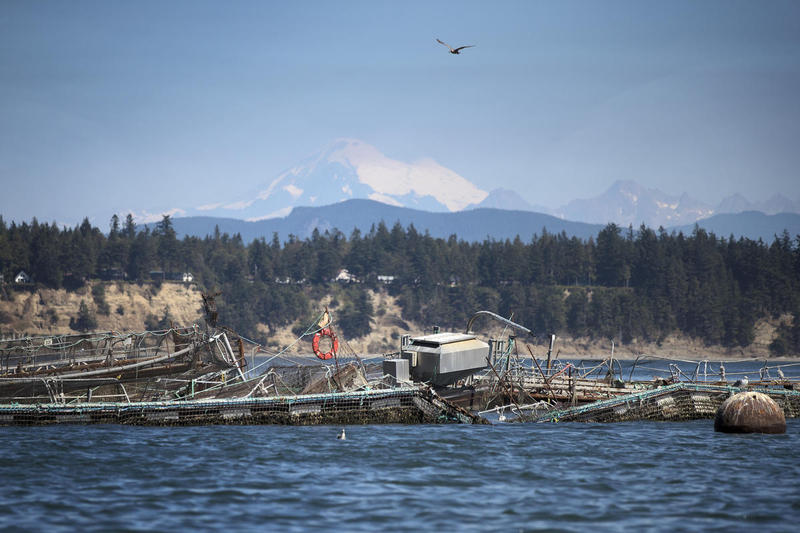 A damaged net pen at Cooke Aquaculture's facility on Cypress Island is shown on Tuesday, August 22, 2017.
- KUOW PHOTO/MEGAN FARMER
By JOHN RYAN
The Washington House of Representatives has voted to phase out farming of non-native fish in state waters, drawing the end of Atlantic salmon farming in Puget Sound one step closer.
The move comes one week after a similar vote by the state Senate.
Both bills let existing salmon farms keep operating only until their current leases run out, in the next four to seven years.
The House vote also comes six months after a poorly maintained fish farm collapsed near Anacortes, letting an estimated 250,000 Atlantic salmon escape into Puget Sound.
Republicans, including Rep. David Taylor of Moxee, called the move an overreaction to a single accident.
"You have an accident on a farm, we don’t try to eliminate that industry," Taylor said. "But in this case, we are."
But Republican Rep. J.T. Wilcox of Yelm said he would vote in favor of the phase-out, even if it meant some jobs would be lost. Wilcox said the risk to runs of native salmon was too great.
“My sympathies are with the people that depend on these fish runs who are unwilling to take the risk, and I don’t blame them," Wilcox said, "and also on the people that this vote is going to harm.”
He said he’d never felt worse after a vote.
Wilcox called on Washingtonians to take all threats to native salmon more seriously.
Canadian company Cooke Aquaculture raises Atlantic salmon on three continents. It employs about 80 people in Washington.
If the House and Senate can hash out the minor differences between their two bills, either by approving the other chamber’s bill or agreeing on some compromise between them, Governor Jay Inslee is expected to sign a ban on Atlantic salmon farms into law.
-
What a Biden Administration might mean for Northwest salmon and orcas

From the desk of Joseph Bogaard
Note: Save Our wild Salmon Coalition is a 501c3 organization. We are non-partisan. We endorse neither political parties nor candidates. Restoring salmon is not - nor should be - a partisan matter. The SOS coalition has a diverse membership; we work closely with people of different political affiliations. Our work is guided by the belief that meaningful, durable solutions to restore salmon and benefit communities will require bipartisan leadership and committed collaboration by people with different interests and backgrounds.
November 30, 2020
On Wednesday, January 20th, 2021, Joe Biden will be inaugurated as the nation’s 46th President and Senator Kamala Harris will be sworn in as the 49th Vice President – and, notably, the first Black, South Asian woman in the position. At this time, we don’t know what the new administration will mean for endangered wild salmon and steelhead and Southern Resident orcas in the Pacific Northwest. But, based on statements and materials and early developments from the then-candidate and now-President-Elect, there are reasons for cautious optimism and a sense of real opportunity.
I hasten to add, however, that the necessary progress that SOS and many advocates seek – that salmon and orcas urgently need – will only come about as the result of excellent and relentless outreach and organizing by salmon, orca, fishing and clean energy advocates – engaging stakeholders and policymakers alike. Now more than ever, we all need to be talking to our friends and family, calling and writing elected officials, encouraging community leaders, supporting Save Our wild Salmon and allied organizations with your time and dollars.
We live in a democracy and good things rarely happen without people organizing and mobilizing. A Biden Administration represents a new window of opportunity to protect and restore endangered wild Snake River salmon and steelhead and the benefits they bring to the Northwest and the nation. We need to work together with people across the Northwest to seize this opportunity and hold the incoming administration accountable to their promises and commitments.
My cautious optimism today for meaningful progress under a Biden Administration is based on four values or priorities anchored in Mr. Biden’s record of public service and his 2020 campaign platform. These include his commitments to (1) embrace science, (2) honor Native American Tribes, (3) confront climate change, and (4) bring diverse people together around shared solutions.
Science: During his campaign, Biden committed to putting science at the heart of his administration’s policymaking. A return to science-informed decision-making will affect all manner of issues – the pandemic, climate change, health care – as well as the fate of salmon and orca in the Pacific Northwest. Advocates shouldn’t expect scientists to make decisions for the President and his administration. But, based on Mr. Biden’s campaign, we should expect scientists to inform the decisions that are made.
Native American Tribes: The Biden-Harris campaign recognized that, while our nation was founded on the notion of equality for all, “we’ve never fully lived up to it. Throughout our history, this promise has been denied to Native Americans who have lived on this land since time immemorial.” Joe Biden and Kamala Harris have committed to uphold the U.S.’s trust responsibility to tribal nations and strengthen the Nation-to-Nation relationship between the United States and Indian tribes.
The Biden Administration has promised to work with America’s Tribes to “empower tribal nations to govern their own communities and make their own decisions,” including to restore tribal lands and safeguard natural and cultural resources. In the Northwest, salmon and orca play central roles in the culture and economy of many Tribes. Protecting and recovering these and other fish and wildlife populations is certain to be an important priority for many tribal communities on the coast and inland.
Climate Change: Addressing climate change was a pillar of the Biden-Harris campaign. The President-Elect recognizes climate change as an existential threat – and understands the urgent need to address it. Climate change imperils our lands and waters and ecosystems, and also puts at risk our health, communities, food systems and economic well-being. While communities of color and low-income communities are often at higher risk, climate change affects everyone - wreaking havoc today on our towns and cities and ways of life in rural as well as urban centers.
In the Northwest, climate change multiplies the challenges facing already-endangered salmon and orcas today – and increases the urgency to act. Scientists tell us that restoring a resilient, freely flowing lower Snake River through dam removal is essential for protecting its native fish from extinction. Salmon and orca – and the rest of us – need an aggressive set of policies to both dramatically reduce carbon emissions (prevention) and invest in resilience and adaptation (care) to better prepare our ecosystems and communities to withstand intensifying climate impacts. The Biden-Harris campaign in 2020 embraced this two-pronged approach of prevention and care - and advocates must be prepared to both support their leadership and hold them accountable.
Collaborative Solutions: The Biden-Harris campaign regularly highlighted a commitment to collaboration and unity. The President-Elect has a reputation as someone who works well with people regardless of their party affiliation or background.
In order to develop and deliver the comprehensive regional solutions our salmon, orcas and communities need, we’re going to need regional and national leadership. And we’re going to need to work effectively with diverse interests and communities. Salmon, fishing and orca advocates are committed to this type of collaboration and we will call on the incoming Administration to bring its leadership, resources and an inclusive and pragmatic approach to problem-solving.
The Need for Urgent Action: Many advocates in the Northwest are hopeful today that the incoming Administration will support leadership by Northwest policymakers, partner with Native American Tribes and engage stakeholders and citizens. To restore salmon abundance, we need to work together with great urgency to develop a comprehensive package that restores the lower Snake River and invests in our inland and coastal communities.
We have a lot of hard work ahead. Nothing good will occur without relentless public pressure, relentlessly applied. Crucial leadership is emerging today – thanks to years of organizing and advocacy by organizations like Save Our wild Salmon with the support of people like you. Policymakers are responding. We’ve made important progress in 2020, despite a pandemic, cataclysmic forest fires, economic disruption and a contentious election. As I see it, 2021 begins with great urgency and opportunity. As ever, we’re depending upon your support and advocacy.
Thank you for all that you do.
Onward together,
Joseph
Below are links to two recent articles exploring what the new administration may mean for the natural resources, fish and wildlife and the environment in the Pacific Northwest. Notably, both articles specifically highlight the plight of the Snake River and its imperiled salmon and steelhead populations.
Seattle Times: What Biden’s agenda on the environment could mean for the Pacific Northwest
Idaho Statesman: As Biden promises renewed climate change focus, will his policies help or hurt Idaho
-
Wild Salmon & Steelhead News

 Wild Salmon & Steelhead News is published regularly by the Save Our wild Salmon Coalition. Read on to learn about the Columbia-Snake River Basin’s endangered wild salmon and steelhead, the many benefits they deliver to people and ecosystems, and the extinction crisis they face today - unless we act! Find out how SOS is helping lead efforts to restore health, connectivity, and resilience to the rivers and streams these fish depend upon in the Columbia-Snake Basin and how you can get involved to help restore healthy, abundant, and harvestable populations and sustain more just and prosperous communities. To learn more and/or get involved, contact Martha Campos.
1. Our progress to defend salmon and steelhead from extinction – and support their recovery
2. Court-ordered relief to protect endangered salmon and steelhead does not imperil reliable, affordable power
3. NextGen Salmon Collective summer internship applications!
4. Salmon advocacy and community-building in the Inland Northwest and Southwest Washington
5. Join SOS at upcoming advocacy events!
6. Save Our wild Salmon Coalition members and friends gather in Portland!
7. Salmon Media Round-up
1. Our progress to defend salmon and steelhead from extinction – and support their recovery
 Pilgrimage © Josh Udesen, 2020, acrylic painting on birch panel, 24" x 30"
With the start of spring, salmon and steelhead have begun their ancestral migration – as recently hatched juveniles high in the Columbia-Snake River Basin swim toward the ocean and as adults return from the ocean in search of their spawning gravels. Their miraculous full-circle migration spans many thousands of miles from freshwater to salt and back again. Unfortunately, this annual ritual, which not long ago saw as many as 16 million adult fish returning each year, has shrunk today to a trickle. Some populations have been lost altogether; many others return today at just 1 or 2 percent of their historic abundance. The federal dams and their reservoirs on the lower Columbia and lower Snake rivers today are the main driver of these precipitous population declines.
Still, the Northwest native fish's persistence and fidelity to place lies at the heart of its encouraging resilience. It’s devotion to completing this journey year after year in the face of such obstacles and barriers inspires us also - to continue our work with you and many others to protect, restore, and reconnect the healthy waters and habitats across the Columbia-Snake River Basin that native fish - and all of us - rely upon and benefit from.
Thanks to your support and our collective advocacy, and despite such challenging times, we’re successfully defending against attacks coming from Washington D.C. We’re continuing to make progress, build power and maintain momentum regionally – supporting the Six Sovereigns alliance and its salmon recovery funding priorities in Congress, securing new funding from the Washington State legislature to continue to advance lower Snake River dam service replacement planning, and much more. Our successful defense work to date, as well as our policy and funding progress regionally, has been dependent on YOU – your calls, letters, and other advocacy and activism to educate your friends and family, and support and pressure on policymakers. Working together, we're demonstrating strong public support and a positive vision for present and future generations who will benefit from a healthy, resilient, and sustainable Columbia Basin, with clean water, healthy rivers and ecosystems, abundant salmon, steelhead, and orcas, and vibrant communities.
Defending the Endangered Species Act by blocking the ‘ESA Amendments Act’:
On Earth Day this year, House leadership had cynically scheduled a floor vote to pass the ‘ESA Amendments Act' (H.R. 1897). Notwithstanding its modest title, this bill would have gutted the Endangered Species Act and eliminated critical protections and recovery programs for wild salmon and steelhead, and hundreds of other imperiled species across the Northwest and nation.
Thanks to an amazing mobilization in the Northwest and across the country, hundreds of NGOs and many thousands of people called and wrote their House members to oppose this devastating legislation. As a result of the public outcry, Speaker Mike Johnson canceled the vote at the last minute when he realized that he no longer had the votes needed to pass it. This win reflects what polls consistently show: People strongly support the Endangered Species Act and strongly oppose allowing species to go extinct. Like our successful efforts last year to protect our public lands, waters, and wildlife, together we sent our representatives a message they couldn’t ignore: to protect endangered species and our nation’s special natural heritage, and to continue supporting their recovery and restoration.
Of course, this battle is far from over. The bill’s lead sponsor, chairman of the House Committee on Natural Resources and Arkansas Representative Bruce Westerman, commented that he will continue to work on provisions and intends to bring a similar bill to the floor for a vote soon. We will stay vigilant and continue our strong advocacy together!
After the so-called ‘Amendments’ bill was pulled and the vote canceled, House Natural Resources Committee Ranking Member and California Representative Jared Huffman applauded our collective and effective advocacy to protect what we love: “Americans will reject any legislation that leads to their wildlife disappearing forever. That is who we are as a country. We protect what we love, and we pass it on… We will keep fighting alongside them for an Endangered Species Act strong enough to bring these animals back for the next generation, and for a country where our children inherit the same wild beauty, we were lucky enough to grow up with.”
Washington State legislature approves additional funding to advance lower Snake River dam service replacement studies:
Earlier this year, the Washington State legislature included critical new funding in its annual budget to continue advancing the replacement planning of the energy and recreation provided by the lower Snake River dams! Governor Ferguson had included these line items in his proposed budget released in December – and the legislature supported them in its final budget as well!
In 2023 and 2024, the Washington State Legislature allocated funding and directed state agencies to develop replacement plans in partnership with federal agencies. Four plans are needed to develop roadmaps for replacing the dams’ energy, water supply, transportation, and recreation services. These planning processes are critical near-term steps in preparation for dam removal in the future. Replacing the dams’ current services with alternatives will help ensure communities remain vibrant and everyone moves forward together. In June 2025, however, the Trump Administration terminated the Resilient Columbia Basin Agreement (RCBA) and withdrew the federal government’s partnership with the region. Fortunately, elected leaders in Washington State and Oregon continue to support many of the RCBA’s priorities and purposes, and have continued to advance these planning processes regionally.
Most recently, in the 2026 legislative session, even amid a state budget deficit, Washington State approved funding and designated resources to complete planning efforts for energy and recreation (transportation and irrigation planning processes are well underway, led by state agencies, and additional funding was not necessary at this time).
Salmon, orca, and fishing advocates are deeply grateful to Governor Ferguson and legislative champions for their leadership to ensure we plan for a resilient future without the four outdated and harmful lower Snake River dams, honor tribal treaties, and recover the once-great salmon runs of the Columbia and Snake River Basin.
Tribes, conservation and fishing advocates’ court win secures emergency measures to protect Columbia Basin salmon and steelhead from extinction:
This past fall, plaintiff groups led by Earthjustice and supported by the lower Columbia River Tribes and states of Oregon and Washington filed a motion asking the U.S. District Court in Portland to lift the litigation stay that had been in place as part of the historic Resilient Columbia Basin Agreement (RCBA) that was unilaterally terminated by the Trump Administration last June. The court lifted the stay and plaintiff groups moved quickly to request preliminary injunctive relief in time for the 2026 salmon migration season (now underway). The plaintiffs' request asked the court to modify federal dam and reservoir operations – and other emergency actions – in order to increase survival of endangered adult and juvenile fish migrating through the lower Columbia and Snake rivers to the ocean.
Since our last newsletter, the District Court sided with the plaintiffs’ request and ordered modifications to the federal hydro-system operations starting this spring, including increased spill at all eight dams on the lower Snake and Columbia rivers between April 4 and August 31, when most of the juvenile salmon and steelhead are migrating downstream to the ocean.
Spill allows young ocean-bound fish to pass over the dams rather than through the lethal turbines and arrive at the ocean more quickly and safely. Spill is necessary because of repeated failures by BPA and other federal agencies to adequately protect salmon, but it is not sufficient by itself to recover imperiled Columbia basin fish populations – especially those that spawn and rear in the Snake River and its tributaries.
Salmon, orca, and fishing advocates applaud the Tribes, States, and non-governmental organizations for securing these emergency actions, and we appreciate that the court moved quickly to issue its decision. This order will improve the survival of fish imperiled by the federal dams and give us humans additional time to develop and implement a durable, long-term salmon recovery plan that must include lower Snake River dam removal.
SOS brings advocates and experts to Washington D.C. to support Fiscal Year 2027 Appropriations necessary for critical salmon recovery programs:
 In March, Save Our wild Salmon Coalition hosted a team of clean energy and salmon experts to travel to Washington D.C. to meet with members of Congress and advocate for Columbia Basin salmon and steelhead. As many populations face extinction today, it is critical that we adequately fund programs and implement policies to support their recovery.
Our team met with 16 Congressional offices over 2.5 days! We thanked them for championing last year’s funding priorities from the Six Sovereigns, despite the administration's significant attacks on these programs. The Fiscal Year 2026 (FY2026) appropriations requests by the Six Sovereigns (four Lower Columbia River Treaty Tribes and the states of Washington and Oregon) were actively supported by SOS and more than three dozen NGOs. They included key federal programs that support the restoration of salmon and steelhead in the Columbia River Basin. Thanks to critical leadership from Northwest Congressional offices, these essential programs will receive funding this year at levels similar to those in 2024.
This year, the administration has once again put forward a budget proposal to Congress that slashes environmental and salmon recovery funding. As part of our ongoing advocacy in Washington D.C., we are urging members of Congress to support the Six Sovereigns’ FY2027 appropriations requests - to continue investing in restoration efforts and preventing salmon and steelhead extinction.
TAKE ACTION TODAY: Urge your Northwest members of Congress to support the Six Sovereigns’ salmon recovery appropriation requests for FY2027.
2. Court-ordered relief to protect endangered salmon and steelhead does not imperil reliable, affordable power
 Monumental I © Rachel Teannalach, 2022 oil on canvas 48 x 48
On February 25, 2026, Judge Michael Simon of the U.S. District Court in Portland granted (salmon advocates) plaintiffs’ request for a preliminary injunction to modify federal dam and reservoir operations to protect threatened and endangered salmon and steelhead from further harm. The court ordered increased water spilled over eight dams on the lower Columbia and Snake rivers. The court-ordered spill enables juvenile fish to pass over the dams rather than through lethal turbines, and speeds them towards the ocean.
The federal agency defendants in this lawsuit have recently filed a notice of intent to appeal the District Court decision to the Ninth Circuit Court of Appeals.
The Bonneville Power Administration (BPA), the federal agency that sells Columbia Basin hydropower, is not one of the federal defendants in this case but has mounted its own counterattack on the judge’s ruling. BPA recently announced it will carry out an “expedited” rate case to account for what it claims are significant revenue losses due to the court-ordered spill operations that provide critical relief for endangered fish. The agency has claimed that as much as a 6.4% increase in rates for power sold to regional utilities will be required. BPA and allied utilities have also claimed that the spill order imperils reliability and creates the risk of blackouts
These alarmist claims are grossly inflated and grievously misleading. Until the Trump Administration tore it up in June 2025, river operations had been guided by the 2023 Resilient Columbia Basin Agreement (RCBA) negotiated between the Biden Administration, four Northwest Tribes, and the States of Oregon and Washington. The relevant provisions of the RCBA were broadly similar to the spill recently ordered by Judge Simon, though not identical (and included $300 million in BPA capital costs not included in the court order). In 2024, BPA Administrator John Hairston told Congress under oath that implementing the RCBA would increase BPA rates by 0.05% per year, accumulating to 0.7% over the ten-year life of the agreement. He expressed no concerns about system reliability under the RCBA. Indeed, Judge Simon explicitly recognizes long-standing operational practices that provide the federal government with tremendous flexibility to modify hydropower operations whenever there is any risk to power system reliability or during emergency conditions.
The court order does not imperil reliable, affordable energy across the region.
What is different now is that BPA, emboldened by an anti-conservation White House and Congress, is reverting to its historic prioritization of power production over salmon and steelhead production. Last year, BPA told the Northwest Power and Conservation Council that its Columbia Basin Fish and Wildlife Program, intended to “protect, mitigate, and enhance” fish and wildlife impacted by hydroelectric dams in the Columbia Basin, should eliminate its long-standing goal of doubling adult salmon and steelhead returns to the Basin and absolve BPA from any responsibilities to contribute to salmon recovery programs moving forward.
Instead of working with states, Tribes, plaintiffs, and stakeholders to ensure energy reliability, affordability, and solutions to protect and mitigate harm to our environment and imperiled salmon and steelhead, BPA is putting up roadblocks that harm our progress toward collaborative solutions for a resilient energy future.
Federal Defendants and utilities are also spreading misinformation about harm to salmon during spill operations, like gas bubble trauma (when water becomes supersaturated with gas, mostly nitrogen). Studies such as the Fish Passage Center’s Annual Comparative Survival Study (a long-running, empirically-based collaborative salmon and steelhead life cycle monitoring program) have shown that dissolved gas levels under the current managed spill conditions do not have a negative effect on smolt survival.
The real harm to Snake River salmon and steelhead? The lower Snake River dams and their hot, stagnant reservoirs. During the summer, water temperatures in the lower Snake and Columbia rivers routinely reach lethal levels between 70-73°F. The longer and the higher water temperatures rise above 68°F, the greater the harm to the fish including: increased susceptibility to disease, reduced reproductive potential (by reducing egg viability), suffocation (warm water carries less oxygen), and in the worst case - death.
Spill will not increase ratepayer rates. BPA’s reckless energy decisions will.
At the same time, BPA is making unfounded claims about rate impacts due to court-ordered measures to aid salmon survival, many ratepayers are facing higher energy bills due to BPA’s choice to join Southwest Power Pool’s Markets+, an Arkansas-based energy trading market. Without a near-term course correction, BPA will officially start to buy and sell energy in that market in October 2028. According to BPA’s own consultants, the region's households and businesses will pay more than $400 million in higher power bills each year, in a Markets+ energy market. And these losses would persist indefinitely into the future.
As a result, five Northwest groups have filed a legal challenge to BPA’s recent market choice, arguing it violates federal law. BPA would save far more money than any potential costs of the court order simply by choosing another day-ahead energy market, the California-based Extended Day Ahead Market (EDAM), rather than Markets+.
We need BPA to commit to its public responsibilities and ensure it develops a more sustainable energy system that also safeguards salmon, bolsters orcas, and upholds tribal treaty rights. The Columbia-Snake hydro-system today is the single greatest source of human-caused mortality for these endangered salmon and steelhead, and we need to change how we manage and steward the Columbia and Snake rivers in order to protect and rebuild sustainable fish populations, including the restoration of the lower Snake River.
Read below for information on BPA’s failures:
- Washington State Standard: Guest Opinion: Salmon are not to blame for Bonneville Power Administration failing to meet its responsibilities
- Idaho Capital Sun: Guest Opinion: BPA follows time-worn pattern: Blame salmon for its own failings to adapt
- Seattle Times: Guest Opinion: Ruling on Columbia, Snake dams was a lifeline for salmon
3. NextGen Salmon Collective summer internship applications are now closed!

NextGen Salmon Collective is a space for young advocates to develop their community organizing and advocacy skills with the goal of rebuilding abundant wild salmon and steelhead populations in the Columbia-Snake River Basin by protecting and restoring the healthy, resilient rivers and streams they depend upon.
This team-based internship will support passionate and creative students to educate and mobilize their peers on the importance of Columbia-Snake River restoration and the benefits they bring to people and ecosystems. Interns will plan and execute strategic community outreach projects and advocacy initiatives in collaboration with other youth organizers across the region.
Hear from a NextGen student leader about their experience joining the collective:
"Being in a cohort of young people who are so incredibly passionate about salmon restoration has been an amazing opportunity to learn about grassroots organizing. My favorite part was traveling to D.C. with advocates from across the region to talk to lawmakers about the importance of salmon to so many communities in the PNW. As a dual Politics and Environmental Analysis major, I loved the chance to put what I've learned in class into practice with what I've learned in NextGen and really feeling my confidence and advocacy skills grow along the way." - Marin P.
Learn more about NextGen Salmon Collective here. Stay tuned for the next application cycle to apply! If you have any questions, please reach out to Abby Dalke abby@wildsalmon.org
4. Salmon advocacy and community-building in the Inland Northwest and Southwest Washington
By Abby Saks, Inland Northwest Grassroots Organizer &
Tyler Troelsen, Western Washington OrganizerSOS staff members Abby Saks and Tyler Troelsen are leading community organizing and advocacy activities in the Inland Northwest and Southwest Washington!
Together, advocates are building public support and political leadership to restore the lower Snake River and its imperiled wild salmon and steelhead. Here is more from Abby and Tyler on recent and upcoming projects to educate and engage people and support and pressure our elected officials to become champions for salmon and orca recovery and help to uphold our nation’s promises to Northwest Tribal Nations.
 Abby Saks, Inland Northwest Grassroots OrganizerINLAND NORTHWEST: After a mild but gray winter, the Inland Northwest has begun to warm up and see the sun, meaning it’s time for outdoor event season! I always enjoy this time of year, as it means I can get outside at events and talk with community members across the region about salmon, SOS, and how they can get involved in supporting salmon recovery.
As industry groups continue to propagate misinformation about salmon, we are actively working to disseminate accurate information into Inland Northwest communities through letters-to-the-editor, community events (such as film screenings and salmon walks), and presentations to various community groups and college classes/clubs. Education like this is crucial for building well-informed public support for science-based solutions, like 'dam spill' and lower Snake River restoration. We’re excited to join partners in hosting a couple of events in May and June, including our Spokane Book Club (May 6), theYakima Environmental Justice Film Series (May 15), and a Salmon Bike Ride and Kayak in Yakima (June 6). We'll have a tabling presence at community gatherings throughout the spring and into Pride Month, and we are also excited to begin our Get Out the Vote work through poster distribution, launch events, and more.
As always, if you’re interested in learning more about volunteering with SOS in the Inland Northwest, reach out to me at abbys@wildsalmon.org, or join us on Zoom or in-person (in Saranac Commons, Spokane) on May 12 at 5:30pm for our May Salmon Advocate meeting.
 Tyler Troelsen,
Western Washington OrganizerSOUTHWEST WASHINGTON: Over the past several months, my organizing work in Southwest Washington has focused on building a strong, connected base of environmental advocates through consistent relationship-building and accessible entry points for engagement. We've launched our SW WA Environmental Advocacy Brunches, which serve as informal but highly effective spaces for coalition-building across organizations and issue areas. These gatherings bring together a diverse mix of community members, from long-time advocates to those newly getting involved. At these brunches, we share ideas, align priorities, and strengthen collaboration around conservation, climate, and public policy. If you would like to join our May Environmental Advocacy Brunch, please feel free to reach out, I would love to see you there!This spring, we raised our collective voices to protect our land, water, salmon, and communities at large events like the No Kings III rally and the Roadless Rule Area Conservation Act happy hour and town hall, where I met many of you from the Southwest Washington region!
Looking ahead, I am working on 'Get Out the Vote' activities as well as leading outings on threatened public lands and rural listening sessions to connect and work together for a healthier and more sustainable Southwest Washington.
I hope you will join us at these opportunities to expand our movement-building: connecting with our ecosystem, wildlife, and each other, and channeling our energy into meaningful advocacy and political action. If you’re interested in learning more or to volunteer with me in Southwest Washington, reach out attyler@wildsalmon.org!
5. Join SOS at upcoming advocacy events!
 May 21: RENEWAL webinar featuring Kiliii Yüyan!
This spring, Save Our wild Salmon Coalition, Braided River, and NGO partners are co-hosting RENEWAL, a webinar series that invites you to renew and reimagine our commitment to each other, our non-human neighbors, and the special places we all call home.
Join us as we share stories of renewal, positive change, and resilience, and spotlight inspiring work under way to repair and recover the lands, waters, and wildlife in the Columbia Basin, across the Northwest, and beyond.
 May 19: Hear the People, Heal the River Action Hour
You're invited to Hear the People, Heal the River Virtual Action Hour! Join to hear updates on issues impacting salmon recovery and the health of the Columbia-Snake rivers!
On our May 19th Action Hour at 12:30pm PT, we will cover how to get involved with SOS' collaborative ‘Get Out the Vote’ community organizing project - to elevate the upcoming election and encourage others to vote with salmon and orca and our Pacific Northwest home in mind. We’ll also provide a policy update and opportunities to get more involved and help defend keystone environmental policies and funding under threat today.
 September 11-12: Free The Snake Flotilla
SAVE THE DATE: Join SOS and many other NGOs at Nimíipuu Protecting the Environment's Free The Snake Flotilla, on September 11-12 at Hells Gate State Park in Lewiston, ID. Gather in community, meet fellow advocates, learn from Tribal leaders and other experts, and celebrate the profound opportunities a free-flowing lower Snake River and abundant salmon and steelhead will bring—Tribal justice, ecosystem health, community resilience, recreation, and more. Join forces with hundreds of others to call on our policymakers to become champions of salmon recovery in the Columbia-Snake River Basin.
Let's come together and take action to heal the Snake River and its imperiled salmon and steelhead populations!
We hope to see you at these events and check out wildsalmon.org/events for updates on future events.
6. Save Our wild Salmon Coalition members and friends gathered in Portland!

Save Our wild Salmon Coalition member organizations from across the Northwest region came together for a day full of connection, celebration, and planning for the advocacy ahead.
Coalition members approved an updated board of directors, including three new leaders: Abbie Abramovich (Idaho Conservation League’s Salmon Program Senior Associate), Lia Brewster (Sierra Club’s Conservation Campaign Strategist), and Amy Grondin (co-owner of Duna Fisheries and F/V Arminta). Please join us in welcoming Abbie, Amy, and Lia! You can learn more about our board members here!
During this especially challenging time, together, we paused and reflected on our mission and work with others to protect and restore wild salmon and steelhead and the benefits they bring to our lands, waters, and communities. We are thankful to our coalition member organizations for their support and many valuable contributions and to supporters like you, who bring your energy, ideas, and action to realize a more sustainable and resilient future for the Columbia-Snake River Basin and Northwest!
Here are a couple of recent stories about the urgency and opportunity today for salmon and orca recovery and river restoration:
News:
- Spokesman Review: Judge orders hydropower changes on Columbia, Snake to help salmon
- CLEARING UP: Simon Orders More Spill, But No Drawdowns or Conservation Measures
Op-eds and LTEs:
- Washington State Standard Commentary: Salmon are not to blame for Bonneville Power Administration failing to meet its responsibilities
- Seattle Times Guest Opinion: Ruling on Columbia, Snake dams was a lifeline for salmon
- Idaho Statesman Opinion: Running out of time: Breach the Snake River dams not to save salmon
- Lewiston Tribune LTE: Need for healthy rivers
- Spokesman-Review LTE: Hydropower changes to help salmon
- Spokesman-Review LTE: Breach the dams
- Seattle-Times LTE: Salmon: Much-needed progress
-
Wild Salmon & Steelhead News (September/October 2025)
Wild Salmon & Steelhead News is published regularly by the Save Our wild Salmon Coalition. Read on to learn about the Columbia-Snake River Basin’s endangered wild salmon and steelhead, the many benefits they deliver to people and ecosystems, and the extinction crisis they face today - unless we act! Find out how SOS is helping lead efforts to restore health, connectivity, and resilience to the rivers and streams these fish depend upon in the Columbia-Snake Basin and how you can get involved to help restore healthy, abundant, and harvestable populations and sustain more just and prosperous communities. To learn more and/or get involved, contact Martha Campos.
1. A summer full of activism and connection with the land, water, salmon and community!
2. Our work ahead to recover healthy salmon, orca, and rivers
3. The RECIPROCITY webinar series is back for fall 2025!
4. Honoring Dr. Jane Goodall (1934-2025)
5. Salmon media roundup
1. A summer full of activism and connection with the land, water, salmon and community!
In these extraordinarily challenging times, SOS staff found solace, energy and inspiration this summer in the opportunity to connect with many community members across the Northwest and the healthy lands, clean waters, and fish and wildlife we all hold dear.
In August, Tanya Riordan, Abby Saks, and Abby Dalke gathered on the banks of the lower Snake River near Lewiston to prepare for the annual flotilla hosted by our good friends and allies at Nimiipuu Protecting the Environment (read more about it below!). We were scurrying around to set up, when we were stopped in our tracks by a mesmerizing flock of swallows flying above our heads. Swooping and swirling in every which way, the birds were flying in a jumbled yet also highly coordinated and unified pattern. This spectacular sight, Tanya shared with us, is called murmuration. The birds moving en masse offer several key survival tactics – safety in numbers; leading the flock to roost, staying warmer together at night; and a visual invitation to straggling birds to join the flock. While we stood in awe, we were reminded of an important lesson: the power of the flock; the strength in community and the profound impact of collective care for one another.
This issue of the News recaps and highlights just a few of our activities this past summer - getting our hands dirty and feet wet in the Columbia Basin. Thank you to those who were able to join us at various events. As always, consider this your invitation to join our flock at future events, too. You are always welcome.
Envisioning a Restored Snake River Flotilla led by Nimiipuu Protecting the Environment -August 15-16.

In mid-August, hundreds of community members gathered at Hells Gate State Park near Lewiston, Idaho, to envision a free-flowing lower Snake River. Advocates floated along the Snake River, encircling a "Free the Snake" banner while Tribal leaders spoke to the urgent need to restore the river and uphold our nation's longstanding promises to Indigenous People in the Snake River Basin and beyond. Nez Perce Elders welcomed Tribal canoe families ashore, followed by other participants of this year's flotilla. Ashore, we heard Indigenous leaders' stories about salmon's profound significance in Tribal communities, and the Columbia Basin Restoration Initiative (CBRI) and how it will benefit salmon, ecosystems, and Tribal and non-Tribal communities alike. This powerful gathering culminated with a call to action - that participants contact their members of Congress and other policymakers to urge them to support the implementation of the CBRI and restore salmon abundance across the Basin.
Flights above the Snake River Basin with EcoFlight -August 13-14.

With the help of our coalition partners at EcoFlight, we hosted several flyovers of the Snake River Basin to help policymakers better understand this river and the surrounding landscape as well as the urgency and opportunity presented by lower Snake River restoration. Boarding a small six-passenger plane, we took off with policymaker staff, Tribal leaders, an energy expert, and a local farmer. Looking down at the reservoir behind Lower Granite Dam, we spotted a spreading toxic algal bloom - another sign of the river's degraded health. We veered south, flying over the Tucannon River, that flows into a warm, stagnant reservoir on the lower Snake. The Tucannon represents an urgent and compelling case study. This river demonstrates that the most advanced tributary habitat restoration efforts cannot protect imperiled salmon if out-migrating smolts must run the gauntlet through multiple, hot, stagnant reservoirs filled with non-native predator fish during their journey to the Pacific Ocean.
Huge appreciation to EcoFlight for helping us all see the Basin from a new perspective!
Sawtooth Salmon Fest hosted by Idaho Rivers United (IRU) and the Sawtooth Interpretive & Historical Association (SIHA) - August 26-28.

As August came to an end and Idaho’s salmon persevered through their 900-mile journey home to the heart of the Rocky Mountains, we joined friends and allies in Stanley, Idaho for Sawtooth Salmon Fest, an annual event hosted by IRU and SIHA celebrating this epic migration. Before the festival began, IRU’s Tom Stuart and Stephen Pfeiffer led us on a search for spawning salmon along the banks of the Salmon River and its tributaries. Originally named for the bright red sockeye that once filled its waters during spawning season, Redfish Lake and other Stanley Basin lakes that the Salmon River flows from saw a combined 14 wild salmon return in 2025. Our struggle to find any sockeye (wild or otherwise) swimming upstream was a stark reminder of the multitude of obstacles that Idaho’s salmon must overcome to return and spawn, including and especially the eight dams and 140 miles of hot, toxic, and stagnant reservoir waters on the lower Snake River between the Tri-Cities and Lewiston, ID.
Our time at Sawtooth Salmon Fest itself was absolutely energizing. We connected with all sorts of amazing community members through a very popular activity, creating beautiful works of salmon art. Over a hundred participants joined us to use Northwest Artists Against Extinction-designed stencils to create salmon prints. It was a beautiful way to end the weekend: gathering in community and creating advocacy art for salmon, while the Sawtooth Mountains stood in the backdrop and the Salmon River flowed freely right behind us.
Thank you to IRU and SIHA for hosting this amazing event, and we hope to see you all at Sawtooth Salmon Fest next year!
The Way of the Masks Journey led by Se’Si’Le -September 9-20.

In September, SOS was proud to support and participate in Se'Si'Le's 'Way of the Masks' journey as it toured through the Pacific Northwest, featuring powerful cultural events rooted in Indigenous artistry and environmental activism. The tour's message: protecting ancient forests is not just good policy — it's an integral part of Indigenous identity, our Northwest legacy, and our shared responsibility. Carved by Lummi Nation Master Carver Jewell James, a 12-foot cedar totem pole adorned with Coast Salish stories and symbols served as a striking visual and call-to-action for protecting our most sacred forests and the wild salmon that depend on them.
At each stop, local and Indigenous speakers shared heartfelt stories, prayers, music, and calls to action to protect ancient forests, wild salmon, and our Northwest home. Eight beautiful wooden masks, also hand-carved by Jewell James, was gifted in each location to a community leader who has played a key role in forest and salmon protection efforts.
Check out SOS' Events page to join events near you!
2. Our work ahead to recover healthy salmon, orca, and rivers

Thanks to your ongoing support and advocacy, we're making a strong and stead impression on regional policymakers and influential stakeholders and partners. Working with allies across the Northwest, we organized dozens of meetings and many thousands of grassroots/citizen contacts with Members of Congress, governors and local elected officials - urging them to defend our Northwest values and work collaboratively and consistently toward a more prosperous future for all, with healthy waters and abundant fish in the Columbia-Snake Basin.
Here are some recent developments and updates on the status of our rivers, endangered salmon and steelhead, and Southern Resident orcas, and our work ahead to protect and restore a healthier and more resilient Columbia-Snake Basin and Pacific Northwest.
Tragic death of a Southern Resident calf:
On September 12, Alki (J36) was observed by researchers at the Center for Whale Research carrying a dead female neonate calf with its umbilical cord still attached. This was not her first loss. Alki’s 2-year-old son Sonic (J52) died in 2017, and she is known to have experienced multiple miscarriages in recent years. We will never know for certain the exact cause of this calf's death, but we do know that the lack of salmon continues to be the single greatest threat to the survival of the Southern Resident orcas. Despite many years of effort to better protect Southern Resident orcas and many populations of Pacific Northwest salmon, both continue to teeter on the brink of extinction. These tragic deaths of the Southern Residents underscore the urgent need to rebuild abundant salmon populations in the Columbia-Snake Basin and across the Pacific Northwest. Scientists agree that rebuilding Spring/Summer chinook salmon in the Snake River Basin is essential priority to protect orcas from extinction. Removing the four lower Snake River dams represents our nation's greatest river/salmon restoration opportunity anywhere on the West Coast.
Dangerous water conditions in the lower Snake River:
This summer, all eight lower Columbia and Snake River reservoirs experienced sustained water temperatures above 68°F – the biological and legal limit scientists tell us is needed to protect cold water fish like salmon and steelhead from harm or death.
The hot water temperatures now regularly occurring in the summer months in the Columbia and Snake rivers impact the behavior, reproductive success, and survival of all upriver populations of salmon and steelhead. At a minimum, elevated water temperatures can significantly delay in their migration journey to Idaho. At higher temperatures, impacts can worsen and include disease, degraded egg and milt quality, and death. Hot water impacts on salmon and steelhead behavior and health can also impact Tribal and non-tribal fisheries, harming these communities and economies.
The lower Snake River reservoirs also now routinely test positive for microcystins in the summer and fall months. Microcystins are a toxin that can harm the liver and is commonly responsible for human and animal poisonings, and habitat degradation. Already under stress due to warm temperatures in all eight reservoirs, salmon and steelhead must now also migrate through toxic algal blooms that can cause dangerous oxygen depletion and changes in pH levels.
Sovereigns and NGOs return to court to protect imperiled salmon and steelhead:
On September 11, a coalition of conservation, fishing, and clean energy groups, along with the states of Oregon and Washington and four Lower Columbia River Treaty Tribes, filed a motion with the U.S. District Court in Portland to lift a stay or pause in litigation that had been put in place as part of the historic Resilient Columbia Basin Agreement (RCBA).
Across nearly three decades of litigation, three different federal district court judges have declared six federal dam management plans inadequate and illegal for protecting imperiled wild salmon and steelhead populations in the Snake and Columbia rivers as required by federal law. The most recent 2020 federal salmon/dams plan, developed during the first Trump Administration, is no exception. Plaintiffs in the case - the Nez Perce Tribe, the state of Oregon and conservation and fishing NGOs led by Earthjustice - made a decision to pause this long-running litigation in 2021 and work with the Biden Administration with the hope of developing a durable, long-term solution to protect and restore endangered wild salmon and steelhead populations. Then in December 2023, the Biden Administration and Northwest Tribes, states, and stakeholders announced the Resilient Columbia Basin Agreement. The RCBA represented a first significant step toward implementing a comprehensive and collaborative plan to protect and rebuild salmon abundance, expand clean energy resources, honor Tribal treaty rights, and restore healthy ecosystems while supporting a robust Pacific Northwest economy. Importantly, the agreement included planning and funding to replace the services provided by the lower Snake River dams.
However, in June 2025, the Trump Administration suddenly terminated the RCBA and walked away from this historic collaboration to recover the Northwest's native fish, invest in communities and begin to solve some longstanding regional problems. Without the agreement in place, plaintiffs have been left with no alternative but to return to court to challenge the inadequate 2020 federal salmon plan and to ask the court to require critical near-term changes in the operations of the dams and reservoirs to provide urgently-needed survival benefits for migrating salmon and steelhead. See this factsheet for additional details on the status of fish populations.
Save Our wild Salmon Coalition deeply appreciates the leadership of the plaintiffs, and we hope the court acts expeditiously to approve the urgent measures needed to improve the dismal survival rates of salmon and steelhead in time for the upcoming 2026 spring-summer migration season.
Read more:
- Idaho River United News: IRU Returns to Court to Defend Snake River Salmon & Steelhead
- Earthjustice Press Release: Groups Return to Court to Protect Imperiled Columbia Basin Salmon
- The Oregonian Opinion: Back to court, but our regional work to protect salmon will continue
Congressional hearing on the harmful bill “Defending Our Dams Act” - Sept. 4:
On September 3, the House Natural Resources Subcommittee on Water, Wildlife, and Fisheries held a hearing for the “Defending our Dams Act” (H.R. 2073), introduced earlier this year by Rep. Newhouse (WA-04). If passed, the legislation would stop progress to restore a freely flowing lower Snake River restoration by prohibiting federal funds or activity to understand and/or study lower Snake River dam removal or service replacement. H.R. 2073 would also prevent the implementation of the Columbia Basin Restoration Initiative (CBRI) — the comprehensive strategy developed by the Six Sovereigns to recover salmon abundance in the Columbia basin while investing in clean and affordable energy, healthy communities, and modernized infrastructure.
Salmon and fishing advocates thank Representatives Huffman, Hoyle, Randall, and Stansbury of the House Natural Resources Subcommittee for attending this important hearing and voicing their strong opposition to this harmful legislation.Here are a few quotes from the hearing:
- Representative Huffman: “In December of 2023, four Tribes, two States, five federal agencies, and nonprofits all reached a historic agreement on Columbia River salmon restoration…called the Resilient Columbia Basin agreement. President Trump blew that up in June with this Presidential Memorandum entitled ‘Stopping Radical Environmentalism to Generate Power for the Columbia River Basin’... there's nothing radical about honoring tribal treaty rights or wanting functional salmon runs that people can actually fish, or building clean energy to address all climate change and salmon extinction.
- Representative Hoyle: “Unfortunately, I can't get behind the fact that HR 2073 would ban studies into what it would take to replace or modify these dams, but we shouldn't tie our own hands for being able to research their impacts, even while we acknowledge that right now, there is no other way to replace that power.”
- Representative Stansbury: “It's important to understand that there has been decades of litigation on the lower Snake River to ensure that the historic damming of those rivers that impact the salmon fisheries that are subject to numerous treaties of our Tribes and the federal trust responsibility are rectified. At the end of the day, this is not just about the restoration of that vast watershed and the river and ecosystem that it sustains, but it is also compliance with both federal law and tribal trust and treaty responsibilities. I humbly but emphatically oppose that bill.”
Nez Perce Tribal Chairman Shannon F. Wheeler also testified at the hearing, asking Congress to reject the bill. “The wild runs are indeed in dire straits,” said Chairman Wheeler. “This bill would tie the hands of federal agencies and set the United States on an unambiguous course to destroy wild Snake River salmon runs, which would abrogate our Treaty-reserved rights to fish in all our usual and accustomed fishing areas.” Chairman Wheeler reminded Congress that the dams block access to some of the most pristine salmon and steelhead habitat in the Lower 48, and that the health, culture, and treaty rights of Columbia Basin Tribes are inseparable from the survival of wild fish runs.
We thank Chairman Wheeler and all who contacted their representatives to oppose this bill and called upon them to work collaboratively to implement the CBRI, the only existing plan today that comprehensively addresses the issues facing salmon, the health of our rivers, community needs, and infrastructure. The CBRI represents an historic opportunity for the people of the Northwest and nation - and we all need to work together to support the Six Sovereigns leadership in collaboration with others in the region to move it forward.
Act Now! Petition to restore the Columbia Basin's native fish and hold BPA accountable:
The Northwest Power and Conservation Council is now working on amendments to update its region-wide Fish and Wildlife Program. As an initial step in this process, the Council solicited recommendations from state, federal and tribal fisheries managers and accepted recommendations from others, including the Bonneville Power Administration (BPA). BPA recommended that the Council abandon its long-held goal of seeing 5 million adult salmon and steelhead returning annually to the Columbia Basin to spawn. BPA further called on the Council to affirm that BPA was under no legal obligation to meet any numerical goal the Council might set.
In response, Save Our wild Salmon Coalition and partners released a petition calling on the Council to reassert its intended leadership role in undoing the vast damage hydropower development has done to fish and wildlife throughout the region and to hold BPA accountable to honor its legal obligations. Please add your name to the petition! Thank you all for signing and sharing the petition!
3. The RECIPROCITY webinar series is back for fall 2025!

Join Oregon Wild, Washington Wild & SOS on October 23 at 6pm PT for the second fall installment of RECIPROCITY featuring award-winning Seattle Times reporter and author Lynda V. Mapes!
Lynda Mapesrecently published The Trees are Speaking: Dispatches from the salmon forests, an essential read for those with a deep interest in environmental stewardship, Indigenous land rights, sustainable communities and the urgent challenges posed by climate change. With vibrant storytelling supported by science and traditional ecological knowledge, Mapes will share a call to rethink our relationship with forests and invite us into a world where trees are kin, not commodities.
Last month, we were honored to hear from Dr. Christopher J. Preston, who spoke about his latest book, Tenacious Beasts, which brings to life nature’s formidable resilience through successful recovery stories from wolves in Europe, bison on America’s Great Plains, and humpback whales in the Atlantic and Pacific. We’re grateful to Dr. Preston for sharing the evening with us, full of optimism as well as guidance about how we might live more harmoniously alongside our animal kin. If you missed it, you can watch the webinar recording here.
4. Honoring Dr. Jane Goodall (1934-2025)

Dr. Jane Goodall is widely known for her groundbreaking research on chimpanzees and unconventional approach, by Western scientific standards at the time, to learn from nature, acknowledging, for example, that the chimpanzees were astutely watching her, too. While the salmon ecosystems of the Northwest may seem far from the forests of Gombe, her deep commitment, vision, wisdom and humanity has moved and inspired millions of people here and across the planet. Dr. Goodall had an infectious, innate love for all that is living and a deep understanding of what it means to be a part of nature. She inspired countless people to get outside, poke around in nature, and ultimately grow into strong environmental leaders. Not only did she fundamentally change the way we, as humans, understand ourselves, she also paved the way for young leaders in science. Dr. Goodall's legacy offers us all an enduring gift of perseverance, patience, and hope.
 News:
News:- Moscow-Pullman: Tribes, states push to revive Snake and Columbia River salmon lawsuit after Trump order
- Capital Press: Governors respond to ad placed by dam advocates
- The Seattle-Times: Legal battle reignites over Lower Snake River Dams, salmon
- WA State Standard: Lawsuits against federal government over Columbia Basin dams to resume
- Daily Astorian: Oregon, tribes return to court to save Columbia River salmon from extinction
- Columbia Gorge News: Lummi Nation totem pole visits Hood River, drums up opposition to potential roadless rule recission
- News Data: Klamath River Water Temperatures Responding to Dam Removal
Opinion:
- Idaho Statesman: Opinion: Snake River salmon lawsuits were on hold. Now we have to resume
- The Oregonian: Opinion: Back to court, but our regional work to protect salmon will continue
- The Columbian: In Our View: Salmon policy ill-conceived, puts process in reverse
- NewsData: Guest Column: The Righteous Shall Prevail, or Perhaps Fail?
- The Spokesman-Review: Breach the dams save the ecosystem
- The Spokesman-Review: Clean water the answer to salmon recovery
-
Yes! Magazine: 5 Reasons Salmon Are an Environmental Justice Solution

Shannan Lenke Stoll
Jul 04, 2018Last year, for the first time, scientists surveying Pacific Northwest salmon came up with empty nets. They weren’t all empty, but some were—and that’s “really different than anything we have ever seen,” David Huff of the NOAA survey team told The Seattle Times. It’s a bit too early to identify a particular cause of these unusual salmon surveys, but it’s not too early to be concerned.
Wild salmon populations are affected by dams, development, and salmon farms. Now, ocean and river temperatures are rising. That’s not good news for wild salmon.
At every life stage, salmon need clean, cold water. When water heats up, even by a few degrees, diseases can set in. Once it passes 73–77 degrees, salmon die.
That’s what happened in 2015, when unseasonably hot river water killed nearly half of the sockeye salmon that returned to the Columbia River to spawn in Oregon and Washington. And this year, fisheries managers estimate low returns because of a warming ocean and drought conditions for the third year in a row for California’s Sacramento River fall chinook—so low they’re recommending a significantly shortened commercial season.
Their sensitivity to changing environmental conditions make salmon susceptible to climate change, but it’s also why scientists use salmon as an indicator species to gauge the health of the ecosystem. We need salmon—and not just because they’re tasty.
1. Salmon feed forests.
On their journey out to sea and back, salmon feed humans, bears, orcas—and trees, too. It’s their unique life cycle that make them an important food source. Washington state biologists have estimated that salmon come into contact with 137 different species—and that’s not including plants. They’re such an important food source that scientists identify them as a “keystone species”—a species without which the ecosystem would change dramatically. Salmon spend most of their lives at sea. So when they return inland to spawn and die, they bring ocean nutrients—stored in their bodies—with them upstream, sometimes hundreds of miles, depositing nitrogen and phosphorus that forests need.
2. Salmon can tear down dams.
Almost four years ago, the largest dam removal project in U.S. history was completed, and scientists are already recording regeneration up and down the Elwha River in Washington state as it rushes back to life. The proposed removal of four dams on the Klamath River in 2020 would be even bigger in scale. And one driver behind dam removal is salmon. The federal relicensing process requires dams to make sometimes costly upgrades for fish passage under modern environmental laws. PacifiCorp, which owns and operates the four dams on the Klamath, has said in public statements that tearing the dams down is less costly than relicensing and maintaining them. When environmental laws protect salmon, removing dams makes economic sense.
3. Salmon sustain cultures.
Historically, members of the Karuk Tribe in Northern California ate more than one pound of salmon every day. Today, as dams, climate change, and development impact Klamath River salmon, that number averages less than five pounds of salmon eaten per person—in a year. In 2017, the tribe announced it would limit its harvest to just 200 chinook salmon. And it’s not just diet that’s impacted. All along the Pacific coast, Native people have lived alongside salmon for thousands of years. Salmon is at the center of ceremonies, art, and identity for tribes in the Pacific Northwest, Alaska, and California. When salmon are threatened, so is culture.
4. Salmon keep humans healthy.
Salmon is one of the most nutrient-dense foods for humans. It’s a healthy source of protein and has lots of vitamins and minerals, including vitamin B-12, magnesium, potassium, and selenium. And, of course, fatty fish like salmon have lots of omega-3s. We eat a lot of it. Worldwide, salmon overtook shrimp as the most traded seafood in 2016. And we pay a lot. Right now, a wild king salmon fillet is $37.99 from my local fish market in Seattle. That’s less for wild salmon than we used to pay because of competition from cheaper farmed salmon. But it may not be able to continue meeting the demand it helped create: Last year, sea lice—which kill Atlantic farmed salmon—caused a worldwide shortage.
5. Salmon shape the landscape.
When they spawn, salmon may move mountains, according to a recent study. Over millennia, salmon sex has helped to carve the mountain ranges of the Pacific Northwest. It works like this: When fish spawn, they stir up the river bed, digging holes for their eggs and swishing their tails in the process. That sends gravel downstream and also loosens the riverbed, making it less compact and more likely to move when the river floods. Over thousands of years, the tons of gravel that salmon move add up. The study, whose lead author is from Washington State University, showed that the landscape surrounding the streams where salmon spawn would be nearly a third taller if the salmon weren’t there.
-
You're Invited to 'A Majestic Matriarchy: Honoring the Southern Residents' on June 14 in Seattle!

 Please join us on June 14 for A Majestic Matriarchy: Honoring the Southern Resident Orcas at St. Joseph Parish in Seattle! Join us to listen, learn, and be inspired by the heartfelt words, visions, and voices of Indigenous women leaders from around the Northwest. There will be a Netse Mot: A Gathering Meal from 5:00 - 6:30 pm, and the program begins at 6:30 pm. A Majestic Matriarchy is presented by Se’Si’Le, an Indigenous-led nonprofit in Washington State, and is supported by Save Our wild Salmon and a coalition of NGOs and faith-based partners.
Building on the success of Tribute to the Orca last June, this year’s event will feature a powerful lineup of Indigenous women who will bring attention to the plight and importance of the Southern Resident orcas. Many Native people have a deep affinity with the matriarchal lifeway of the majestic Southern Resident relatives who rely on the older females for stability, especially in times of crisis. A grave crisis is now upon them, and their existence is imperiled.
Tickets are available on a sliding scale basis. Indigenous People are welcome to attend free-of charge. Space is limited so be sure to reserve your tickets. Learn more and reserve your tickets here.
SOS is excited to support this special event and we hope to see you there!
-
You're invited to Nimíipuu Protecting the Environment's Free The Snake Flotilla!

Join Nimíipuu Protecting the Environment in rallying for a free-flowing lower Snake River! All are welcome to this free two-day community gathering. Join to listen, learn, and take meaningful action towards salmon recovery in the Columbia Basin and healing the Snake River.
When: Friday, September 11 (5:30-8:30pm) and Saturday, September 12 (9:00am start)
Where: Hells Gate State Park, Lewiston, Idaho (5100 Hells Gate Rd, Lewiston ID, 83501)DONATE TO NIMÍIPUU PROTECTING THE ENVIRONMENT
SCHEDULE
Friday, September 11
5:30-7:00pm - Dinner, live music, and interactive Get Out the Vote art activities along the banks of the Snake River.
7:00-8:30pm - Outdoor film screenings:
- The River
 Remembers, new film by Setting Sun Circle
The River Remembers follows Tribal members of the Elwha and lower Klamath Rivers as they lead the largest dam removals in U.S. history, restoring salmon and renewing culture after a century of struggle. - Paddle Tribal Waters, short film by Ríos to Rivers
When the largest dam removal in history begins, a group of Indigenous youth learns to whitewater kayak to become the first people to paddle the restored river from source-to-sea, in a free-flowing Klamath River. - Ever Flowing, short film by the Columbia Snake River Campaign
Voices from across the Pacific Northwest unite to make the case for the survival of wild salmon by breaching the four lower Snake River dams.
8:30-9:00pm - Speakers and closing.
For Friday night accomodations, we recommend reserving a campsite at Hells Gate State Park or other nearby campgrounds. See below for information on reserving a campsite.
Saturday, September 12
9:00-9:30am - Gather at the Asotin Boat Ramp.
9:30-11:30am - Rally on the water for a free-flowing lower Snake River!
- Participants will paddle from the Asotin Boat Ramp to Hells Gate State Park (a 2.6-mile paddle downstream).
- Please bring your own non-motorized watercrafts. See below for information on renting a watercraft.
- If you’re not able to join us on the river, you are welcome to meet us at Hells Gate State Park and join for the on-land activities.
11:30am-12:00pm: Flotilla welcoming blessing at Hells Gate shoreline.
12:00pm-1:00pm: Salmon lunch and partner tabling.
1:00pm-2:00pm: Speaker program.
2:00-2:30pm: Closing with a blessing, song, and drums. A shuttle will be available back to the Asotin Boat Ramp from Hells Gate.
Thank you to our partners!


DIRECTIONS, RENT WATERCRAFTS, AND CAMPSITE INFORMATION:
Directions and Campground Map:
Hells Gate State Park | Group Shelter #6
5100 Hells Gate Rd, Lewiston, ID 83501
Campground mapPlease do not park on the grass at Hells Gate State Park. Doing so may result in a fine.
Where to rent watercrafts:
- University of Idaho Outdoor Rental Center (Moscow, ID)
- Lewis and Clark College Float and Tote Rental Center (Lewiston, ID)
If you are participating in the flotilla, you are responsible for bringing your own non-motorized watercraft (kayak, canoe, raft, etc.). Personal Flotation Devices are also strongly encouraged.
Reserving a campsite:
NOTE: Campsite reservations at Hells Gate State Park for Friday night are no longer available. Chief Timothy Park in Clarkston, WA still has campsites available that can be reserved here. Chief Timothy Park is a ~20-minute drive from Hells Gate State Park.
- Go to getoutside.idaho.gov/hells-gate/camping
- Enter the zip code of your residential address.
- From the calendar on the left, select a check-in date of Friday, September 11 and a check-out date of Saturday, September 12. Click the green button below the calendar that says “Map View for 9/15 to 9/16”.
- Once in map view, if you have any requirements for your site (e.g. ADA sites, RV sites, etc.), check them in on the left. Then, from the map, select any of the three loops. Within those loops, select the site you want to reserve.
- Click the red “Reserve” button on the left. Input your vehicle, guest, and payment information, and then select the blue “Reserve” button from the bottom right. Note down what site you reserved before closing out.
- When arriving at Hells Gate State Park on September 11, make sure to check in at the Park Office before heading to your campsite and let them know you are a part of the Nimiipuu Protecting the Environment flotilla.
Emailabbys@wildsalmon.org with any questions or if you need assistance reserving a campsite.
- The River
-
You're invited to SOS' Salmon Action Hours!


SUMMER UPDATE:
We are pausing our Action Hours for the summer. Stay up to date on actions and events by subscribing to our email list and following us on social media!

Healthy rivers and salmon are vital to our way of life in the Pacific Northwest, but Columbia Basin salmon, steelhead, and other native fish are in crisis. In fact, “Most wild salmon and steelhead runs persist at a fraction of their historic abundance and geographic distribution, and some (including three of five in the Snake River) persist at less than one percent of their historic abundance”.
Regional Tribes have led important comprehensive and collaborative progress to recover imperiled salmon populations, but salmon recovery efforts and goals are under attack: false and misleading information is being used to defend a harmful status quo, federal agencies critical to salmon recovery are threatened, and habitat restoration funding is in jeopardy.
Our region’s future is at stake, and our advocacy is more important now than ever.
Taking collective action to protect salmon by attending our VIRTUAL SALMON ADVOCACY ACTION HOUR!
When: One Tuesday each month, rotating between 12:30-1:30pm PT and 5:30-6:30pm PT
Upcoming Action Hour - stay tuned for the fall Action Hour dates
Where: Zoom
What to expect during an Action Hour:
- Get updates from experts on issues affecting salmon recovery.
- Ask questions.
- Most importantly, take strategic and timely actions with a community of other advocates during the call, and get the resources you need if you want to continue your advocacy outside of the hour.
We can defend progress and push back on harmful policies and attacks, but it will require all of us working together, strategically, and collectively!
All are welcome, from seasoned salmon advocates to folks who are new to the issue!
Contact abbys@wildsalmon.org with any questions.
PAST ACTION HOUR RESOURCES
 Chinook Salmon© Sue Coccia
 -
You're Invited: 'Dammed to Extinction'

Coming to a river, -er, location near you!
For eons, a one-of-a-kind population of killer whales has hunted chinook salmon along the Pacific Coast. For the last 40 years, renowned whale scientist Ken Balcomb has closely observed them. He’s familiar with a deadly pattern: Salmon numbers plummet and orcas starve. The downward spiral compelled him to realize that studying whales is no longer enough. He needed to act. The orcas need roughly a million salmon a year, where to find a million fish? The solution says Balcomb, is getting rid of four fish-killing dams 500 miles away, on the largest tributary to what was, until it was dammed nearly to death in the last century, the largest chinook producing river on earth. Studying whales is science. Removing dams is politics. Defiantly mixing the two, says Balcomb, has become the most important work of his storied career.
Click here to see the preview and visit the Dammed to Extinction website.
Join the filmmakers and SOS and friends at a screening near you! Learn how four deadbeat dams on the lower Snake River choke off access to thousands of miles of high, wild, pristine river and stream habitat upstream. Restoring this river in southeast Washington State by removing its costly dams will save money, restore declining salmon populations, and feed starving orcas.
Help promote these screenings by visiting and sharing the events on the SOS Facebook Page!
Upcoming Screenings:
Seattle, WA.Friday, October 4th. 7 PM. Meaningful Movies Wallingford. Keystone Congregational Church, 5019 Keystone Place N. In association with Save Our wild Salmon. Visit the Facebook page for more information.
Eugene Environmental Film Festival.October 4th - 6th. For more information, visit www.eugevoff.org.
Portland, OR. Tuesday, October 8th. 7 PM. Patagonia, 1106 W Burnside St, Portland, OR 97209. For more information, click here.
Poulsbo, WA. Tuesday, October 17th. 7 PM Vibe Coworks, 19225 8th Ave NE, Suite 201. In partnership with Grounds for Change. Tickets available here.
New York, NY. October 17th - 27th. Wildlife Conservation Film Festival. For more information, visit www.wcff.org
Friday Harbor Film Festival. More details coming soon. Visit www.fhff.org.
Portland, OR. Tuesday, November 12th. 6:30 PM. OMSI Empirical Theater. 1945 SE Water Ave Suite 100, Portland, OR 97214. Screening hosted by Columbia River Keeper.
Walla Walla, WA. November 14th. More information coming soon.
Past Screenings:
Olympia, WA. Thursday, September 12th. Capitol Theater, 206 5th Ave SE, Olympia, WA 98501. Visit the FaceBook page for more information or contact angela@wildsalmon.org. Tickets available at here.
Anderson Island Washington. September 13th - 15th. Johnson Farm Archival Building. For more information, visit https://andersonislandarts.com/film-festival/.
Tacoma, WA. Thursday, September 26th. 6:30 PM. The Grand Theater, 606 Fawcett Ave, Tacoma, WA 98402. Tickets available here.
Gig Harbor, WA.September 26-29th. Gig Harbor Film Festival. For more information, visit www.gigharborfilm.org.
Portland EcoFilm Festival.September 26th - 29th. For more information, visit http://www.portlandecofilmfest.org/
Boise, ID.Tuesday, October 1st. 7 PM. The Flicks, 646 W. Fulton St. Tickets $10 at the door. Post-screening Q&A with filmmakers Steven Hawley and Michael Peterson.
Moscow, ID. Friday, September 9th. 7 PM. Kenworthy Theater, 308 Main St, Moscow, ID 83843. Admission free, donations appreciated. For more information, contact angela@wildsalmon.org
Issaquah, WA. Tuesday, August 20th. 7 PM. Gibson Hall 105 Newport Way SW, Issaquah, WA 98027. For more information, visit the Facebook event or contact angela@wildsalmon.org. SOLD OUT!
Seattle, WA. Thursday, August 8th. 7 PM. Patagonia 2100 1st Ave, Seattle, WA 98121. For more information, visit the Facebook event or contact angela@wildsalmon.org.
Langley, WA. Saturday, July 20th. 2 PM. The Clyde Theater. Post screening Q&A with filmmaker Steven Hawley and Orca Network's Howard Garrett.
Bellingham, WA. Tuesday, July 2nd, Doors at 5:30 PM, film at 6:00 PM. Pickford Theater, 1318 Bay St, Bellingham, WA 98225. Post-screening discussion with filmmaker Michael Peterson. Tickets available here. For more information, contact angela@wildsalmon.org
Vashon, WA. Tuesday, June 11th, 6 PM. Vashon Theater, 17723 Vashon Highway SW Vashon, WA. Hosted by Meaningful Movies Vashon. For more information see the Facebook event or contact amy@backbonecampaign.org
Seattle, WA. Friday, June 7th, Pre-reception at 5:30, general doors at 6:30. The Mountaineers, 7700 Sand Point Way NE, Seattle, WA 98115. Access to pre-reception with food and drinks with minimum $10 donation ticket. Reserve your spot here. After-screening Q&A with filmmaker Michael Peterson and orca experts. For more information see the Facebook event or contact angela@wildsalmon.org.
Spokane, WA. Thursday, May 16th, 7 PM. The Garland Theater, 924 W Garland Ave, Spokane, WA 99205. After-screening Q&A with producers Steve Hawley and Michael Peterson. For more information see the Facebook event or contact sam@wildsalmon.org
Seattle, WA. Thursday, May 9th, 7 PM. SIFF Uptown, 511 Queen Anne Ave N, Seattle, WA 98109. After-screening Q&A with producers Steve Hawley and Michael Peterson.
TAKE ACTION: Tell the governors its high-time we had an honest cost/benefit analysis for the four lower Snake River dams.
VISITthe Dammed to Extinction website.
SOS' Northwest Dammed to Extinction film tour is brought to you with the partnership and/or sponsorship from Defenders of Wildlife, Earthjustice, Sierra Club, Whale Scout, Wild Orca, Environment Washington, Backbone Campaign, Wild Orca, and National Wildlife Federation. We are deeply grateful for their support.
-
You're invited: Stand with Tribal communities for the 'Snake River to Salish Sea Spirit of the Waters Totem Pole Journey' (May 2022)


This May, Se'Si'Le invites you to stand with Lummi tribal members, the House of Tears Carvers and Tribal communities across the Pacific Northwest in support of a totem pole journey and the Indigenous-led movement to remove the Snake River dams. This important Journey comes at a critical time for the Snake River, endangered salmon and orcas, and the region's Tribal communities.
Snake River to Salish Sea Spirit of the Waters Totem Pole Journey
May 3 - 20, 2022
 Bellingham Unitarian Fellowship: May 3 - 6:00-7:00 pm - Bellingham, WA:Learn more and share with your networks here.Support contacts: Deb Cruz and Abbie Abramovitch.University of Oregon: May 5 - 8 - Eugene, OR -May 5: Science in Ceremony Roundtable - 2:00-4:00 pm / EMU Gumwood Room. Learn more here.May 6: Art, Ceremony and Activism - 12:00 - 1:30 pm / EMU Ballroom &May 7: Pow-wow (virtual); 7:30 - 9:30 pm / Whale Protectors Exhibit.Learn more and share with your networks here.Support contact: tpjuo2022@gmail.comChinook Nation: May 9 - 2:30 pm - Astoria, OR -Clatsop Community College: Towler Hall parking lot / Patriot Hall gymSupport contact: Alex Craven.Portland, OR: May 10 - 6:00 - 8:00 pm -The ReddLearn more and share with your networks here.Support contact: Kate Murphy.Celilo Falls - May 11:8:00 am ceremony at Celilo Park10:30 am - Salmon Peoples' Testimonials in the Longhouse (Invitation-only event)7:00 pm - Ceremony for the Totem Pole departureEvent contact: Kurt Russo.Umatilla Tribe: May 14 - Pendleton, OR -Totem Pole eventsSaturday, May 14th @ Tamastslikt Cultural Institute
-- 2:00 pm, "Meet the Carvers" event at the museum
-- 7:00pm - 8:30 pm, Totem Pole Journey program
-- 8:30 pm - 9:30 pm, Whale Protectors Exhibit IMAX-style screening
Learn more / share with your networks here.
Support contact: Beka EconomopoulosNez Perce Tribe: May 16 - Lewiston, ID -Hell's Gate State Park - 8:30 am - 2:30 pm.Learn more, share with your networks and RSVP here.Support contact: Carrie Herrman.Shoshone-Bannock Tribe: May 18 - 12:00 - 1:30 pm - Fort Hall, ID -Details TBA.Support contact: Lisa Young.University of Washington Longhouse:May 19 - 6:00 - 8:00 pm - Seattle, WA -Details TBA.Support contact: Mariska Kecskes.Tacoma, WA: May 20 - St. Leo's Parish - Evening event, 6:00 - 8:00 pmLearn more, share with your networks and RSVP here.Support contact: Jessica Zimmerle.
Learn more by visiting - and sharing with your networks - the 'Spirit of the Waters Totem Pole Journey' landing page and Facebook page.

Se’Si’Le (saw-see-lah) is an intertribal 501c3 nonprofit founded by Lummi tribal member Jay Julius. The goal of Se’Si’Leis to reintroduce Indigenous spiritual law into the mainstream conversation about climate change and the environment. Se’Si’Le is the fiscal sponsor and lead entity of the Snake River to Salish Sea Spirit of the Waters Totem Pole Journey.
BACKGROUND:The May 2022 totem pole journey is the latest of a dozen totem pole journeys conducted by the project leads over the past 20 years. In 2021, the Red Road Totem Pole Journey to DC, was dedicated to the protection of sacred sites and reached an estimated 1.2 million people over a period of the twenty-day journey to the Capitol (www.redroadtodc.org). The 2022 journey builds upon, strengthens and reaffirms the growing indigenous-led environmental movement across the Pacific Northwest that began with a successful campaign to oppose proposed fossil fuels projects. The fossil fuels campaign included 4 totem pole journeys conducted by the project leads.
GOAL:The 2022 totem pole journey aims to inspire, inform, and engage Pacific Northwest communities through intergenerational voices, ceremony, art and science, spirituality, ancestral knowledge, and cross-cultural collaboration in support of the indigenous-led movement to remove the Snake River dams and restore to health the Snake River salmon runs and our relatives, the Southern Resident Killer Whales (Skali’Chelh in the Lummi language) that depend on them.
APPROACH AND SCOPE:To achieve its goal, the totem pole journey will engage the intellect, emotion, and imagination through an inspiring mix of generational voices, collective vision, science, ceremony, and venues. The journey includes public events in metropolitan areas (Eugene, Astoria, Portland, Seattle and Tacoma), and tribal communities (Lummi, Chinook, Nez Perce, Umatilla, Shoshone-Bannock, and the Village of Celilo). At each stop, art and culture will spark understanding of our natural heritage. In two locations (Eugene and Umatilla) the award-winning Whale Protectors Exhibit will all be featured. In-person events will include ceremonial moments steeped in ancestral knowledge to present the challenges the region faces—and avenues for cross-cultural collaboration and engagement on solutions.
JOURNEY PARTNERS INCLUDE:
Nimiipuu Protecting the EnvironmentSave Our Wild Salmon Coalition
Sierra ClubColumbia Riverkeeper
Earth MinistrySalmon NationEcotrustSaint Leo ParishThe Natural History MuseumUniversity of Oregon (Department of Philosophy)University of Washington (wǝɫǝbʔaltxʷ– Intellectual House)Freebuilt Films -
You're invited! 2018 Flotilla to 'Free the Snake' - Sept. 7/8 in the Lewiston-Clarkston Valley


For further information, visit freethesnake.com or contact jacob@wildsalmon.org


For further information, visit freethesnake.com or contact jacob@wildsalmon.org
-
YOU'RE INVITED! CELEBRATE 50 YEARS OF WILD & SCENIC RIVERS WITH SAWYERS PADDLES AND OARS - A BENEFIT FOR SAVE OUR WILD SALMON

PURCHASE TICKETS AT BROWNPAPERTICKETS.COM
HELP US SPREAD THE WORD TO YOUR NETWORKS THROUGH THIS FACEBOOK EVENT PAGE.
THANK YOU! SEE YOU ON JUNE 8!


